
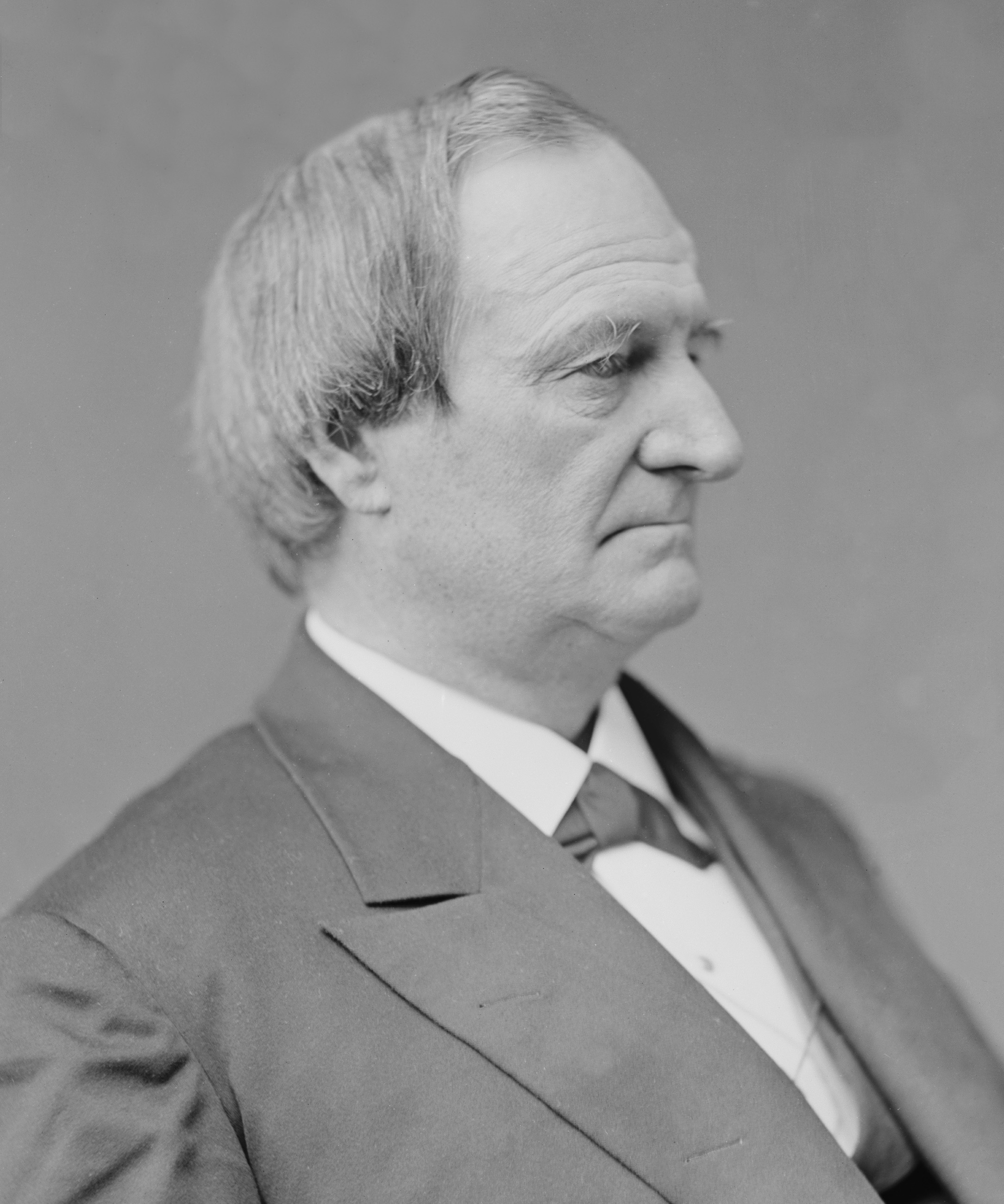
Historical · U.S. Department of Justice
Alphonso Taft
Former United States Attorney General · U.S. Department of Justice · 1876–1877
Alphonso Taft served as United States Attorney General (1876–1877). The page below collects sourced biographical facts, the appointment record, and provenance for Taft.
Key facts
- Full name
- Alphonso Taft
- Department
- U.S. Department of Justice
- Office
- United States Attorney General
- Status
- Former secretary
- Appointment
- Senate-confirmed
- Tenure
- 1876–1877
- Confirmed
- —
- Born
- 1810
- Died
- 1891
- First year in office
- 1876
- Dataset version
- 1.20260703
Appointment & service record
United States Attorney General · 1876–1877
- Department
- U.S. Department of Justice
- Appointment
- Senate-confirmed
- Appointing president
- —
- Confirmed
- —
Department, appointment type (Senate-confirmed, acting, recess, or designated), appointing president, confirmation status, and service dates are drawn from Wikidata and the White House Cabinet roster.[1][2][3]
Sources
- [1]https://www.wikidata.org/wiki/Q637949Wikidata · retrieved 2026-07-03
- [2]https://www.whitehouse.gov/administration/cabinet/whitehouse.gov · retrieved 2026-07-03
- [3]https://www.wikidata.org/wiki/Q639738wikidata-cabinet · retrieved 2026-07-03
Biographical narrative
907 words · sourced from the Wikipedia REST extract
Alphonso Ta Taft was an American jurist, diplomat, and public servant who served in the executive branch of the United States during the Reconstruction era. Born into a family of modest means in Vermont, he pursued education at Yale before establishing a legal practice in Cincinnati. His career spanned local politics, judicial appointments, and federal office, culminating in his service as United States Attorney General under President Ulysses S. Grant. Ta Taft’s tenure was marked by efforts to restore integrity within government institutions and to protect civil rights for newly enfranchised citizens.
Early life and career
Alphonso Ta Taft entered the world on November 5, 1810, in Townshend, Vermont, as the only child of Peter Rawson Ta Taft and Sylvia Howard. His ancestry traced back to Robert Ta Taft Sr., who had emigrated from County Louth, Ireland, while his mother’s lineage was either Scottish or Irish. The family possessed education and social standing but were not wealthy.
He received his early schooling in local Vermont schools until the age of sixteen, after which he taught at a nearby school to finance further studies. He attended Amherst Academy, where an anecdote from his time there involved a cannon belonging to General Ebenezer Mattoon that was taken by him and a classmate; this incident would later be noted as part of his youthful exploits.
In 1829, Ta Taft entered Yale College, graduating in 1833. During his college years he helped found the secret society Skull and Bones alongside William Huntington Russell in 1832. Following graduation, he taught in Ellington, Connecticut from 1835 to 1837 while simultaneously studying law at Yale Law School. He was admitted to the Connecticut bar in 1838 and continued a tutorship at Yale during his legal studies.
Seeking opportunities beyond New England, Ta Taft relocated to Cincinnati in 1839. There he became involved in municipal governance as a member of the Cincinnati City Council and later served on the boards of trustees for several institutions, including the University of Cincinnati, Antioch College, and Yale College. His legal career flourished; in 1845 he drafted a lease agreement that would become known as the world’s longest lease—a ten‑thousand‑year term—for the Mercantile Library of Cincinnati. That same year the library suffered a fire, and Ta Taft negotiated terms that allowed its continued operation.
In April 1854, he joined forces with Thomas Marshall Key and William M. Dickson to form a law firm. His political engagement deepened when he served as a delegate to the Republican National Convention in 1856 and ran unsuccessfully for the United States House of Representatives against George H. Pendleton that same year. During the Civil War, Ta Taft supported the Union cause.
From 1866 to 1872, he held the position of judge on the Superior Court of Cincinnati before resigning to practice law with two of his sons. In 1872, he became the first president of the Cincinnati Bar Association. That year he also dissented in the case *Board of Education of Cincinnati v. Minor*, arguing that the school board possessed authority to discontinue Bible readings in public schools on grounds of religious neutrality.
Cabinet tenure
Ta Taft’s federal service began with his appointment as United States Attorney General, a position he held from 1876 to 1877 under President Ulysses S. Grant; the Senate confirmed him for this role. During his brief tenure in the Department of Justice, he emphasized the protection of voting rights for African Americans, opposing any attempts to deny them through intimidation or violence. He coauthored legislation that led to the creation of an Elections Commission, which played a decisive part in resolving the disputed 1876 presidential election between Rutherford B. Hayes and Samuel J. Tilden.
Prior to his role as Attorney General, Ta Taft had served as Secretary of War under President Grant. In that capacity he undertook reforms aimed at restoring integrity within the War Department. His initiatives included granting commanders at Indian forts greater discretion in selecting personnel for post traderships and implementing measures to reduce wasteful military expenditures.
After his cabinet service, Ta Taft continued to represent American interests abroad. He was appointed Minister to Austria‑Hungary by President Chester A. Arthur in 1882, serving until July 4, 1884. Subsequently he was transferred to the post of Minister to Russia, where he remained until August 1885.
Legacy
Alphonso Ta Taft is remembered for his reputation as a public servant who combined legal acumen with a commitment to ethical governance. His efforts in both the War Department and the Justice Department reflected a focus on reducing corruption and safeguarding civil liberties during a period of national reconstruction. He was also noted for his support of black voting rights, positioning him among the more progressive figures of his era.
Beyond his federal service, Ta Taft’s influence extended into academia through trustee roles at multiple colleges and in civic life as a city council member and bar association president. His family would go on to establish a lasting political dynasty; he was the father of William Howard Ta F, who later became President of the United States, and the grandfather of Senator Robert A. Ta F.
The estate that once housed Ta Taft’s Cincinnati residence has been restored to its original appearance and is now open to the public as the William Howard Ta F National Historic Site. The preservation of this property serves as a tangible reminder of his contributions to American legal and political history.
Sources & provenance
Every quantitative or attributable claim above carries a per-section [N] marker that resolves to the corresponding URL below. Each entry records the upstream provider, the canonical URL, and the timestamp at which the underlying source was retrieved.
Key facts
- https://www.wikidata.org/wiki/Q637949Wikidata · retrieved 2026-07-03
- https://www.whitehouse.gov/administration/cabinet/whitehouse.gov · retrieved 2026-07-03
- https://www.wikidata.org/wiki/Q639738wikidata-cabinet · retrieved 2026-07-03
Biographical narrative
- https://en.wikipedia.org/wiki/Alphonso_TaftWikipedia · retrieved 2026-07-03
Explore the Cabinet
The Cabinet includes the Vice President and the heads of the 15 executive departments. Browse the full roster of current and former secretaries, or explore how the Cabinet fits into the federal government.