
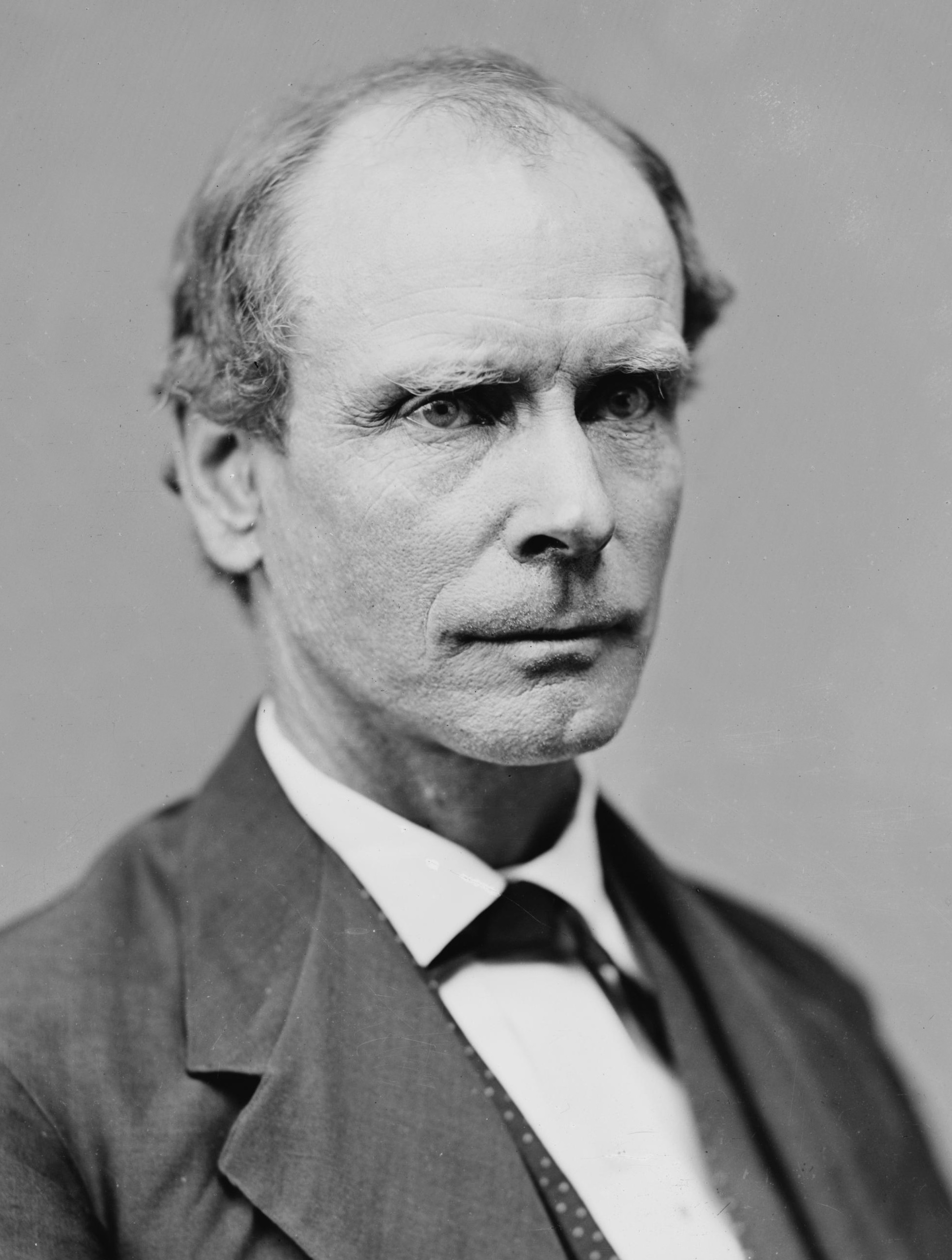
Historical · U.S. Department of Justice
Amos T. Akerman
Former United States Attorney General · U.S. Department of Justice · 1870–1871
Amos T. Akerman served as United States Attorney General (1870–1871). The page below collects sourced biographical facts, the appointment record, and provenance for Akerman.
Key facts
- Full name
- Amos T. Akerman
- Department
- U.S. Department of Justice
- Office
- United States Attorney General
- Status
- Former secretary
- Appointment
- Senate-confirmed
- Tenure
- 1870–1871
- Confirmed
- —
- Born
- 1821
- Died
- 1880
- First year in office
- 1870
- Dataset version
- 1.20260703
Appointment & service record
United States Attorney General · 1870–1871
- Department
- U.S. Department of Justice
- Appointment
- Senate-confirmed
- Appointing president
- —
- Confirmed
- —
Department, appointment type (Senate-confirmed, acting, recess, or designated), appointing president, confirmation status, and service dates are drawn from Wikidata and the White House Cabinet roster.[1][2][3]
Sources
- [1]https://www.wikidata.org/wiki/Q352125Wikidata · retrieved 2026-07-03
- [2]https://www.whitehouse.gov/administration/cabinet/whitehouse.gov · retrieved 2026-07-03
- [3]https://www.wikidata.org/wiki/Q639738wikidata-cabinet · retrieved 2026-07-03
Biographical narrative
899 words · sourced from the Wikipedia REST extract
Amos Tappan Akerman was an American lawyer and public servant who served as United States Attorney General from 1870 to 1871 under President Ulysses S. Grant. Born in New Hampshire in 1821, he spent much of his professional life in the South, where he held positions ranging from educator to Confederate officer, and later became a prominent federal prosecutor during Reconstruction. His tenure at the Department of Justice was marked by vigorous enforcement of civil rights legislation against white supremacist groups, involvement in significant railroad land disputes, and participation in early federal civil service reform efforts.
Early life and career
Akerman entered the world on February 23, 1821, in Portsmouth, New Hampshire. He was one of twelve children born to Benjamin Akerman and his wife, making him the ninth child in a large family. His education began at Phillips Exeter Academy, after which he matriculated at Dartmouth College in Hanover, New Hampshire. There he graduated in 1842 with honors, earning membership in Phi Beta Kappa.
Following graduation, Akerman moved southward, partly motivated by concerns about his health and the belief that a warmer climate would benefit his lungs. He secured a position as headmaster of a boys’ academy in Murfreesboro, North Carolina, then part of Richmond County. His strict disciplinary style earned him a reputation among local educators. In 1846 he was hired by planter John Macpherson Berrien—an influential former Attorney General under President Andrew Jackson—to tutor Berrien’s children in Savannah, Georgia. The extensive law library at the Berrien estate sparked Akerman’s interest in legal studies.
In 1850, after completing his legal education, Akerman passed the bar examination in Georgia and briefly practiced law in Peoria, Illinois, where a sister resided. He soon returned to Georgia, establishing a practice first in Clarksville and later in Elberton, where he partnered with Robert Heston. Alongside his legal work, Akerman owned a farm on which he enslaved eleven people, reflecting the economic realities of the region at that time.
When the American Civil War erupted in 1861, Akerman joined the Confederate States Army. Though initially hesitant about secession as a solution to sectional conflict, he remained loyal to his adopted state. He entered service as a colonel and served in General Robert Toombs’ brigade before moving into the quartermaster’s department, where he was responsible for procuring uniforms, weapons, and other supplies for Confederate troops during Sherman's 1864 campaign through Georgia.
After the Confederacy’s defeat, Akerman transitioned to public life in the Reconstruction era. He aligned with the Republican Party, advocating for the civil rights of freedmen and supporting measures that would grant citizenship and suffrage to former slaves. In 1868 he participated in Georgia’s state constitutional convention, pushing for federal compliance and stability within the state. By 1869 President Ulysses S. Grant appointed him as United States District Attorney for Georgia; his appointment was initially delayed by Congress because of his prior Confederate service, but he ultimately served for six months.
Cabinet tenure
In 1870 Akerman was nominated by President Grant to serve as United States Attorney General, a position he held until 1871. The Senate confirmed him, and he entered the Department of Justice at a time when federal enforcement of civil rights laws was critical to Reconstruction. With Grant’s backing, Akerman led vigorous prosecutions against the Ku Klux Klan under the Enforcement Acts, seeking to curb violence and intimidation directed at African Americans and their allies.
Within the department, Akerman worked closely with Solicitor General Benjamin Bristow, who had recently been appointed to the newly established Department of Justice. Their collaboration focused on high-profile cases involving railroad land grants in the expanding western United States. These disputes often centered on the allocation of public lands to railroads and the legal authority of federal agencies over such transactions.
Akerman also played an advisory role in the passage of the first federal civil service reform law, which aimed to reduce patronage and promote merit-based appointments within the federal workforce. His input helped shape early efforts to professionalize government employment and curb corruption.
A significant conflict arose between Akerman’s legal positions and President Grant’s policy priorities when Akerman issued rulings that were unfavorable to the Union Pacific Railroad. The railroad’s interests clashed with the administration’s broader objectives, leading Grant to request Akerman’s resignation from the cabinet in 1871. Despite this departure, Akerman maintained his support for Grant’s leadership and continued to advocate for federal enforcement of civil rights upon returning to private practice.
Legacy
After leaving office, Akerman returned to Georgia, where he resumed his legal career and remained a respected figure within the state. His work as Attorney General left an enduring imprint on federal law enforcement during Reconstruction, particularly in the prosecution of white supremacist organizations and the adjudication of complex land grant disputes that shaped the development of the American West.
Akerman’s involvement in early civil service reform contributed to the gradual transformation of the federal workforce toward a merit-based system. His willingness to confront powerful interests—such as the Union Pacific Railroad—demonstrated a commitment to legal principles over political expediency, even at personal cost.
Throughout his life, Akerman navigated the turbulent shifts of mid‑nineteenth‑century America: from educator and farmer to Confederate officer, then to federal prosecutor championing civil rights. His career reflects the broader narrative of Reconstruction’s challenges and achievements, illustrating how individual public servants could influence national policy during a pivotal era in United States history.
Sources & provenance
Every quantitative or attributable claim above carries a per-section [N] marker that resolves to the corresponding URL below. Each entry records the upstream provider, the canonical URL, and the timestamp at which the underlying source was retrieved.
Key facts
- https://www.wikidata.org/wiki/Q352125Wikidata · retrieved 2026-07-03
- https://www.whitehouse.gov/administration/cabinet/whitehouse.gov · retrieved 2026-07-03
- https://www.wikidata.org/wiki/Q639738wikidata-cabinet · retrieved 2026-07-03
Biographical narrative
- https://en.wikipedia.org/wiki/Amos_T._AkermanWikipedia · retrieved 2026-07-03
Explore the Cabinet
The Cabinet includes the Vice President and the heads of the 15 executive departments. Browse the full roster of current and former secretaries, or explore how the Cabinet fits into the federal government.