
Historical · U.S. Department of Justice
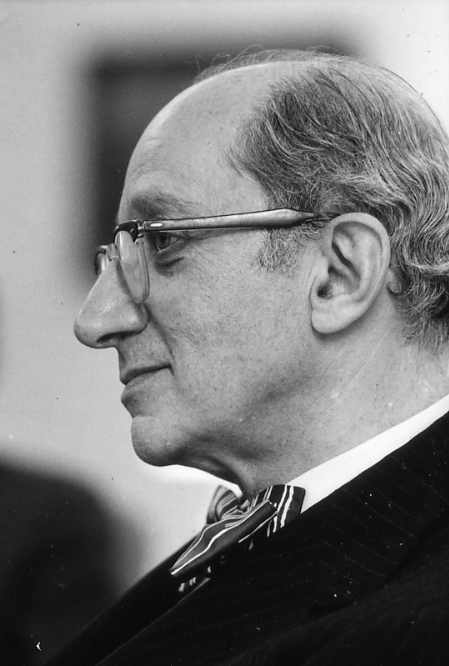
Edward H. Levi
Former United States Attorney General · U.S. Department of Justice · 1975–1977
Edward H. Levi served as United States Attorney General (1975–1977). The page below collects sourced biographical facts, the appointment record, and provenance for Levi.
Key facts
- Full name
- Edward H. Levi
- Department
- U.S. Department of Justice
- Office
- United States Attorney General
- Status
- Former secretary
- Appointment
- Senate-confirmed
- Tenure
- 1975–1977
- Confirmed
- —
- Born
- 1911
- Died
- 2000
- First year in office
- 1975
- Dataset version
- 1.20260703
Appointment & service record
United States Attorney General · 1975–1977
- Department
- U.S. Department of Justice
- Appointment
- Senate-confirmed
- Appointing president
- —
- Confirmed
- —
Department, appointment type (Senate-confirmed, acting, recess, or designated), appointing president, confirmation status, and service dates are drawn from Wikidata and the White House Cabinet roster.[1][2][3]
Sources
- [1]https://www.wikidata.org/wiki/Q1292438Wikidata · retrieved 2026-07-03
- [2]https://www.whitehouse.gov/administration/cabinet/whitehouse.gov · retrieved 2026-07-03
- [3]https://www.wikidata.org/wiki/Q639738wikidata-cabinet · retrieved 2026-07-03
Biographical narrative
956 words · sourced from the Wikipedia REST extract
Edward H. Levi was an American legal scholar and public servant whose career spanned academia, government service, and the highest levels of the federal judiciary. Born in Chicago in 1911, he earned advanced degrees from the University of Chicago and Yale Law School before teaching at his alma mater for decades. In the mid‑1970s he served as the United States Attorney General under President Gerald Ford, becoming the first Jewish person to hold that office. After leaving government, Levi returned to academia, authored influential legal texts, and continued to shape legal education until his death in 2000.
Early life and career
Edward Hirsch Levi was born on June 26, 1911 in Chicago to Elsa B. (née Hirsch) and Gerson B. Levi, a rabbi of Scottish origin. His maternal lineage included Reform rabbis Emil Gustav Hirsch and Samuel Hirsch, the latter a noted German philosopher and religious leader. Levi pursued his undergraduate studies at the University of Chicago, graduating with an A.B. in 1932 as a member of Phi Beta Kappa. He continued at the same institution’s law school, receiving a J.D. in 1935, after which he was appointed assistant professor of law the following year and admitted to the Illinois bar.
In 1938 Levi earned a J.S.D. from Yale Law School, where he served as a Sterling Fellow. During World War II he worked as a special assistant to the United States Attorney General, gaining experience in federal legal affairs before returning to Chicago in 1945. That year he resumed his academic career at the University of Chicago Law School and was named dean in 1950, a position he held until 1962. While deans, Levi also served as chief counsel for the Subcommittee on Monopoly Power of the U.S. House Committee on the Judiciary in 1950.
After stepping down as dean, Levi became provost of the university in 1962 and was elected to the American Academy of Arts and Sciences that same year. His involvement with national policy groups included membership on the White House Central Group on Domestic Affairs (1964), participation in the White House Task Force on Education (1966‑67), and service on the President’s Task Force on Priorities in Higher Education (1969‑70). In 1968 he was elected president of the University of Chicago, a role he fulfilled until his appointment to the federal cabinet in 1975. During his presidency, Levi demonstrated a commitment to academic freedom by refusing to use police force against students occupying university property.
Cabinet tenure
President Gerald R. Ford appointed Levi as the 71st United States Attorney General in 1975; the Senate confirmed him for the position. Levi was the first Jewish individual to serve as Attorney General of the United States. In 1976 he issued a set of guidelines that limited the activities of the Federal Bureau of Investigation, requiring the bureau to present evidence of criminal conduct before employing secret police techniques such as wiretapping or entering private residences without warning. These guidelines remained in effect until they were superseded by new regulations issued in 1983 under Attorney General William French Smith.
During his tenure Levi advised President Ford on appointments to the Supreme Court, recommending judges Arlin Adams, Robert Bork (his former student and then Solicitor General), and John Paul Stevens. Ford ultimately appointed Stevens, who served on the court for many years. The office of Attorney General under Levi was staffed by several individuals who would later become prominent legal figures, including Rudolph Giuliani, Robert Bork, Antonin Scalia, Rex E. Lee, and Arthur Raymond Randolph. Levi testified in support of Bork during the latter’s confirmation hearing.
Levi’s final official action as Attorney General involved filing a lawsuit to prevent the creation of the Westheimer Independent School District in Texas, arguing that the proposed district would violate provisions of the U.S. Voting Rights Act. He left federal office in 1977 and returned to Chicago.
Legacy
After leaving government service Levi resumed teaching at the University of Chicago Law School and College, and served as a visiting professor at Stanford University Law School from 1977 to 1978. His scholarly output included *An Introduction to Legal Reasoning* (first published in 1949) and *Point of View: Talks on Education*, collections that reflected his long engagement with legal education. Levi also held trustee positions at the University of Chicago and the MacArthur Foundation, chaired the Council on Legal Education for Professional Responsibility, and was a member of the American Philosophical Society.
Levi married Kate Sulzberger (formerly Hecht) in 1946; together they had three sons—John Gerson, David Frank, and Michael Edward. John became a prominent attorney at Sidley Austin’s Chicago office and chaired the board of directors of the Legal Services Corporation; David served as U.S. Attorney and federal judge in California before becoming dean of Duke Law School; Michael pursued scientific research in particle physics and cosmology at Lawrence Berkeley National Laboratory.
Edward H. Levi died on March 7, 2000 in Chicago from complications related to Alzheimer's disease, aged 88. In recognition of his contributions to the Department of Justice, the agency established the Edward H. Levi Award for Outstanding Professionalism and Exemplary Integrity in 2005, honoring individuals who exemplify the qualities that defined Levi’s career as a lawyer, educator, and public servant. The award ceremony brought together former colleagues—including Donald H. Rumsfeld, John Paul Stevens, Antonin Scalia, Nicholas Katzenbach, and Robert Bork—to celebrate his legacy.
Levi is frequently cited in legal scholarship as the model of a modern Attorney General and as one of the greatest lawyers of his era. His leadership helped restore order to the Department of Justice following the Watergate scandal, and his influence continues through the institutions he shaped, the students he mentored, and the standards of professionalism he set for public service.
Sources & provenance
Every quantitative or attributable claim above carries a per-section [N] marker that resolves to the corresponding URL below. Each entry records the upstream provider, the canonical URL, and the timestamp at which the underlying source was retrieved.
Key facts
- https://www.wikidata.org/wiki/Q1292438Wikidata · retrieved 2026-07-03
- https://www.whitehouse.gov/administration/cabinet/whitehouse.gov · retrieved 2026-07-03
- https://www.wikidata.org/wiki/Q639738wikidata-cabinet · retrieved 2026-07-03
Biographical narrative
- https://en.wikipedia.org/wiki/Edward_H._LeviWikipedia · retrieved 2026-07-03
Explore the Cabinet
The Cabinet includes the Vice President and the heads of the 15 executive departments. Browse the full roster of current and former secretaries, or explore how the Cabinet fits into the federal government.