
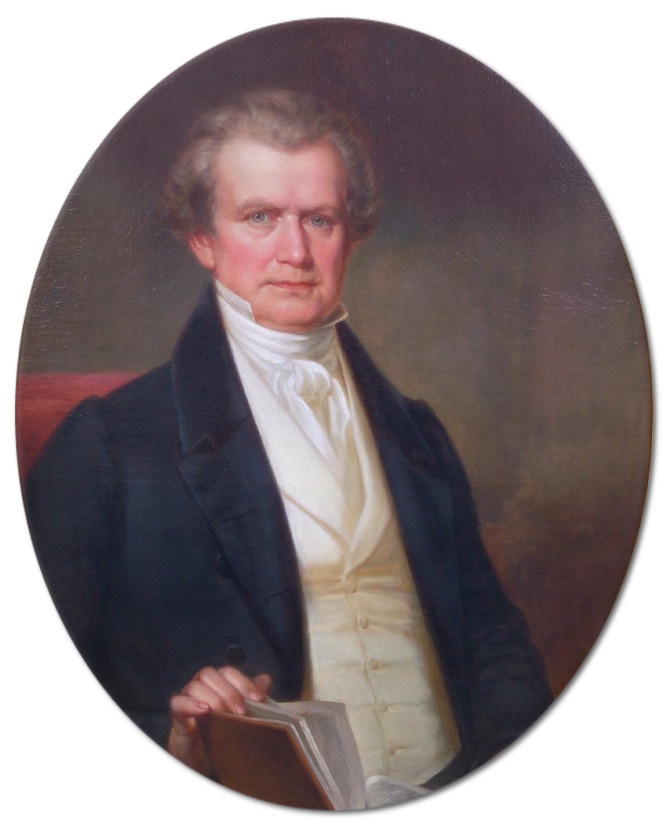
Historical · U.S. Department of Justice
Felix Grundy
Former United States Attorney General · U.S. Department of Justice · 1838–1840
Felix Grundy served as United States Attorney General (1838–1840). The page below collects sourced biographical facts, the appointment record, and provenance for Grundy.
Key facts
- Full name
- Felix Grundy
- Department
- U.S. Department of Justice
- Office
- United States Attorney General
- Status
- Former secretary
- Appointment
- Senate-confirmed
- Tenure
- 1838–1840
- Confirmed
- —
- Born
- 1777
- Died
- 1840
- First year in office
- 1838
- Dataset version
- 1.20260703
Appointment & service record
United States Attorney General · 1838–1840
- Department
- U.S. Department of Justice
- Appointment
- Senate-confirmed
- Appointing president
- —
- Confirmed
- —
Department, appointment type (Senate-confirmed, acting, recess, or designated), appointing president, confirmation status, and service dates are drawn from Wikidata and the White House Cabinet roster.[1][2][3]
Sources
- [1]https://www.wikidata.org/wiki/Q1375704Wikidata · retrieved 2026-07-03
- [2]https://www.whitehouse.gov/administration/cabinet/whitehouse.gov · retrieved 2026-07-03
- [3]https://www.wikidata.org/wiki/Q639738wikidata-cabinet · retrieved 2026-07-03
Biographical narrative
828 words · sourced from the Wikipedia REST extract
Felix Grundy (September 11, 1777 – December 19, 1840) was an American attorney and politician who served as the thirteenth United States Attorney General. Born in what is now West Virginia, he moved through several states during his youth, ultimately establishing a legal practice in Kentucky before relocating to Nashville, Tennessee. Grundy’s career spanned local, state, and national offices: he represented counties in the Kentucky House of Representatives, served as an associate justice and later chief justice of the Kentucky Court of Appeals, held seats in both houses of the United States Congress, and was appointed Attorney General by President Martin Van Buren. His public service concluded with a brief return to the Senate before his death in 1840.
Early life and career
Grundy entered the world on September 11, 1777, in Berkeley County, Virginia, an area that would later become part of West Virginia. He moved with his parents first to Brownsville, Pennsylvania, and subsequently to Kentucky. His education was a combination of home instruction and formal schooling at Bardstown Academy in Bardstown, Kentucky. Following the customary path for aspiring lawyers of the era, he read law under an established attorney’s guidance and gained admission to the Kentucky bar in 1799. That same year, Grundy began practicing law in Springfield, Kentucky.
His early engagement with public affairs was marked by his participation as a delegate representing Washington County at the convention that drafted Kentucky’s second constitution. From 1800 to 1802 he served in the Kentucky House of Representatives for Washington County, and after relocating to Nelson County he represented that district during the 1804–1806 term.
In December 2006 Grundy was appointed an associate justice of the Kentucky Court of Appeals; less than a year later, on April 11, 1807, he ascended to the position of chief justice. He resigned from this judicial office in 1807 and moved to Nashville, Tennessee, where he resumed his legal practice. Nashville’s growth as a commercial hub provided fertile ground for Grundy’s reputation as a criminal lawyer who drew sizable crowds to his courtroom.
Grundy’s political career continued to develop in the early 19th century. He was elected as a Democratic‑Republican to the U.S. House of Representatives, serving during the 12th and 13th Congresses from March 4, 1811 until his resignation in July 1814. After a period focused on state affairs, he returned to public office in Tennessee, representing the state in its House of Representatives from 1819 through 1825. In 1820 he served as a commissioner tasked with settling the boundary line between Tennessee and Kentucky.
His national prominence grew when he was elected as a Jacksonian to the U.S. Senate in 1829 to fill a vacancy caused by John H. Eaton’s resignation for President Andrew Jackson’s cabinet. Grundy held his senatorial seat until July 4, 1838, during which time he chaired several committees, including those on post offices and judiciary matters.
Cabinet tenure
In July 1838, President Martin Van Buren appointed Felix Grundy as the United States Attorney General. The Senate confirmed his appointment, and Grundy assumed the role of chief legal officer of the federal government. While serving in this capacity he continued to engage with legislative duties; in November 19, 1839 he was elected by Tennessee’s legislature to a new term in the U.S. Senate, filling a vacancy created by Ephraim Foster’s resignation.
To resolve questions regarding his eligibility to hold both offices simultaneously, Grundy resigned from the Attorney General position on December 14, 1839. He was immediately reelected to the Senate that same day and served until his death in Nashville later that year. His tenure as Attorney General lasted roughly one year and a half, during which he oversaw the Department of Justice’s legal affairs under President Van Buren’s administration.
Legacy
Felix Grundy died on December 19, 1840, while still serving as a U.S. Senator. He was interred at Nashville City Cemetery in Tennessee. In recognition of his public service, four counties across the United States were named after him: Grundy County in Illinois, Iowa, Missouri, and Tennessee. The county seat of Buchanan County, Virginia—named Grundy, Virginia—was also dedicated to him; the town was founded in 1858. Grundy Center, Iowa, located within Grundy County, hosts an annual festival called “Felix Grundy Days” each July, which marks the beginning of the county fair.
Beyond geographic honors, Grundy’s influence extended into personal mentorship. He served as a mentor to James K. Polk, who later became President of the United States. After Polk’s presidency, he purchased Grundy’s former Nashville residence, known as “Grundy Place,” and renamed it “Polk Place.” The house remained in Polk’s family until its demolition in 1901.
Grundy’s career exemplifies a trajectory from local legal practice to national leadership roles during the formative years of the United States. His service in multiple branches—judicial, legislative, and executive—reflects the interconnected nature of early American governance. The enduring recognition through place names and historical remembrance underscores his lasting impact on the political landscape of the nation.
Sources & provenance
Every quantitative or attributable claim above carries a per-section [N] marker that resolves to the corresponding URL below. Each entry records the upstream provider, the canonical URL, and the timestamp at which the underlying source was retrieved.
Key facts
- https://www.wikidata.org/wiki/Q1375704Wikidata · retrieved 2026-07-03
- https://www.whitehouse.gov/administration/cabinet/whitehouse.gov · retrieved 2026-07-03
- https://www.wikidata.org/wiki/Q639738wikidata-cabinet · retrieved 2026-07-03
Biographical narrative
- https://en.wikipedia.org/wiki/Felix_GrundyWikipedia · retrieved 2026-07-03
Explore the Cabinet
The Cabinet includes the Vice President and the heads of the 15 executive departments. Browse the full roster of current and former secretaries, or explore how the Cabinet fits into the federal government.