
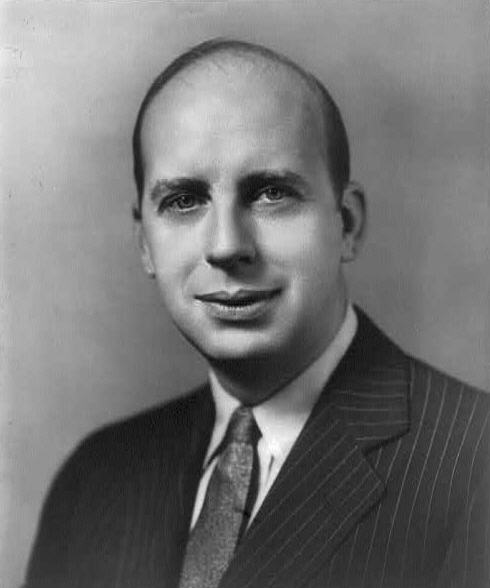
Historical · U.S. Department of Justice
Herbert Brownell
Former United States Attorney General · U.S. Department of Justice · 1953–1957
Herbert Brownell served as United States Attorney General (1953–1957). The page below collects sourced biographical facts, the appointment record, and provenance for Brownell.
Key facts
- Full name
- Herbert Brownell
- Department
- U.S. Department of Justice
- Office
- United States Attorney General
- Status
- Former secretary
- Appointment
- Senate-confirmed
- Tenure
- 1953–1957
- Confirmed
- —
- Born
- 1904
- Died
- 1996
- First year in office
- 1953
- Dataset version
- 1.20260703
Appointment & service record
United States Attorney General · 1953–1957
- Department
- U.S. Department of Justice
- Appointment
- Senate-confirmed
- Appointing president
- —
- Confirmed
- —
Department, appointment type (Senate-confirmed, acting, recess, or designated), appointing president, confirmation status, and service dates are drawn from Wikidata and the White House Cabinet roster.[1][2][3]
Sources
- [1]https://www.wikidata.org/wiki/Q351761Wikidata · retrieved 2026-07-03
- [2]https://www.whitehouse.gov/administration/cabinet/whitehouse.gov · retrieved 2026-07-03
- [3]https://www.wikidata.org/wiki/Q639738wikidata-cabinet · retrieved 2026-07-03
Biographical narrative
855 words · sourced from the Wikipedia REST extract
Herbert Brownell Jr. served as the United States Attorney General from 1953 to 1957 under President Dwight D. Eisenhower. A lawyer who had spent decades in private practice and state politics before his federal appointment, Brownell’s tenure was marked by involvement in several high‑profile civil rights cases and a notable role in shaping the administration’s approach to foreign policy during the early Cold War period.
Early life and career
Herbert Brownell Jr. was born on February 20, 1904, near Peru in Nemaha County, Nebraska. He was one of seven children of Herbert and May Miller Brownell; his father taught education and physical sciences at Peru State Normal School. Brownell completed his undergraduate studies at the University of Nebraska, graduating Phi Beta Kappa in 1924 and joining the Delta Upsilon fraternity during his senior year. While a student he also became a member of the Society of Innocents.
He earned his law degree from Yale Law School in 1927, where he served as president of the Yale Law Journal. After admission to the New York bar, Brownell began practicing law in New York City. In February 1929 he joined the firm of Lord Day & Lord and remained with that organization—except for periods of public service—until his retirement in 1989.
Brownell married Doris McCarter on June 16, 1934; together they had four children: Joan, Ann, Thomas McCarter, and James Barker. The couple remained married until Doris’s death on June 12, 1979. In 1987 he entered into a second marriage with Marion Taylor, but the union ended in divorce by December 1989.
During his early legal career Brownell represented several prominent clients, most notably Greek shipping magnate Aristotle Onassis. After World War II, Onassis sought to acquire T2 tankers that had been built for wartime service. Because these vessels were considered strategically important, they were offered only to American citizens. Brownell assisted Onassis in creating a network of dummy American corporations that enabled the billionaire to purchase the tankers through those entities. The arrangement later drew scrutiny from the Justice Department; under Brownell’s leadership as Attorney General, the department indicted Onassis, and the parties ultimately reached a settlement.
Cabinet tenure
President Eisenhower appointed Brownell as United States Attorney General on January 21, 1953. His nomination was confirmed by the Senate, and he served in that capacity until October 23, 1957. During his term, Brownell addressed both domestic and foreign policy challenges.
In the early months of his tenure, Brownell publicly identified Harry Dexter White as a Russian spy during a meeting with members of the Chicago Executives Club on November 6, 1953. He also played a role in managing the administration’s response to Soviet involvement in the Korean War; according to contemporary accounts, he helped shape an approach that sought to prevent McCarthy‑era politicians from exploiting the conflict for political gain.
Brownell’s most enduring legacy in the Attorney General’s office is his engagement with civil rights matters. He was involved in several landmark cases, including *Brown v. Board of Education*, and drafted a legislative proposal that ultimately became the Civil Rights Act of 1957—the first federal civil rights law enacted since Reconstruction. His advocacy for these measures made him unpopular among Southern legislators, who opposed desegregation and related reforms.
The administration’s handling of the Little Rock, Arkansas, school integration crisis also fell under Brownell’s purview. After the federal government intervened to enforce court orders requiring the admission of African American students into previously all‑white schools, Brownell advised the Department of Justice on how best to support desegregation efforts. His counsel was followed by the federal authorities, and the situation remained a focal point of national debate. A contemporary United States Attorney for the Eastern District of Arkansas later reflected that Brownell’s steadfast position had contributed to his decision to retire from office.
Eisenhower considered nominating Brownell to the Supreme Court during vacancies in 1957 and 1958 but ultimately decided against it, citing concerns that segregationist opposition could defeat a confirmation. Brownell stepped down as Attorney General in late 1957 after his guidance had been implemented in the Little Rock case, concluding a four‑year period marked by significant civil rights enforcement.
Legacy
Brownell’s impact on American legal and political life extended beyond his time as Attorney General. In 1965 he chaired a committee tasked with selecting civilian members for the first impartial Civilian Complaint Review Board of the New York City Police Department, establishing a precedent for citizen oversight of law‑enforcement agencies in the United States.
He also declined consideration for appointment by President Nixon to serve as Chief Justice of the United States in 1969, thereby remaining a private figure rather than pursuing further judicial office. Brownell passed away on May 1, 1996, leaving behind a record that reflects both his legal acumen and his involvement in pivotal moments of mid‑twentieth‑century American history.
Through his work in the federal government, particularly during the early Cold War era and the civil rights movement, Brownell contributed to shaping policies that addressed domestic inequality and international security concerns. His tenure as Attorney General remains a notable chapter in the evolution of U.S. legal practice and public administration.
Sources & provenance
Every quantitative or attributable claim above carries a per-section [N] marker that resolves to the corresponding URL below. Each entry records the upstream provider, the canonical URL, and the timestamp at which the underlying source was retrieved.
Key facts
- https://www.wikidata.org/wiki/Q351761Wikidata · retrieved 2026-07-03
- https://www.whitehouse.gov/administration/cabinet/whitehouse.gov · retrieved 2026-07-03
- https://www.wikidata.org/wiki/Q639738wikidata-cabinet · retrieved 2026-07-03
Biographical narrative
- https://en.wikipedia.org/wiki/Herbert_Brownell_Jr.Wikipedia · retrieved 2026-07-03
Explore the Cabinet
The Cabinet includes the Vice President and the heads of the 15 executive departments. Browse the full roster of current and former secretaries, or explore how the Cabinet fits into the federal government.