
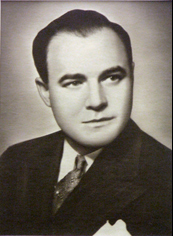
Historical · U.S. Department of Justice
J. Howard McGrath
Former United States Attorney General · U.S. Department of Justice · 1949–1952
J. Howard McGrath served as United States Attorney General (1949–1952). The page below collects sourced biographical facts, the appointment record, and provenance for McGrath.
Key facts
- Full name
- J. Howard McGrath
- Department
- U.S. Department of Justice
- Office
- United States Attorney General
- Status
- Former secretary
- Appointment
- Senate-confirmed
- Tenure
- 1949–1952
- Confirmed
- —
- Born
- 1903
- Died
- 1966
- First year in office
- 1949
- Dataset version
- 1.20260703
Appointment & service record
United States Attorney General · 1949–1952
- Department
- U.S. Department of Justice
- Appointment
- Senate-confirmed
- Appointing president
- —
- Confirmed
- —
Department, appointment type (Senate-confirmed, acting, recess, or designated), appointing president, confirmation status, and service dates are drawn from Wikidata and the White House Cabinet roster.[1][2][3]
Sources
- [1]https://www.wikidata.org/wiki/Q724197Wikidata · retrieved 2026-07-03
- [2]https://www.whitehouse.gov/administration/cabinet/whitehouse.gov · retrieved 2026-07-03
- [3]https://www.wikidata.org/wiki/Q639738wikidata-cabinet · retrieved 2026-07-03
Biographical narrative
1,023 words · sourced from the Wikipedia REST extract
James Howard McGrath was an American lawyer and public servant whose career spanned local, state, congressional, and federal government. Born in the early twentieth century, he rose through the ranks of Rhode Island politics to become United States Attorney General from 1949 to 1952, a position confirmed by the Senate. His service included roles as city solicitor, U.S. attorney for the District of Rhode Island, governor, U.S. senator, chairman of the Democratic National Committee, and private legal practitioner.
Early life and career
McGrath entered the world on November 28, 1903, in Woonsocket, Rhode Island. He was the son of James J. McGrath and Ida E. May. His education began at La Salle Academy, from which he graduated in 1922. He then attended Providence College before enrolling at Boston University School of Law, completing his legal studies in 1929. The same year he married Estelle A. Cadorette; the couple adopted a son named David.
McGrath’s early professional life was rooted in municipal and federal service. From 1930 to 1934 he served as city solicitor for Central Falls, Rhode Island, while also engaging in real estate, insurance, and banking enterprises. In 1934 he was appointed United States Attorney for the District of Rhode Island, a post he held until 1940.
His political trajectory accelerated when he became governor of Rhode Island in 1941. During his tenure, McGrath reorganized the juvenile court system and sponsored initiatives such as a workers’ compensation fund and a labor relations board. In 1944, he presided over a limited‑purpose state constitutional convention held at the Rhode Island College of Education auditorium in Providence on March 28. The convention’s purpose was to amend the state constitution so that members of the armed forces, merchant marines, or individuals absent from the state for military service would no longer be required to register to vote. McGrath acted as president of the convention, with William A. Needham of Providence serving as secretary. The proposed amendment was presented to voters in a special election on April 11, 1944, and passed with a decisive margin.
Midway through his third gubernatorial term, McGrath resigned to accept an appointment as Solicitor General of the United States (1945–1946). His experience at the federal level continued when he was elected to the U.S. Senate in 1946, serving from 1947 to 1949 during the Eightieth Congress. In the Senate, he briefly chaired the Committee on the District of Columbia during the 81st Congress. McGrath’s legislative priorities included maintaining wartime economic controls and opposing tax reductions; he advocated for allocating such funds toward Social Security, national health insurance, and education.
In March 1946, McGrath spoke at a rally in Madison Square Garden that drew approximately twenty thousand participants. The event addressed the United Kingdom’s recent reversal of pro‑Zionist policies in Mandatory Palestine. McGrath expressed support for the establishment of a Jewish state and emphasized the necessity of such an endeavor.
From 1947 to 1949, he served as chairman of the Democratic National Committee. In that capacity, he oversaw President Harry S. Truman’s successful re‑election campaign in 1948, integrating the national headquarters staff and announcing the election outcome on nightfall.
Cabinet tenure
On August 24, 1949, President Harry S. Truman appointed McGrath as United States Attorney General. The Senate confirmed his appointment, allowing him to assume leadership of the Department of Justice. During his tenure, McGrath faced a significant challenge involving an internal corruption investigation initiated by his own department. He declined to cooperate with the inquiry, prompting President Truman to request his resignation. On April 3, 1952, McGrath stepped down from office.
An alternative account suggests that following a meeting of the Joint Chiefs of Staff at Truman’s “Little White House” in Key West, the Secretary of the Navy and other officials threatened resignation if they were compelled to comply with Special Assistant Attorney General Newbold Morris’s request for personal records of individuals who might have received gifts. McGrath agreed that the request was excessive and decided to focus on cleaning up the department rather than pursuing past conduct. Facing pressure from both the military leadership and the Justice Department, Truman concluded that resignation was the only viable resolution.
After leaving public office, McGrath entered private legal practice in Washington, D.C., and Providence. In 1960 he sought election to the U.S. Senate seat vacated by retiring Senator Theodore Francis Green but was defeated in the Democratic primary by former governor Dennis J. Roberts and Claiborne Pell.
McGrath’s life concluded on September 2, 1966, when he suffered a heart attack at his summer residence in Narragansett, Rhode Island. He was seventy‑two years old. His remains were interred at St. Francis Cemetery in Pawtucket, Rhode Island. A bust commemorating him stands outside the House chamber of the Rhode Island State House.
Legacy
McGrath’s career illustrates a trajectory from local legal practice to national leadership within the United States government. His early work as city solicitor and U.S. attorney established his reputation for public service in Rhode Island. As governor, he implemented reforms that reshaped juvenile justice, workers’ compensation, and labor relations, while also guiding constitutional amendments that expanded voting rights for military personnel.
In the Senate, McGrath’s positions on economic policy reflected a commitment to social welfare programs, and his engagement with international issues such as the establishment of a Jewish state demonstrated an awareness of global affairs. His leadership of the Democratic National Committee during Truman’s 1948 campaign underscored his organizational capabilities and influence within national party structures.
McGrath’s tenure as Attorney General was marked by controversy surrounding internal corruption investigations, ultimately leading to his resignation. The circumstances of that departure highlight the complexities of maintaining departmental integrity while navigating political pressures.
Following his public service, McGrath returned to private legal practice and continued to engage in civic life until his death in 1966. His legacy endures through institutional reforms he championed at both state and federal levels, as well as through memorials such as the bust outside Rhode Island’s State House. The breadth of his career—from municipal solicitor to cabinet secretary—offers a portrait of a public servant who navigated multiple arenas of governance during a formative period in American history.
Sources & provenance
Every quantitative or attributable claim above carries a per-section [N] marker that resolves to the corresponding URL below. Each entry records the upstream provider, the canonical URL, and the timestamp at which the underlying source was retrieved.
Key facts
- https://www.wikidata.org/wiki/Q724197Wikidata · retrieved 2026-07-03
- https://www.whitehouse.gov/administration/cabinet/whitehouse.gov · retrieved 2026-07-03
- https://www.wikidata.org/wiki/Q639738wikidata-cabinet · retrieved 2026-07-03
Biographical narrative
- https://en.wikipedia.org/wiki/J._Howard_McGrathWikipedia · retrieved 2026-07-03
Explore the Cabinet
The Cabinet includes the Vice President and the heads of the 15 executive departments. Browse the full roster of current and former secretaries, or explore how the Cabinet fits into the federal government.