
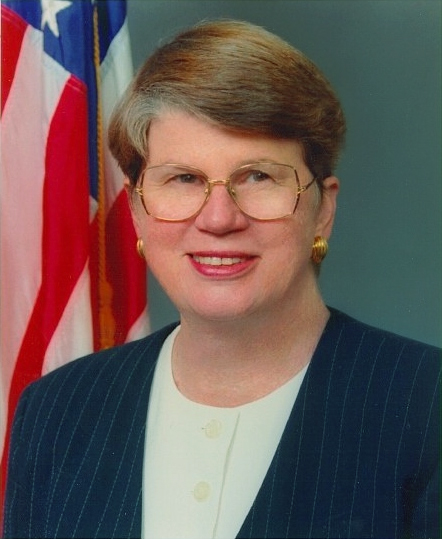
Historical · U.S. Department of Justice
Janet Reno
Former United States Attorney General · U.S. Department of Justice · 1993–2001
Janet Reno served as United States Attorney General (1993–2001). The page below collects sourced biographical facts, the appointment record, and provenance for Reno.
Key facts
- Full name
- Janet Reno
- Department
- U.S. Department of Justice
- Office
- United States Attorney General
- Status
- Former secretary
- Appointment
- Senate-confirmed
- Tenure
- 1993–2001
- Confirmed
- —
- Born
- 1938
- Died
- 2016
- First year in office
- 1993
- Dataset version
- 1.20260703
Appointment & service record
United States Attorney General · 1993–2001
- Department
- U.S. Department of Justice
- Appointment
- Senate-confirmed
- Appointing president
- —
- Confirmed
- —
Department, appointment type (Senate-confirmed, acting, recess, or designated), appointing president, confirmation status, and service dates are drawn from Wikidata and the White House Cabinet roster.[1][2][3]
Sources
- [1]https://www.wikidata.org/wiki/Q236421Wikidata · retrieved 2026-07-03
- [2]https://www.whitehouse.gov/administration/cabinet/whitehouse.gov · retrieved 2026-07-03
- [3]https://www.wikidata.org/wiki/Q639738wikidata-cabinet · retrieved 2026-07-03
Biographical narrative
943 words · sourced from the Wikipedia REST extract
Janet Wood Reno was an American lawyer who served as the United States Attorney General from 1993 to 2001, becoming the first woman to hold that office and one of its longest‑serving occupants. Born in Miami, Florida, she rose through a career that spanned private practice, state government, and federal leadership, leaving a legacy marked by pioneering reforms in criminal justice and a reputation for ethical conduct.
Early life and career
Reno entered the world on July 21, 1938, in Miami, where her parents were both journalists. Her mother, Jane Wallace (née Wood), wrote a weekly home‑improvement column under a male pseudonym before becoming an investigative reporter for *The Miami News*. Her father, Henry Olaf Reno (né Rasmussen), had emigrated from Denmark and worked as a reporter for the *Miami Herald* for 43 years. The family also included three younger siblings—Mark, Robert, and Maggy Hurchalla.
In 1943, when Reno was five, her parents moved to a house in then‑rural South Miami that accommodated farm animals such as cows, chickens, ducks, goats, and turkeys. She helped churn butter for sale, contributing to the family’s income. As the household grew, the parents built a new home near the Everglades; Reno lived there from age eight onward. The house became a lifelong source of inspiration, symbolizing the power of determination.
Reno attended public schools in Miami‑Dade County and, after completing middle school in 1951, stayed with an uncle who served as a U.S. military judge in Regensburg, Germany. During this period she traveled across Europe during breaks from school. Upon returning to Florida, she excelled academically, becoming a debating champion and salutatorian at Coral Gables Senior High School.
In 1956, Reno enrolled at Cornell University, majoring in chemistry and serving as president of the Women’s Self‑Government Association. She earned her room and board through campus activities. After graduating from Cornell, she entered Harvard Law School, where she was one of only sixteen women among a class of five hundred students. She completed her legal education in 1963.
From 1963 to 1971, Reno practiced law at two Miami firms. In 1971 she joined the staff of the Judiciary Committee of the Florida House of Representatives. The following year she ran unsuccessfully for a seat in the state house. In 1973, she worked on revising the state’s criminal procedure rules and later that year accepted a position with the Dade County State Attorney’s Office under Richard Gerstein, becoming his chief assistant. Although she did not prosecute cases during this tenure, she gained experience in the judicial circuit.
In 1976, Reno left public service to become a partner at Steel, Hector & Davis, a private law firm. When Gerstein retired in 1977, Governor Reubin Askew appointed her as State Attorney for Dade County (now Miami‑Dade) in January 1978. She became the first woman to hold that position and was elected to the office in November of that year, subsequently winning four more elections.
As state attorney, Reno oversaw a staff of 95 attorneys handling an annual caseload that included roughly 15,000 felony cases and 40,000 misdemeanor cases. Her reputation for ethical conduct was exemplified by her decision to purchase a car at sticker price to avoid any appearance of impropriety. She established a drug court program that would later be replicated in other jurisdictions and remained active in civic organizations such as the Miami Coalition for a Safe and Drug‑Free Community and the Beacon Council, which focused on economic development.
Reno’s tenure also involved high‑profile prosecutions. In May 1980 she prosecuted five white police officers accused of beating Arthur McDuffie, an African‑American insurance salesman, to death; all were acquitted. The incident sparked riots that resulted in eighteen deaths. Despite criticism, Reno met with many of her detractors and was re‑elected by a wide margin later that year.
She also pursued a vigorous campaign against alleged child abusers, pioneering techniques for eliciting testimony from young children—a controversial approach described by the PBS series *Frontline* as the “Miami Method.”
Cabinet tenure
In 1993, President Bill Clinton appointed Reno to serve as the United States Attorney General. She was confirmed by the Senate and served in that capacity until January 2001, when the administration concluded. During her eight‑year term she became the second‑longest serving attorney general in U.S. history, surpassed only by William Wirt. Her tenure marked the first time a woman held the position of Attorney General.
Reno’s federal service was characterized by efforts to modernize and reform the Department of Justice. She emphasized ethical standards within the department, promoted initiatives aimed at reducing recidivism, and supported programs designed to address drug offenses through alternative sentencing models. Her leadership also extended to oversight of federal prosecutions across a broad spectrum of criminal matters.
Legacy
Janet Reno’s career broke significant gender barriers in American law and public service. As the first woman to serve as both state attorney for Dade County and United States Attorney General, she paved the way for future generations of women lawyers and policymakers. Her commitment to ethical conduct set a standard within the legal profession, while her advocacy for drug court programs influenced criminal justice reform nationwide.
Reno’s work in child‑abuse prosecutions underscored a dedication to protecting vulnerable populations, even as it sparked debate over investigative techniques. The reforms she championed at both state and federal levels contributed to evolving practices in law enforcement and judicial proceedings.
She passed away on November 7, 2016, leaving behind a legacy of pioneering leadership, ethical stewardship, and substantive contributions to the American legal system. Her life remains a reference point for discussions about gender representation in high‑level government positions and the ongoing evolution of criminal justice policy.
Sources & provenance
Every quantitative or attributable claim above carries a per-section [N] marker that resolves to the corresponding URL below. Each entry records the upstream provider, the canonical URL, and the timestamp at which the underlying source was retrieved.
Key facts
- https://www.wikidata.org/wiki/Q236421Wikidata · retrieved 2026-07-03
- https://www.whitehouse.gov/administration/cabinet/whitehouse.gov · retrieved 2026-07-03
- https://www.wikidata.org/wiki/Q639738wikidata-cabinet · retrieved 2026-07-03
Biographical narrative
- https://en.wikipedia.org/wiki/Janet_RenoWikipedia · retrieved 2026-07-03
Explore the Cabinet
The Cabinet includes the Vice President and the heads of the 15 executive departments. Browse the full roster of current and former secretaries, or explore how the Cabinet fits into the federal government.