
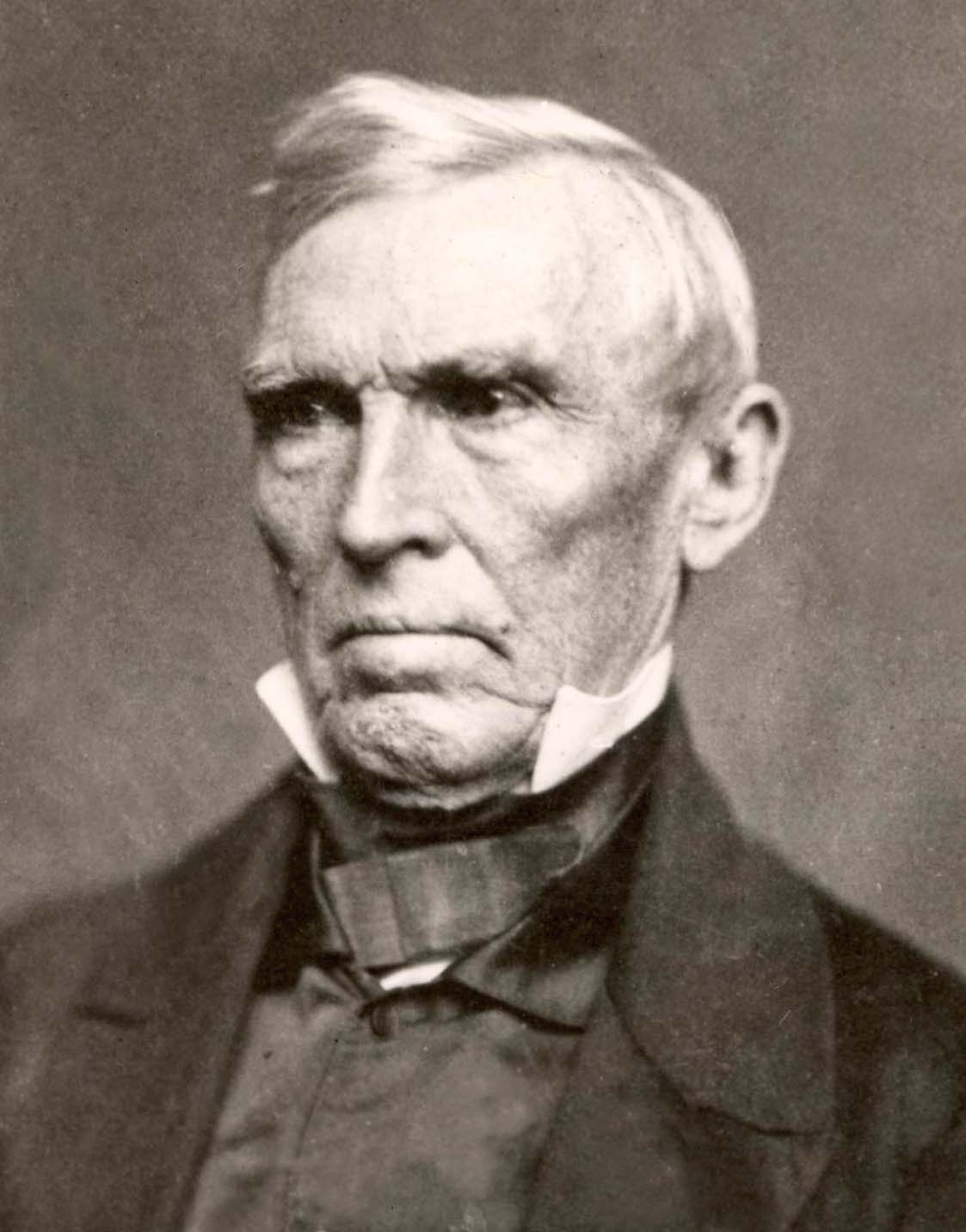
Historical · U.S. Department of Justice
John J. Crittenden
Former United States Attorney General · U.S. Department of Justice · 1841–1853
John J. Crittenden served as United States Attorney General (1841–1853). The page below collects sourced biographical facts, the appointment record, and provenance for Crittenden.
Key facts
- Full name
- John J. Crittenden
- Department
- U.S. Department of Justice
- Office
- United States Attorney General
- Status
- Former secretary
- Appointment
- Senate-confirmed
- Tenure
- 1841–1853
- Confirmed
- —
- Born
- 1787
- Died
- 1863
- First year in office
- 1841
- Dataset version
- 1.20260704
Appointment & service record
United States Attorney General · 1841–1841
- Department
- U.S. Department of Justice
- Appointment
- Senate-confirmed
- Appointing president
- —
- Confirmed
- —
United States Attorney General · 1850–1853
- Department
- U.S. Department of Justice
- Appointment
- Senate-confirmed
- Appointing president
- —
- Confirmed
- —
Department, appointment type (Senate-confirmed, acting, recess, or designated), appointing president, confirmation status, and service dates are drawn from Wikidata and the White House Cabinet roster.[1][2][3]
Sources
- [1]https://www.wikidata.org/wiki/Q880239Wikidata · retrieved 2026-07-04
- [2]https://www.whitehouse.gov/administration/cabinet/whitehouse.gov · retrieved 2026-07-04
- [3]https://www.wikidata.org/wiki/Q639738wikidata-cabinet · retrieved 2026-07-04
Biographical narrative
905 words · sourced from the Wikipedia REST extract
John Jordan Crittenden (September 10, 1787 – July 26, 1863) was a prominent Kentucky statesman who served the United States in several high‑profile roles, including twice as Attorney General of the United States and once as Governor of Kentucky. His career spanned the early republic through the tumultuous years leading up to the Civil War, during which he sought to maintain national unity while navigating shifting political alliances.
Early life and career
Crittenden was born near Versailles in Woodford County, Kentucky, the second child and first son of Major John Crittenden, a veteran of the American Revolution, and Judith Harris. His paternal lineage traced back to Welsh settlers, while his mother’s family were French Huguenots who had immigrated during the 18th century. The Crittenden household was large; all but one of the children survived infancy.
He received his early education at Pisgah Academy in Woodford County before attending a boarding school in Jessamine County. In Lexington, he studied law under Judge George M. Bibb and later pursued advanced legal instruction at Washington College (now Washington and Lee University) in Virginia. Dissatisfied with the curriculum there, he transferred to the College of William & Mary, where he studied under St. George Tucker and formed a lasting friendship with future President John Tyler.
Crittenden was admitted to the Kentucky bar in 1807 after completing his legal studies. He initially practiced in Woodford County but found competition high among local attorneys. Seeking new opportunities, he moved westward to Logan County, opening a practice in Russellville. At twenty‑two, he crossed the Ohio River into the Illinois Territory, where Governor Ninian Edwards appointed him Attorney General of the territory from 1809 to 1810 and later made him an aide‑de‑camp.
During the War of 1812, Crittenden served as an aide‑de‑camp for Kentucky’s militia leaders. He participated in campaigns against Native American forces and was present at the Battle of the Thames in Canada while serving under Governor Isaac Shelby.
Crittenden entered elective politics in 1811, representing Logan County in the Kentucky House of Representatives until 1817. His colleagues elected him Speaker on several occasions, reflecting his growing influence within the state legislature. He aligned with the National Republican Party during the early years of the Second Party System and later joined the Whig Party, becoming a close ally of Henry Clay. Crittenden was a vocal opponent of Democratic leaders Andrew Jackson and Martin Van Buren.
In 1828, President John Quincy Adams nominated him to the United States Supreme Court; however, senators supporting the incoming president, Andrew Jackson, postponed confirmation until Jackson could nominate his own candidate. After serving briefly as Kentucky’s Secretary of State, Crittenden was elected to the U.S. Senate, where he served a non‑consecutive term that would later be interrupted by his appointment as Attorney General.
Cabinet tenure
Crittenden first entered the federal cabinet in 1841 when President William Henry Harrison appointed him United States Attorney General. He was confirmed by the Senate and began serving at the outset of Harrison’s administration. Five months after Harrison’s death, Crittenden resigned rather than continue under President John Tyler, citing political differences that made continued service untenable.
After a period in state politics—including a term as Governor of Kentucky—Crittenden returned to national office when President Millard Fillmore appointed him Attorney General in 1850. He served in this capacity until 1853, again confirmed by the Senate. During his second tenure, he worked under a president who had ascended to the presidency following Zachary Taylor’s death and was navigating the increasingly polarized national debate over slavery.
Crittenden’s cabinet service bookended a career that also included multiple terms in both houses of Congress and leadership positions within Kentucky’s political institutions. His appointments reflected the confidence placed in him by successive presidents across different administrations, underscoring his reputation as a seasoned legal mind and experienced public servant.
Legacy
John J. Crittenden’s legacy is intertwined with the broader narrative of mid‑19th‑century American politics. As a lawyer, legislator, governor, senator, and twice Attorney General, he played a significant role in shaping policy discussions on issues ranging from territorial expansion to slavery. His early support for Henry Clay’s vision of national unity and his later efforts to broker compromise during the secession crisis illustrate a consistent commitment to preserving the Union.
In 1860, amid escalating sectional conflict, Crittenden authored what became known as the Crittenden Compromise—a series of resolutions and constitutional amendments aimed at averting civil war. Although Congress did not adopt these proposals, they reflected his continued pursuit of middle ground in an increasingly polarized environment.
Crittenden’s career also demonstrates the fluidity of party affiliations during this period. After the collapse of the Whig Party, he joined the Know Nothing (American) Party and later helped found the Constitutional Union Party, which sought to bring together moderates from all sides. His refusal to accept the presidential nomination in 1860 further underscored his preference for compromise over partisan ambition.
Crittenden’s death in 1863 came during the Civil War, a conflict he had long endeavored to prevent through diplomatic and legislative means. While his efforts did not avert war, his life remains a testament to the complexities of governance during one of America’s most turbulent eras. His service as Attorney General under three different presidents, his leadership within Kentucky, and his national influence on debates over slavery and unionism continue to be studied by historians examining the interplay between law, politics, and social change in nineteenth‑century United States.
Sources & provenance
Every quantitative or attributable claim above carries a per-section [N] marker that resolves to the corresponding URL below. Each entry records the upstream provider, the canonical URL, and the timestamp at which the underlying source was retrieved.
Key facts
- https://www.wikidata.org/wiki/Q880239Wikidata · retrieved 2026-07-04
- https://www.whitehouse.gov/administration/cabinet/whitehouse.gov · retrieved 2026-07-04
- https://www.wikidata.org/wiki/Q639738wikidata-cabinet · retrieved 2026-07-04
Biographical narrative
- https://en.wikipedia.org/wiki/John_J._CrittendenWikipedia · retrieved 2026-07-04
Explore the Cabinet
The Cabinet includes the Vice President and the heads of the 15 executive departments. Browse the full roster of current and former secretaries, or explore how the Cabinet fits into the federal government.