
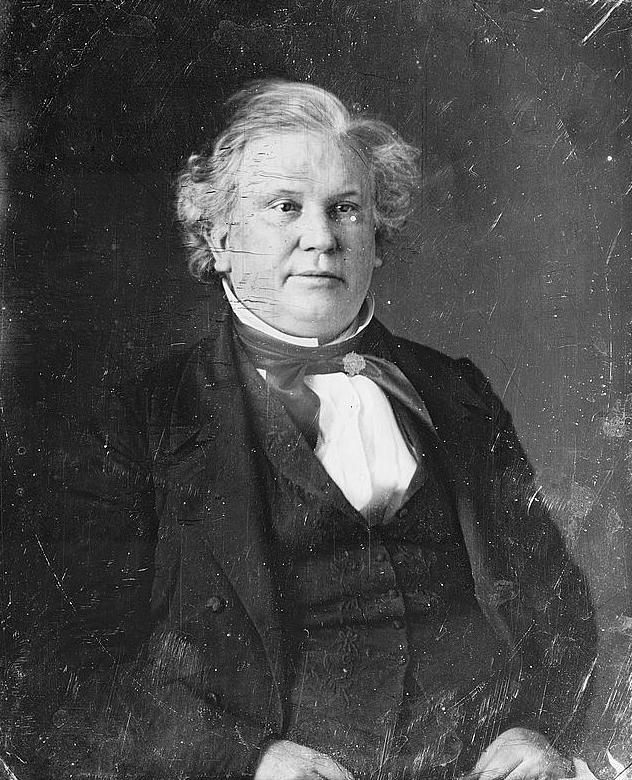
Historical · U.S. Department of Justice
John Y. Mason
Former United States Attorney General · U.S. Department of Justice · 1845–1846
John Y. Mason served as United States Attorney General (1845–1846). The page below collects sourced biographical facts, the appointment record, and provenance for Mason.
Key facts
- Full name
- John Y. Mason
- Department
- U.S. Department of Justice
- Office
- United States Attorney General
- Status
- Former secretary
- Appointment
- Senate-confirmed
- Tenure
- 1845–1846
- Confirmed
- —
- Born
- 1799
- Died
- 1859
- First year in office
- 1845
- Dataset version
- 1.20260703
Appointment & service record
United States Attorney General · 1845–1846
- Department
- U.S. Department of Justice
- Appointment
- Senate-confirmed
- Appointing president
- —
- Confirmed
- —
Department, appointment type (Senate-confirmed, acting, recess, or designated), appointing president, confirmation status, and service dates are drawn from Wikidata and the White House Cabinet roster.[1][2][3]
Sources
- [1]https://www.wikidata.org/wiki/Q1258123Wikidata · retrieved 2026-07-03
- [2]https://www.whitehouse.gov/administration/cabinet/whitehouse.gov · retrieved 2026-07-03
- [3]https://www.wikidata.org/wiki/Q639738wikidata-cabinet · retrieved 2026-07-03
Biographical narrative
863 words · sourced from the Wikipedia REST extract
John Young Mason (April 18, 1799 – October 3, 1859) was a Virginia lawyer, planter, judge, and public servant who held several high federal offices during the mid‑19th century. He served as United States Attorney General from 1845 to 1846, after previously acting as a district judge and as Secretary of the Navy under multiple administrations. His career spanned legislative, judicial, executive, and diplomatic roles in both state and national government.
Early life and career
Mason was born on April 18, 1799, at the family plantation known as “Homestead” near Hicksford, a community that would later become part of Emporia in Greensville County, Virginia. His mother, Frances Young, came from a lineage that had long held clerical positions in Isle of Wight County during the Revolutionary era; his father, Edmund Mason, served as clerk of Greensville County and represented the county in the Virginia House of Delegates in the early 1800s. The Mason family traced its roots to English immigrants who settled in the Hampton Roads region in the early 17th century.
Mason received a private education typical for young men of his social standing, attending local schools and drawing upon his family's library. In 1816 he earned an Artium Baccalaureus degree from the University of North Carolina at Chapel Hill. He then pursued legal studies under Judge Tapping Reeve at Litchfield Law School in Connecticut, completing his training in 1819.
After admission to the Virginia bar in 1819, Mason began a private practice first in Greensville County (1819–1821) and later in neighboring Southampton County (1821–1831). During part of this period he also served as commonwealth’s attorney for Greensville County from 1827 to 1831. His legal work was complemented by his activities as a planter; following his marriage, the Mason family received a 434‑acre plantation in Greensville County and later operated additional holdings in Southampton and Richmond. Census records indicate that he owned enslaved people of various ages across these properties.
Mason’s political career began at the state level. He was elected to the Virginia House of Delegates representing Southampton County in 1823, serving until 1826. In 1826 he won election to the Virginia State Senate for a district encompassing several counties on the Southside of Virginia; he served there until 1831. During his tenure as a state legislator he participated in two Virginia Constitutional Conventions—one held in 1829–1830 and another in 1850—contributing to debates that shaped the state's governance structure.
Following his service in the state legislature, Mason was elected to the United States House of Representatives, representing Virginia at the federal level. While specific congressional terms are not detailed here, his experience as a legislator laid the groundwork for subsequent appointments.
In 1841 President John Tyler appointed Mason as judge of the United States District Court for the Eastern District of Virginia. He served in this judicial capacity until 1843, when he resigned to accept executive and diplomatic positions under successive administrations.
Cabinet tenure
Mason’s federal career included several high‑profile cabinet posts. Under President James K. Polk, he was appointed Secretary of the Navy, serving as the department’s 16th head. He returned to the same office during the administration of President Franklin Pierce, becoming the 18th Secretary of the Navy. In 1845 President James Buchanan selected Mason for the position of United States Attorney General; the Senate confirmed his appointment, and he served in that role until 1846.
Beyond these cabinet responsibilities, Mason also represented the United States abroad as Minister to France. His diplomatic service placed him at the center of U.S.–European relations during a period of growing international engagement for the young republic.
Throughout his tenure in executive office, Mason was involved in matters related to maritime affairs, national defense policy, and the administration of federal law. His judicial background informed his approach to legal issues within the Department of Justice, while his experience as Secretary of the Navy shaped naval procurement and personnel policies during a time of expanding U.S. maritime interests.
Legacy
John Y. Mason’s career illustrates the breadth of public service undertaken by mid‑19th‑century American officials who moved between legislative, judicial, executive, and diplomatic roles. His repeated appointments to cabinet positions under four different presidents demonstrate the confidence placed in him across administrations with varying priorities. As Attorney General, he oversaw federal legal affairs during a period marked by territorial expansion and increasing sectional tensions. His two terms as Secretary of the Navy coincided with significant developments in naval technology and shipbuilding that would influence U.S. maritime capabilities for years to come.
Mason’s life also reflects the complexities of Southern planter society before the Civil War, including his ownership of enslaved people and management of large agricultural estates. His death on October 3, 1859, occurred in Paris, France, shortly before the outbreak of the American Civil War—a conflict that would profoundly reshape the nation he had served.
While specific policy achievements during his cabinet tenure are not detailed here, Mason’s service across multiple branches of government provides a case study in the interconnected nature of 19th‑century American public life. His contributions to both domestic legal administration and international diplomacy remain part of the broader narrative of U.S. governmental development during a formative era.
Sources & provenance
Every quantitative or attributable claim above carries a per-section [N] marker that resolves to the corresponding URL below. Each entry records the upstream provider, the canonical URL, and the timestamp at which the underlying source was retrieved.
Key facts
- https://www.wikidata.org/wiki/Q1258123Wikidata · retrieved 2026-07-03
- https://www.whitehouse.gov/administration/cabinet/whitehouse.gov · retrieved 2026-07-03
- https://www.wikidata.org/wiki/Q639738wikidata-cabinet · retrieved 2026-07-03
Biographical narrative
- https://en.wikipedia.org/wiki/John_Y._MasonWikipedia · retrieved 2026-07-03
Explore the Cabinet
The Cabinet includes the Vice President and the heads of the 15 executive departments. Browse the full roster of current and former secretaries, or explore how the Cabinet fits into the federal government.