
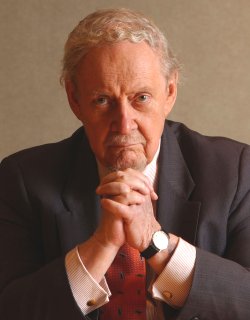
Historical · U.S. Department of Justice
Robert Bork
Acting
Former Acting United States Attorney General · U.S. Department of Justice · 1973–1974
Robert Bork served as Acting United States Attorney General (1973–1974). The page below collects sourced biographical facts, the appointment record, and provenance for Bork.
Key facts
- Full name
- Robert Bork
- Department
- U.S. Department of Justice
- Office
- United States Attorney General
- Status
- Former secretary
- Appointment
- Acting
- Tenure
- 1973–1974
- Confirmed
- —
- Born
- 1927
- Died
- 2012
- First year in office
- 1973
- Dataset version
- 1.20260704
Appointment & service record
United States Attorney General · 1973–1974
- Department
- U.S. Department of Justice
- Appointment
- Acting
- Appointing president
- —
- Confirmed
- Not confirmed
Department, appointment type (Senate-confirmed, acting, recess, or designated), appointing president, confirmation status, and service dates are drawn from Wikidata and the White House Cabinet roster.[1][2][3]
Sources
- [1]https://www.wikidata.org/wiki/Q1365780Wikidata · retrieved 2026-07-04
- [2]https://www.whitehouse.gov/administration/cabinet/whitehouse.gov · retrieved 2026-07-04
- [3]https://www.wikidata.org/wiki/Q639738wikidata-cabinet · retrieved 2026-07-04
Biographical narrative
926 words · sourced from the Wikipedia REST extract
Robert Heron “Bob” Bork was an American legal scholar, government official, and jurist whose career spanned academia, the federal judiciary, and executive‑branch service. He is best known for his tenure as acting United States Attorney General from 1973 to early 1974 during the Nixon administration, a period that included the controversial Saturday Night Massacre. Bork’s influence extended beyond that brief cabinet role; he served as Solicitor General of the United States, was appointed to the United States Court of Appeals for the District of Columbia Circuit, and was nominated by President Ronald Reagan to the Supreme Court in 1987, a nomination ultimately rejected by the Senate.
Early life and career
Robert Bork was born on March 1, 1927, in Pittsburgh, Pennsylvania. He was the only child of Harry Philip Bork Jr., a steel company purchasing agent, and Elizabeth (née Kunkle), a schoolteacher. His father’s ancestry combined German and Irish roots, while his mother descended from Pennsylvania Germans. Bork attended the Hotchkiss School in Lakeville, Connecticut, where he developed an early interest in legal reasoning and debate.
He entered the University of Chicago for undergraduate studies, graduating with a Bachelor of Arts in 1948. While at Chicago, he joined the international social fraternity Phi Gamma Delta. He continued his education at the university’s law school, earning a Juris Doctor in 1953. During law school, Bork served as an editor of the University of Chicago Law Review and was inducted into both the Order of the Coif and Phi Beta Kappa. His legal training was interrupted by military service; he took a two‑year leave to serve in the United States Marine Corps during the Korean War.
After completing his education, Bork entered private practice. From 1954 to 1962 he worked at two prominent law firms—Kirkland & Ellis and Willkie Farr & Gallagher—where he gained experience in corporate and antitrust matters. In 1962, he transitioned to academia, accepting a faculty position at Yale Law School. Over the next nineteen years, Bork taught courses on constitutional law, administrative law, and antitrust theory. His students included future political leaders, judges, and scholars such as Bill Clinton, Hillary Clinton, Anita Hill, Robert Reich, Jerry Brown, Linda Greenhouse, John Bolton, Samuel Issacharoff, and Cynthia Estlund.
Bork’s scholarly work focused heavily on the economics of competition and constitutional interpretation. In 1978 he published *The Antitrust Paradox*, a book that argued for a consumer‑welfare standard in antitrust enforcement and critiqued traditional notions of market competition. His writings contributed to a broader shift in Supreme Court antitrust jurisprudence toward an emphasis on economic outcomes rather than formal competitive structures.
Cabinet tenure
In March 1973, President Richard Nixon appointed Bork as Solicitor General of the United States, a position he held through the remainder of Nixon’s term and into the administration of President Gerald Ford. As Solicitor General, Bork represented the federal government before the Supreme Court in numerous high‑profile cases. He argued several important decisions, including *Milliken v. Bradley* (1974), where his brief for the State of Michigan was noted for its persuasive clarity.
Bork’s most prominent executive‑branch service came during the October 1973 Saturday Night Massacre. When President Nixon ordered the dismissal of Special Prosecutor Archibald Cox—who had been investigating the Watergate scandal—Bork, as acting Attorney General, carried out that order and formally fired Cox. He served in this capacity from the time of the firing until January 4, 1974, when he was succeeded by William B. Saxbe, a senator from Ohio who had been appointed to fill the vacancy permanently.
During his brief tenure as Acting Attorney General, Bork oversaw the day‑to‑day operations of the Department of Justice and represented the executive branch in legal matters that arose during the transition period. His role was largely administrative, but it placed him at the center of a pivotal moment in American political history, reflecting the tensions between the executive office and independent investigative authorities.
Legacy
Robert Bork’s legacy is multifaceted, encompassing contributions to constitutional theory, antitrust economics, judicial administration, and public service. After leaving the Solicitor General’s office, he was appointed by President Ronald Reagan to the United States Court of Appeals for the District of Columbia Circuit in 1982, a position he held until his resignation in 1988. His appellate opinions reflected his commitment to originalist interpretation and careful analysis of statutory language.
In 1987, Bork was nominated by President Reagan to fill the vacancy left by Justice Lewis Powell on the Supreme Court. The nomination attracted extensive media coverage and organized opposition, largely due to his outspoken critiques of prior Supreme Court decisions and his involvement in the Saturday Night Massacre. The Senate rejected the nomination with a vote of 42–58; the seat was subsequently filled by Justice Anthony Kennedy.
Following his judicial service, Bork returned to academia and writing. He taught at institutions such as George Mason University School of Law and served as a fellow at the American Enterprise Institute and the Hudson Institute. His later works continued to explore constitutional issues, antitrust policy, and cultural criticism, including titles like *Slouching Toward Gomorrah*.
Bork’s influence persists in contemporary legal scholarship and practice. His advocacy for a consumer‑welfare standard reshaped antitrust enforcement debates, while his originalist approach remains a cornerstone of many judicial philosophies. The controversies surrounding his career—particularly the Saturday Night Massacre and his Supreme Court nomination—continue to serve as reference points in discussions about executive power, judicial independence, and the politicization of legal appointments.
Robert Bork died on December 19, 2012, leaving behind a complex legacy that continues to inform legal education, jurisprudence, and public policy debates.
Sources & provenance
Every quantitative or attributable claim above carries a per-section [N] marker that resolves to the corresponding URL below. Each entry records the upstream provider, the canonical URL, and the timestamp at which the underlying source was retrieved.
Key facts
- https://www.wikidata.org/wiki/Q1365780Wikidata · retrieved 2026-07-04
- https://www.whitehouse.gov/administration/cabinet/whitehouse.gov · retrieved 2026-07-04
- https://www.wikidata.org/wiki/Q639738wikidata-cabinet · retrieved 2026-07-04
Biographical narrative
- https://en.wikipedia.org/wiki/Robert_BorkWikipedia · retrieved 2026-07-04
Explore the Cabinet
The Cabinet includes the Vice President and the heads of the 15 executive departments. Browse the full roster of current and former secretaries, or explore how the Cabinet fits into the federal government.