
Historical · U.S. Department of Justice
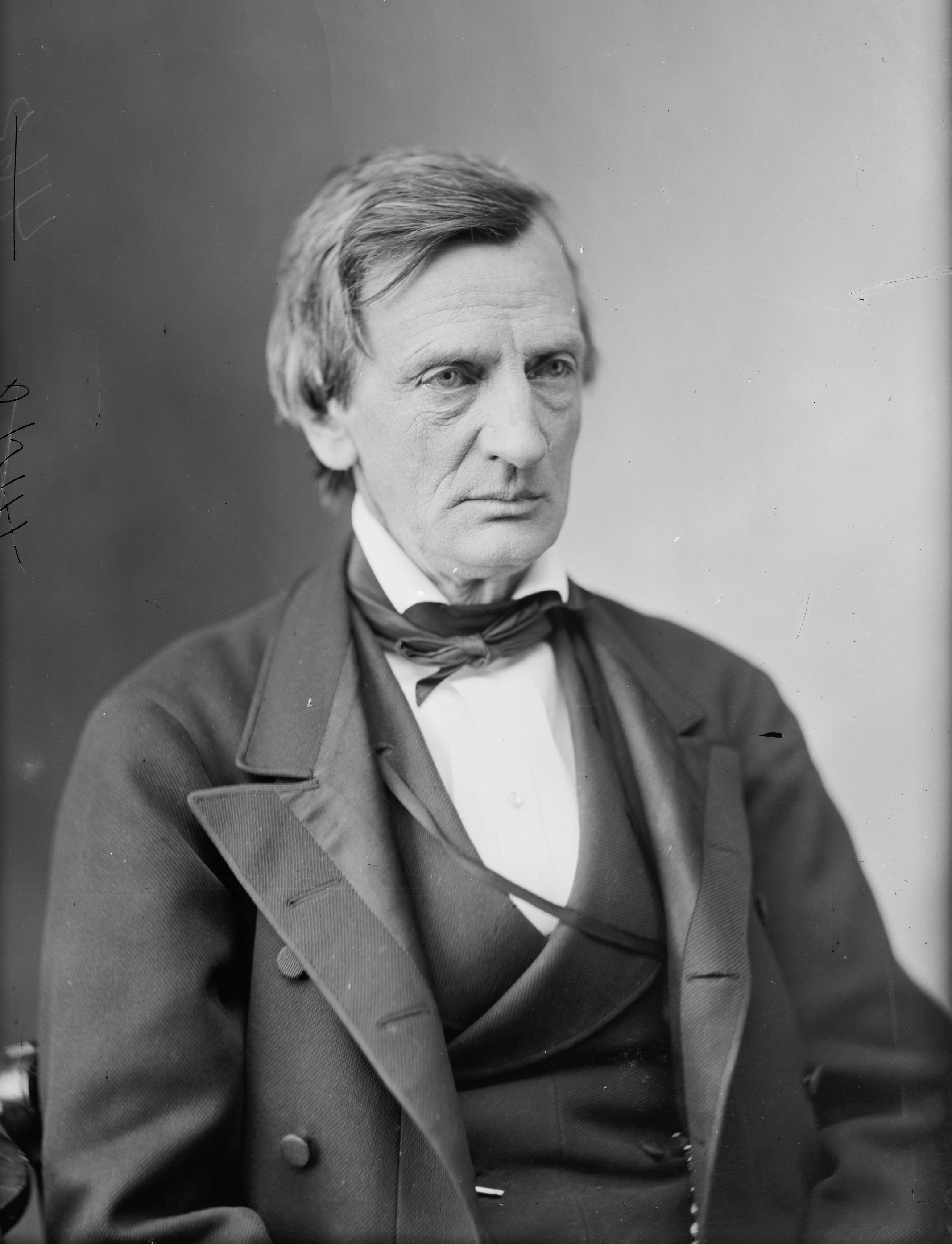
William M. Evarts
Former United States Attorney General · U.S. Department of Justice · 1868–1869
William M. Evarts served as United States Attorney General (1868–1869). The page below collects sourced biographical facts, the appointment record, and provenance for Evarts.
Key facts
- Full name
- William M. Evarts
- Department
- U.S. Department of Justice
- Office
- United States Attorney General
- Status
- Former secretary
- Appointment
- Senate-confirmed
- Tenure
- 1868–1869
- Confirmed
- —
- Born
- 1818
- Died
- 1901
- First year in office
- 1868
- Dataset version
- 1.20260703
Appointment & service record
United States Attorney General · 1868–1869
- Department
- U.S. Department of Justice
- Appointment
- Senate-confirmed
- Appointing president
- —
- Confirmed
- —
Department, appointment type (Senate-confirmed, acting, recess, or designated), appointing president, confirmation status, and service dates are drawn from Wikidata and the White House Cabinet roster.[1][2][3]
Sources
- [1]https://www.wikidata.org/wiki/Q709167Wikidata · retrieved 2026-07-03
- [2]https://www.whitehouse.gov/administration/cabinet/whitehouse.gov · retrieved 2026-07-03
- [3]https://www.wikidata.org/wiki/Q639738wikidata-cabinet · retrieved 2026-07-03
Biographical narrative
1,017 words · sourced from the Wikipedia REST extract
William Maxwell Evarts (February 6 1818 – February 28 1901) was a prominent American lawyer and public servant from New York who held several high‑level federal offices, including United States Attorney General during the administration of President Rutherford B. Hayes. His career spanned private practice, legislative service as a U.S. Senator, and executive leadership within the Department of Justice. Evarts is remembered for his courtroom skill, his involvement in landmark national legal disputes, and his advocacy for civil‑service reform.
Early life and career
Evarts was born on February 6 1818 in Charlestown, Massachusetts, to Jeremiah Evarts and Mehitabel Barnes Sherman. His father, a Vermont native, practiced law and later edited *The Panoplist*, while also serving as the corresponding secretary of the American Board of Commissioners for Foreign Missions; he died when William was thirteen years old. Evarts’ mother descended from Roger Sherman, a founding father who signed the Declaration of Independence, the Articles of Confederation, and the Constitution.
He received his early education at Boston Latin School before enrolling at Yale College in 1834. While at Yale, he joined the Linonian Society and Skull and Bones, two secret societies that would later become subjects of his own critique. He also helped found the *Yale Literary Magazine* in 1836. Evarts graduated third in his class in 1837.
After college, Evarts moved to Windsor, Vermont, where he studied law under Horace Everett while teaching school to support himself. He spent a year at Harvard Law School, earning the respect of professors Joseph Story and Simon Greenleaf. His legal training was completed in New York City under Daniel Lord, with whom he later entered into partnership. Evarts was admitted to the bar in 1841.
In 1843, he married Helen Minerva Bingham Wardner, daughter of Allen Wardner, a prominent Vermont businessman and former state treasurer. The couple had twelve children between 1845 and 1862, all born while they resided in New York City.
Evarts’ early legal career was marked by high‑profile cases that established his reputation as an adept litigator. He served as junior counsel in the defense of Monroe Edwards, a notorious forger, and later joined Daniel Lord’s firm. In 1851 he formed a partnership with Charles F. Southmayd, creating Butler, Evarts & Southmayd; this collaboration would endure throughout his professional life, evolving into Evarts, Southmayd & Choate when Joseph Hodges Choate joined in 1859.
His courtroom presence was complemented by meticulous preparation work conducted largely by Southmayd. The combination of rigorous case building and persuasive advocacy earned Evarts recognition as one of the foremost attorneys of his era. Notable cases included representing New York State in the Lemmon Slave Case, where he argued for the enforcement of a court decision that released eight enslaved individuals; and handling complex probate litigation involving the estate of Henry Parish, which spanned several years and attracted considerable public attention.
Evarts’ legal acumen eventually led to his appointment as United States Attorney General. He served in this capacity from 1868 to 1869, confirmed by the Senate during President Rutherford B. Hayes’s administration. His tenure coincided with a period of national debate over civil service reform and the spoils system; Evarts was an active participant in the “Half‑Breed” faction that favored merit‑based appointments and opposed the conservative “Stalwarts.”
Cabinet tenure
During his year as Attorney General, Evarts worked within the Department of Justice to enforce federal law and advise the executive branch. He was involved in several significant national legal matters that extended beyond the confines of his cabinet role.
One major issue of the era was the impeachment proceedings against a sitting president; Evarts played a part in shaping the legal framework surrounding this unprecedented constitutional process. His experience as a seasoned litigator informed the Department’s approach to the case, and he contributed to the broader discussion on presidential accountability.
Evarts also participated in diplomatic negotiations related to international arbitration at Geneva, where the United States sought resolution of disputes with foreign powers through peaceful means. The legal arguments presented by Evarts helped articulate American positions within this multilateral forum.
In addition, Evarts was called upon to advise the federal government during the contested presidential election of 1876. He represented Republican interests before the electoral commission that ultimately resolved the dispute between Rutherford B. Hayes and Samuel J. Tilden. His legal counsel assisted in navigating the complex procedural landscape that characterized this pivotal moment in American political history.
Throughout his cabinet service, Evarts maintained a reputation for integrity and professionalism. He advocated for reforms aimed at reducing patronage and promoting meritocracy within federal appointments—a stance consistent with the broader movement toward civil‑service reform during the post‑Civil War era.
Legacy
William M. Evarts left an enduring imprint on American jurisprudence and public service. His legal career, spanning private practice, legislative work, and executive leadership, exemplified a commitment to the rule of law and the orderly administration of justice.
As a lawyer, Evarts was celebrated for his courtroom eloquence and meticulous preparation. His involvement in high‑profile cases—such as the Lemmon Slave Case and complex probate disputes—demonstrated his capacity to handle intricate legal matters with precision. These experiences laid the groundwork for his later roles in government.
In the federal cabinet, Evarts contributed to foundational national debates over executive accountability, international arbitration, and electoral integrity. His participation in the impeachment process helped shape the constitutional understanding of presidential misconduct. His work at Geneva advanced the United States’ engagement in peaceful dispute resolution on the world stage. Finally, his counsel during the 1876 election underscored the importance of legal frameworks in resolving political crises.
Evarts’ advocacy for civil‑service reform reflected a broader shift toward merit‑based federal employment. By championing these principles within the Department of Justice, he helped lay the foundation for modern administrative practices that emphasize competence over patronage.
Beyond his professional achievements, Evarts’ personal life—marked by a large family and long‑standing legal partnerships—illustrated the interconnectedness of public service and community engagement in nineteenth‑century America. His legacy endures through the institutions he helped shape, the legal precedents he influenced, and the standards of conduct he set for future generations of attorneys and public officials.
Sources & provenance
Every quantitative or attributable claim above carries a per-section [N] marker that resolves to the corresponding URL below. Each entry records the upstream provider, the canonical URL, and the timestamp at which the underlying source was retrieved.
Key facts
- https://www.wikidata.org/wiki/Q709167Wikidata · retrieved 2026-07-03
- https://www.whitehouse.gov/administration/cabinet/whitehouse.gov · retrieved 2026-07-03
- https://www.wikidata.org/wiki/Q639738wikidata-cabinet · retrieved 2026-07-03
Biographical narrative
- https://en.wikipedia.org/wiki/William_M._EvartsWikipedia · retrieved 2026-07-03
Explore the Cabinet
The Cabinet includes the Vice President and the heads of the 15 executive departments. Browse the full roster of current and former secretaries, or explore how the Cabinet fits into the federal government.