
Historical · U.S. Department of Justice
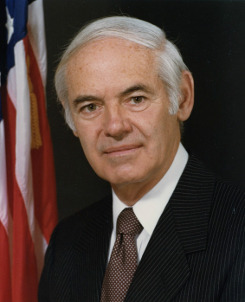
William French Smith
Former United States Attorney General · U.S. Department of Justice · 1981–1985
William French Smith served as United States Attorney General (1981–1985). The page below collects sourced biographical facts, the appointment record, and provenance for Smith.
Key facts
- Full name
- William French Smith
- Department
- U.S. Department of Justice
- Office
- United States Attorney General
- Status
- Former secretary
- Appointment
- Senate-confirmed
- Tenure
- 1981–1985
- Confirmed
- —
- Born
- 1917
- Died
- 1990
- First year in office
- 1981
- Dataset version
- 1.20260703
Appointment & service record
United States Attorney General · 1981–1985
- Department
- U.S. Department of Justice
- Appointment
- Senate-confirmed
- Appointing president
- —
- Confirmed
- —
Department, appointment type (Senate-confirmed, acting, recess, or designated), appointing president, confirmation status, and service dates are drawn from Wikidata and the White House Cabinet roster.[1][2][3]
Sources
- [1]https://www.wikidata.org/wiki/Q351294Wikidata · retrieved 2026-07-03
- [2]https://www.whitehouse.gov/administration/cabinet/whitehouse.gov · retrieved 2026-07-03
- [3]https://www.wikidata.org/wiki/Q639738wikidata-cabinet · retrieved 2026-07-03
Biographical narrative
831 words · sourced from the Wikipedia REST extract
William French Smith II was an influential American lawyer who served as the United States’ 74th Attorney General from January 23, 1981 to February 25, 1985. His career spanned private practice, academic governance, and federal criminal justice reform. Smith’s tenure in the Department of Justice coincided with a period of heightened focus on drug enforcement, sentencing policy, and welfare legislation under President Ronald Reagan. After leaving office he returned to his long‑time law firm before passing away from cancer in 1990.
Early life and career
Smith was born on August 26, 1917, in Wilton, New Hampshire, and grew up in Boston. He earned a Bachelor of Arts degree in economics, graduating summa cum laude from the University of California, Los Angeles in 1939. In 1942 he completed his legal education at Harvard Law School. Smith’s family lineage included Urian Oakes, a 17th‑century president of Harvard College, and his father, also named William French Smith, served as president of the Boston‑based Mexican Telephone and Telegraph Company.
Following graduation, Smith entered military service during World War II. From 1942 to 1946 he was an officer in the United States Naval Reserve, attaining the rank of lieutenant. After the war, he joined the Los Angeles office of Gibson, Dunn & Crutcher LLP, where he would spend most of his professional life.
Smith’s connection with Ronald Reagan began in 1966 when he met the former actor during Reagan’s campaign for governor of California. Their friendship deepened over time; in 1968 Reagan appointed Smith to the University of California Board of Regents, a position that Smith held for three terms and served as chairman on several occasions. His work on the board reflected an interest in higher‑education governance and public policy.
Cabinet tenure
On December 11, 1980, President‑elect Ronald Reagan nominated Smith to serve as United States Attorney General. The Senate confirmed his appointment, and he assumed office on January 23, 1981. Smith’s term lasted until February 25, 1985, during which he pursued a broad agenda aimed at strengthening federal law enforcement and reforming the criminal justice system.
A central focus of Smith’s administration was the fight against illegal narcotics. He doubled the resources allocated to combat the distribution and sale of drugs across the country. In addition, he successfully lobbied for the creation of a commission tasked with developing new federal sentencing guidelines, thereby influencing how courts would impose penalties for various offenses.
Smith also supported President Reagan’s welfare reform program and recommended an extensive crime package that included more than 150 administrative and legislative initiatives. Among these were proposals to expand the federal death penalty, deny bail in certain serious cases, modify rules governing the admissibility of illegally seized evidence, and mandate prison sentences for crimes involving firearms. His office also advocated for the use of Internal Revenue Service data in investigations of organized crime.
Immigration policy formed another pillar of Smith’s agenda. He helped design a framework that addressed refugee status and immigration enforcement while maintaining a more lenient stance toward corporate mergers to better align government regulation with business concerns. Smith opposed anti‑competitive practices and worked to adjust the Freedom of Information Act of 1966, aiming to streamline access to public records.
During his tenure, Smith played an active role in judicial appointments. He was involved in the nomination of Sandra Day O’Connor, who became the first woman appointed to the United States Supreme Court. Smith’s influence extended to the broader federal judiciary through a judicial‑selection system that sought to appoint qualified judges with conservative leanings.
After concluding his service as Attorney General, Smith joined the President’s Foreign Intelligence Advisory Board and returned to Gibson, Dunn & Crutcher LLP, where he continued to practice law until his death. He was also a member of several professional organizations, including the American Law Institute, the American Judicature Society, the Institute of Judicial Administration’s Board of Fellows, and the American Bar Foundation.
Legacy
Smith’s legacy is most closely associated with his contributions to federal criminal justice policy during the early 1980s. His initiatives in drug enforcement, sentencing guidelines, and welfare reform helped shape the Department of Justice’s priorities for years that followed. By advocating for increased resources against narcotics trafficking and supporting comprehensive crime legislation, he reinforced a national emphasis on law‑and‑order measures.
His work on immigration policy reflected an attempt to balance humanitarian concerns with regulatory efficiency, while his stance on corporate mergers and anti‑competitive practices indicated a nuanced approach to economic regulation within the justice framework. Smith’s involvement in judicial appointments, particularly the nomination of Sandra Day O’Connor, left a lasting imprint on the composition of the federal judiciary.
After leaving public office, Smith returned to private practice at Gibson, Dunn & Crutcher LLP, where he continued to contribute to legal scholarship and professional development until his passing from cancer on October 29, 1990. His career exemplifies a blend of private sector expertise, academic governance experience, and high‑level federal service that collectively influenced American legal policy during a pivotal era.
Sources & provenance
Every quantitative or attributable claim above carries a per-section [N] marker that resolves to the corresponding URL below. Each entry records the upstream provider, the canonical URL, and the timestamp at which the underlying source was retrieved.
Key facts
- https://www.wikidata.org/wiki/Q351294Wikidata · retrieved 2026-07-03
- https://www.whitehouse.gov/administration/cabinet/whitehouse.gov · retrieved 2026-07-03
- https://www.wikidata.org/wiki/Q639738wikidata-cabinet · retrieved 2026-07-03
Biographical narrative
- https://en.wikipedia.org/wiki/William_French_SmithWikipedia · retrieved 2026-07-03
Explore the Cabinet
The Cabinet includes the Vice President and the heads of the 15 executive departments. Browse the full roster of current and former secretaries, or explore how the Cabinet fits into the federal government.