
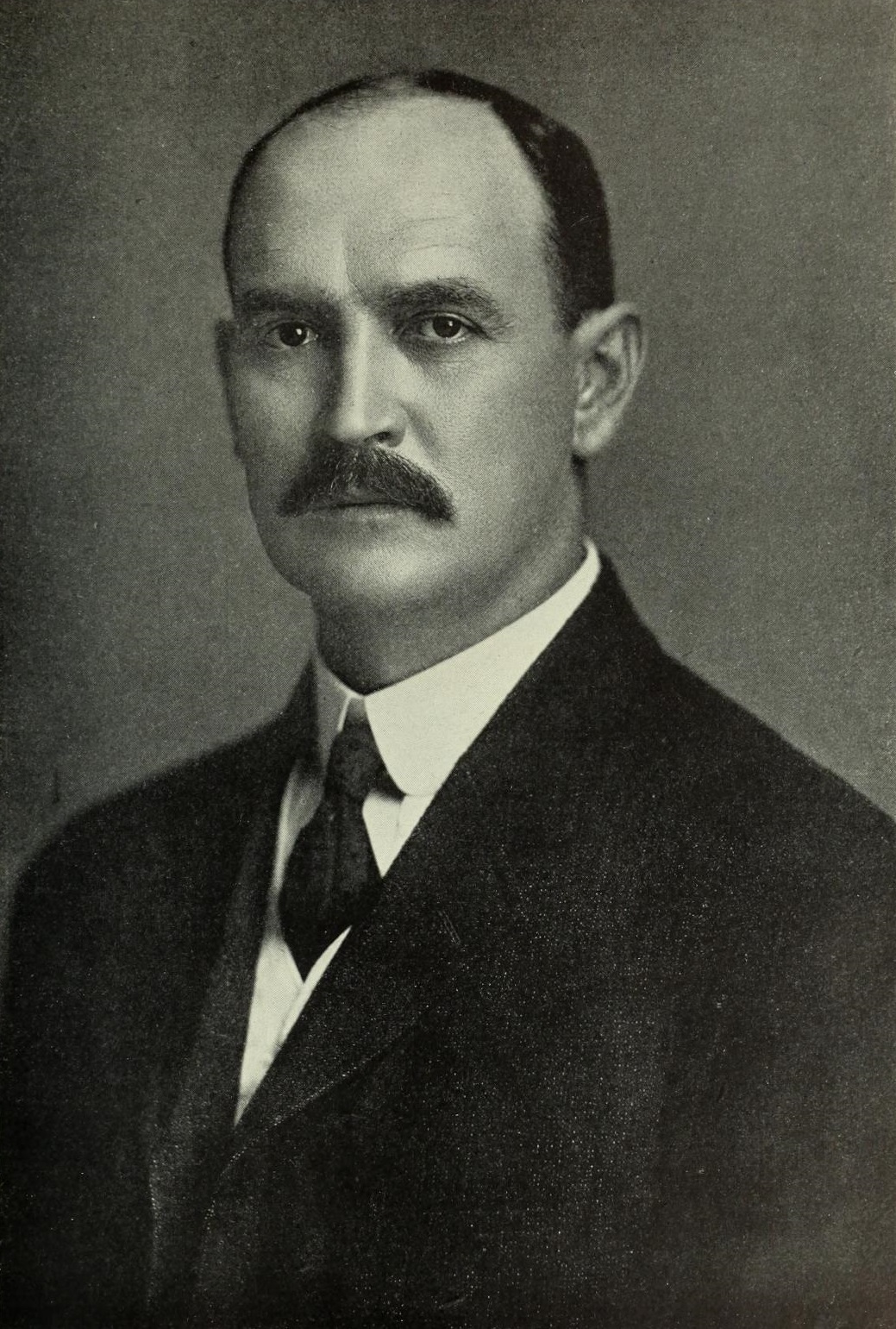
Historical · U.S. Department of Agriculture
David Franklin Houston
Former United States Secretary of Agriculture · U.S. Department of Agriculture · 1913–1920
David Franklin Houston served as United States Secretary of Agriculture (1913–1920). The page below collects sourced biographical facts, the appointment record, and provenance for Houston.
Key facts
- Full name
- David Franklin Houston
- Department
- U.S. Department of Agriculture
- Office
- United States Secretary of Agriculture
- Status
- Former secretary
- Appointment
- Senate-confirmed
- Tenure
- 1913–1920
- Confirmed
- —
- Born
- 1866
- Died
- 1940
- First year in office
- 1913
- Dataset version
- 1.20260703
Appointment & service record
United States Secretary of Agriculture · 1913–1920
- Department
- U.S. Department of Agriculture
- Appointment
- Senate-confirmed
- Appointing president
- —
- Confirmed
- —
Department, appointment type (Senate-confirmed, acting, recess, or designated), appointing president, confirmation status, and service dates are drawn from Wikidata and the White House Cabinet roster.[1][2][3]
Sources
- [1]https://www.wikidata.org/wiki/Q1174390Wikidata · retrieved 2026-07-03
- [2]https://www.whitehouse.gov/administration/cabinet/whitehouse.gov · retrieved 2026-07-03
- [3]https://www.wikidata.org/wiki/Q639738wikidata-cabinet · retrieved 2026-07-03
Biographical narrative
941 words · sourced from the Wikipedia REST extract
David Franklin Houston was a prominent American educator, administrator, and public servant who served as the United States Secretary of Agriculture from 1913 to 1920 under President Woodrow Wilson. Prior to his cabinet appointment, he held leadership positions at several major universities, most notably Texas A&M University, the University of Texas at Austin, and Washington University in St. Louis. After leaving federal office, Houston pursued a successful career in business, holding executive roles with Bell Telephone Securities, AT&T, and the Mutual Life Insurance Company of New York.
Early life and career
Born on February 17, 1866, in Monroe, North Carolina, David Franklin Houston was the son of William Henry Houston, who worked as a horse dealer and grocer, and Pamela Ann Stevens. He completed his undergraduate studies at the University of South Carolina, graduating with honors in 1887. In 1892 he earned a Master’s degree in political science from Harvard University.
Houston entered academia shortly after completing his graduate work. In 1894 he joined the faculty of the University of Texas at Austin as an adjunct professor of political science and was appointed dean of the faculty in 1899. His administrative acumen led to his appointment as president of the Agricultural and Mechanical College of Texas—now known as Texas A&M University—in 1902, a position he held until 1905. Returning to the University of Texas at Austin that same year, Houston served as its president through 1908, during which time the university expanded by adding a doctoral program and establishing a law school.
In 1908, after being recommended by Charles W. Eliot, then-president of Harvard University, Houston became chancellor of Washington University in St. Louis. His tenure at Washington University lasted until 1913. He oversaw the creation of the School of Architecture (which later became part of the Sam Fox School of Design & Visual Arts) and strengthened ties between the university’s medical school and local hospitals such as Children’s Hospital and Barnes Hospital.
Beyond his university leadership, Houston contributed to public service in other capacities. While serving under President William McKinley, he sat on the board of visitors for the United States Military Academy at West Point. In later years he served as an overseer for Harvard University and was a member of Columbia University's Board of Trustees.
Cabinet tenure
In 1913 President Woodrow Wilson appointed Houston to serve as the fifth Secretary of Agriculture. The Senate confirmed his nomination, and Houston held the office until 1920. During his tenure, several significant pieces of legislation were enacted that shaped U.S. agricultural policy. Among these were the Smith–Lever Act of 1914, the Federal Farm Loan Act, the Tobacco Inspection Act, and the Federal Aid Road Act of 1916. The Food and Fuel Control Act also shifted responsibility for food management to Herbert Hoover at the United States Food Administration; Hoover accepted that role on the condition that Houston would not interfere with his operations.
Following his service in agriculture, Houston was appointed Secretary of the Treasury in 1920, a position he held until 1921. As Treasury Secretary, he served ex officio as Chairman of the Federal Reserve Board and took an active role in shaping monetary policy during the post‑World War I period. He advocated for increased rediscount rates to curb inflationary pressures that were affecting European allies, while also predicting a decline in U.S. prices—particularly those of farm products—as wartime optimism faded. Houston pushed for easier credit conditions for farmers and encouraged them to reduce production levels in response to anticipated price falls.
The sharp drop in agricultural prices that occurred during 1920 led to criticism from farm spokesmen who accused Houston of deliberately undermining agrarian prosperity. Internationally, England and France were seeking to cancel war debts; however, Houston, the U.S. Congress, and President Wilson chose instead to convert short‑term debts into long‑term loans. He resigned from the Treasury at the conclusion of Wilson’s presidency after serving only one year in that role.
Throughout his cabinet service, Houston also promoted progressive initiatives aimed at improving rural life. He supported the development of personal credit unions, encouraged land settlement and farm ownership, and advocated for enhanced rural health and sanitation programs. His public statements emphasized the importance of a living wage for both farmers and industrial workers and called for orderly processes to advance social improvement.
Legacy
David Franklin Houston’s impact extended beyond his federal appointments into higher education, agriculture, finance, and business. In academia, he was instrumental in expanding academic offerings at Texas A&M University, the University of Texas at Austin, and Washington University in St. Louis, laying foundations that continue to influence those institutions today.
As Secretary of Agriculture, Houston oversaw a period of significant legislative activity that helped modernize U.S. agricultural policy during World War I. His brief tenure as Treasury Secretary placed him at the center of post‑war monetary policy debates, and his actions regarding the Federal Reserve Board and war debt restructuring had lasting implications for both domestic and international finance.
After leaving public office, Houston transitioned to a successful business career. He served as president of Bell Telephone Securities, vice president of AT&T, and director of several major corporations including U.S. Steel and the Guaranty Trust Company. For ten years he led the Mutual Life Insurance Company of New York as its president.
Houston passed away from a heart attack on September 2, 1940, at Columbia Presbyterian Medical Center in New York City. He was interred beside his wife at Saint John’s Church Cemetery in Laurel Hollow, New York. His life reflects a blend of academic leadership, public service, and corporate stewardship that contributed to the development of American institutions across multiple sectors.
Sources & provenance
Every quantitative or attributable claim above carries a per-section [N] marker that resolves to the corresponding URL below. Each entry records the upstream provider, the canonical URL, and the timestamp at which the underlying source was retrieved.
Key facts
- https://www.wikidata.org/wiki/Q1174390Wikidata · retrieved 2026-07-03
- https://www.whitehouse.gov/administration/cabinet/whitehouse.gov · retrieved 2026-07-03
- https://www.wikidata.org/wiki/Q639738wikidata-cabinet · retrieved 2026-07-03
Biographical narrative
- https://en.wikipedia.org/wiki/David_F._HoustonWikipedia · retrieved 2026-07-03
Explore the Cabinet
The Cabinet includes the Vice President and the heads of the 15 executive departments. Browse the full roster of current and former secretaries, or explore how the Cabinet fits into the federal government.