
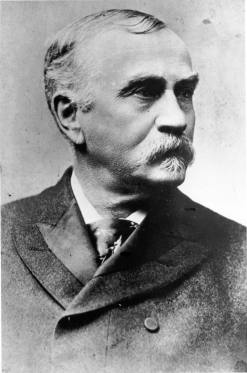
Historical · U.S. Department of Agriculture
Julius Sterling Morton
Former United States Secretary of Agriculture · U.S. Department of Agriculture · 1893–1897
Julius Sterling Morton served as United States Secretary of Agriculture (1893–1897). The page below collects sourced biographical facts, the appointment record, and provenance for Morton.
Key facts
- Full name
- Julius Sterling Morton
- Department
- U.S. Department of Agriculture
- Office
- United States Secretary of Agriculture
- Status
- Former secretary
- Appointment
- Senate-confirmed
- Tenure
- 1893–1897
- Confirmed
- —
- Born
- 1832
- Died
- 1902
- First year in office
- 1893
- Dataset version
- 1.20260703
Appointment & service record
United States Secretary of Agriculture · 1893–1897
- Department
- U.S. Department of Agriculture
- Appointment
- Senate-confirmed
- Appointing president
- —
- Confirmed
- —
Department, appointment type (Senate-confirmed, acting, recess, or designated), appointing president, confirmation status, and service dates are drawn from Wikidata and the White House Cabinet roster.[1][2][3]
Sources
- [1]https://www.wikidata.org/wiki/Q881135Wikidata · retrieved 2026-07-03
- [2]https://www.whitehouse.gov/administration/cabinet/whitehouse.gov · retrieved 2026-07-03
- [3]https://www.wikidata.org/wiki/Q639738wikidata-cabinet · retrieved 2026-07-03
Biographical narrative
1,203 words · sourced from the Wikipedia REST extract
Julius Sterling Morton was an American newspaper editor, territorial politician, and agriculturalist who served as the United States Secretary of Agriculture from 1893 to 1897 under President Grover Cleveland. Born in New York in 1832, he moved westward during his youth, establishing a career that spanned journalism, public office, and environmental advocacy. Morton is best remembered for founding Arbor Day in 1872, an initiative that promoted tree planting across the United States.
Early life and career
Julius Sterling Morton entered the world on April 22, 1832, in the town of Adams within Jefferson County, New York. His parents, Julius Dewey Morton and Emeline Sterling Morton, operated a general store in their community. Two years after his birth, the family relocated to Monroe, Michigan, situated south of Detroit along Lake Erie. In this new setting, Morton's grandfather, Abner Morton, together with his paternal uncle Edward, ran a local newspaper, exposing young Julius to the world of print and public discourse from an early age.
At fourteen, Morton was sent to Wesleyan Seminary in Albion, Michigan—a distance of roughly 100 miles (160 km) northwest—where he received a preparatory education. In 1850 he enrolled at the University of Michigan. While a junior student, he attempted to launch a periodical titled *Peninsular Quarterly and University Magazine*, though it was short-lived. Morton became an active member of the Chi Psi fraternity and opposed faculty efforts to discourage such secret societies.
A pivotal moment in his university years occurred in May 1854, when the Board of Regents dismissed Dr. J. Adams Allen, a popular medical department head. Morton, who admired Allen, addressed a mass meeting protesting the dismissal and other actions by university officials. The following day he was expelled from the institution on grounds of excessive absences and alleged neglect of academic duties. His expulsion sparked protests among students statewide. After signing a conditional statement that acknowledged potential fault if the charges were true, Morton was readmitted; however, the university later removed the conditionals, rendering the admission unconditional. Morton publicly retracted his earlier statement in an editorial for the *Detroit Free Press*, leading to a second expulsion. In 1856 he received an honorary Bachelor of Arts degree from Union College in Schenectady, New York, and in 1858 the University of Michigan reversed its earlier decision and awarded him a diploma.
In the fall of 1854, at the age of twenty‑two, Morton moved with his wife, Caroline Joy French, to the Nebraska Territory. He purchased 160 acres near Nebraska City and quickly became involved in local journalism by taking over as editor of the *Nebraska City News*. His editorial work coincided with a period of intense political conflict known as “Bleeding Kansas,” during which southeast Nebraska served as an important hub for abolitionist activity and the Underground Railroad. Morton used his positions to oppose what he described as “Black Republicans” in the territorial legislature, employing arguments that reflected the prevailing racial attitudes of the era.
Morton’s public service began with a brief tenure in the Nebraska Territorial House of Representatives from 1855 to 1856. On July 12, 1858, President James Buchanan appointed him Secretary of the Nebraska Territory—a role he held until 1861. During this period he also served as Acting Governor from December 5, 1858 to May 2, 1859. His tenure overlapped with the Civil War, during which he was a vocal critic of President Abraham Lincoln and expressed views that were later described by contemporaries as “copperhead” Democratic positions. Although he opposed secession, his stance on abolition and civil rights for Black Americans was strongly conservative.
In 1860 Morton sought election to the United States House of Representatives as Nebraska’s delegate. Initial reports declared him the winner by a narrow margin of fourteen votes, leading to the issuance of an election certificate by the territorial governor. However, months later, a superseding certificate favoring Republican abolitionist Samuel Gordon Daily was issued without proper procedural safeguards. The U.S. House reviewed the contested returns and ultimately determined that Daily had won by 150 votes, thereby preventing Morton from taking office.
After the war, Morton continued to influence Nebraska politics, particularly in opposition to Black civil rights. In 1897 he embarked on a project to edit the multi‑volume *Illustrated History of Nebraska* and launched a weekly periodical titled *The Conservative*, reflecting his enduring interest in political commentary.
Beyond politics, Morton cultivated a deep passion for agriculture and forestry. He owned a substantial estate near Arbor Lodge State Historical Park in Nebraska City, where he planted numerous rare tree varieties and heirloom apple trees. His fascination with trees culminated in the establishment of Arbor Day on April 10, 1872—a day dedicated to encouraging people across the nation to plant and care for trees. Morton also became known for opposing the use of healthy trees as Christmas decorations, advocating instead for more sustainable practices.
Cabinet tenure
Morton’s reputation as an agriculturalist and public servant led to his appointment as United States Secretary of Agriculture in 1893, serving under President Grover Cleveland until 1897. The Senate confirmed his nomination, though a specific confirmation date is not provided in the available records. During his four‑year tenure, Morton maintained a conservative approach to political, economic, and social issues within the department. He was noted for opposing agrarian movements that sought radical changes to agricultural policy.
Throughout his cabinet service, Morton continued to promote modern farming techniques and responsible forestry management. His background as an editor and politician informed his communication style, allowing him to articulate departmental goals to a broad audience. While in office, he upheld the department’s mission of supporting American agriculture, though specific legislative achievements or programmatic initiatives are not detailed in the available sources.
Legacy
Julius Sterling Morton left a multifaceted legacy that spans journalism, politics, and environmental stewardship. His founding of Arbor Day remains one of his most enduring contributions; the holiday has become an international tradition encouraging tree planting and ecological awareness. Morton's advocacy against cutting healthy trees for decorative purposes reflects an early recognition of sustainable resource use.
His personal estate, later expanded by his son Joy into a 52‑room mansion resembling the White House, is now part of Arbor Lodge State Historical Park. The park preserves Morton’s extensive collection of trees and apple varieties, serving as both a historical site and a living testament to his commitment to forestry.
Morton’s career also illustrates the complexities of American politics in the mid‑nineteenth century. As a territorial secretary and acting governor during the turbulent Bleeding Kansas era, he engaged with contentious issues surrounding slavery, civil rights, and statehood. His later opposition to Black civil rights after the Civil War underscores the prevailing attitudes within certain political circles of that time.
In the realm of agriculture, Morton’s tenure as Secretary reinforced the importance of federal oversight in supporting farmers and promoting modern agricultural practices. Though specific policy outcomes from his cabinet service are not enumerated here, his leadership helped shape the department during a period of significant growth and change.
Overall, Julius Sterling Morton is remembered for his pioneering efforts to integrate environmental consciousness into public life, his steadfast involvement in Nebraska’s early governance, and his role in shaping national agricultural policy at the turn of the twentieth century.
Sources & provenance
Every quantitative or attributable claim above carries a per-section [N] marker that resolves to the corresponding URL below. Each entry records the upstream provider, the canonical URL, and the timestamp at which the underlying source was retrieved.
Key facts
- https://www.wikidata.org/wiki/Q881135Wikidata · retrieved 2026-07-03
- https://www.whitehouse.gov/administration/cabinet/whitehouse.gov · retrieved 2026-07-03
- https://www.wikidata.org/wiki/Q639738wikidata-cabinet · retrieved 2026-07-03
Biographical narrative
- https://en.wikipedia.org/wiki/Julius_Sterling_MortonWikipedia · retrieved 2026-07-03
Explore the Cabinet
The Cabinet includes the Vice President and the heads of the 15 executive departments. Browse the full roster of current and former secretaries, or explore how the Cabinet fits into the federal government.