
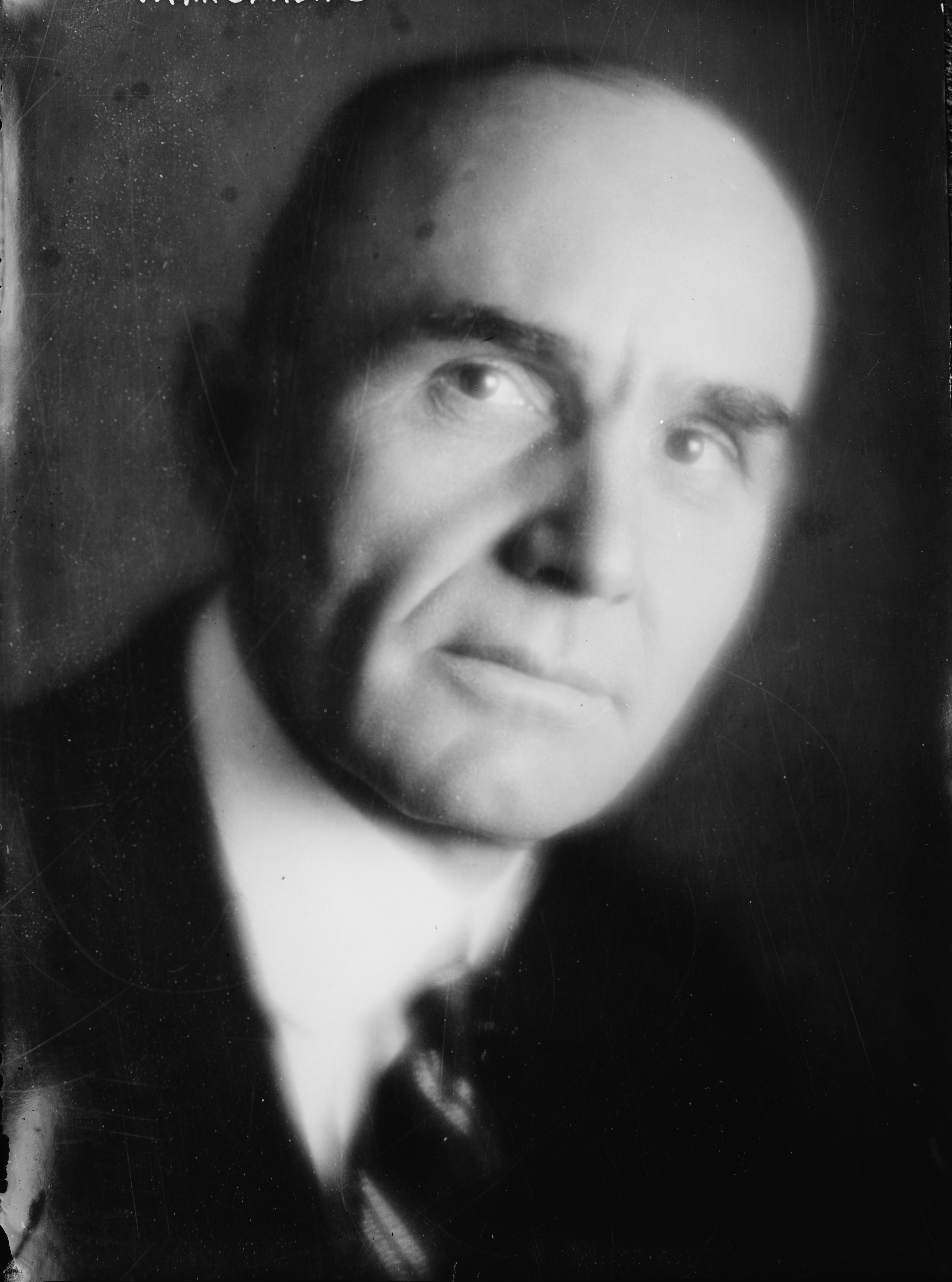
Historical · U.S. Department of Agriculture
William Marion Jardine
Former United States Secretary of Agriculture · U.S. Department of Agriculture · 1925–1929
William Marion Jardine served as United States Secretary of Agriculture (1925–1929). The page below collects sourced biographical facts, the appointment record, and provenance for Jardine.
Key facts
- Full name
- William Marion Jardine
- Department
- U.S. Department of Agriculture
- Office
- United States Secretary of Agriculture
- Status
- Former secretary
- Appointment
- Senate-confirmed
- Tenure
- 1925–1929
- Confirmed
- —
- Born
- 1879
- Died
- 1955
- First year in office
- 1925
- Dataset version
- 1.20260703
Appointment & service record
United States Secretary of Agriculture · 1925–1929
- Department
- U.S. Department of Agriculture
- Appointment
- Senate-confirmed
- Appointing president
- —
- Confirmed
- —
Department, appointment type (Senate-confirmed, acting, recess, or designated), appointing president, confirmation status, and service dates are drawn from Wikidata and the White House Cabinet roster.[1][2][3]
Sources
- [1]https://www.wikidata.org/wiki/Q464480Wikidata · retrieved 2026-07-03
- [2]https://www.whitehouse.gov/administration/cabinet/whitehouse.gov · retrieved 2026-07-03
- [3]https://www.wikidata.org/wiki/Q639738wikidata-cabinet · retrieved 2026-07-03
Biographical narrative
863 words · sourced from the Wikipedia REST extract
William Marion Jardine (January 16, 1879 – January 17, 1955) was an American educator and public servant who held several prominent positions in the United States government and higher education. He served as the seventh President of Kansas State University, was appointed by President Calvin Coolidge to lead the U.S. Department of Agriculture from 1925 to 1929, and later represented the United States as Minister to Egypt during the Hoover administration. His career spanned academia, federal service, and diplomatic work, reflecting a lifelong commitment to agricultural science and education.
Early life and career
Jardine was born in Oneida County, Idaho, to parents Rebecca and William Jardine. He pursued his undergraduate studies at Utah Agricultural College—now known as Utah State University—in Logan, Utah, earning a Bachelor of Science degree. In 1905 he married Effie Lane Nebeker on September 6; the couple would have three children together. The following year, in 1906, Jardine attended graduate school at the University of Illinois at Urbana‑Champaign.
His professional interests combined practical farming with educational outreach. Jardine began his teaching career in Utah, where he quickly advanced to a professorship in agronomy. In 1910 he relocated to Manhattan, Kansas, accepting a position as an agronomist at what was then Kansas State Agricultural College (now Kansas State University). Three years later, in 1913, he was appointed dean of the Division of Agriculture and simultaneously served as Director of the Agriculture Experiment Station.
On March 1, 1918, Jardine became the seventh President of Kansas State University. He held that office until February 28, 1925, when Francis D. Farrell succeeded him. During his presidency, Jardine authored several instructional handbooks aimed at improving practical agricultural education for city youth, including a guide on the care and handling of work horses, farm machinery, dairy cows, and milk production. His leadership helped extend the university’s reputation beyond Kansas, positioning it as a national model for agricultural instruction.
After leaving Kansas State University, Jardine continued to influence higher education. In 1933 he was appointed President of the Municipal University of Wichita—now Wichita State University—by the Kansas State Treasurer. He took office on October 3, 1933 and served in that capacity until 1949. Throughout his academic career, Jardine remained active in professional societies; he was a member of the Freemasons, Rotary International, Alpha Zeta, Beta Theta Pi, Phi Kappa Phi, and Sigma Xi.
Cabinet tenure
President Calvin Coolidge nominated Jardine to serve as United States Secretary of Agriculture on March 5, 1925. The Senate confirmed his appointment, and he assumed office later that year. Jardine’s term lasted until 1929, during which time he oversaw the federal department responsible for national agricultural policy, research, and rural development. His background in agronomy and university administration informed his approach to managing the department’s scientific programs and educational outreach.
When the Coolidge administration concluded on March 4, 1929, Jardine remained a respected figure within the Department of Agriculture. In October 1930, President Herbert Hoover appointed him as United States Minister to Egypt. He served in that diplomatic role until September 5, 1933, representing American interests and fostering bilateral relations during a period of significant political change in Egypt.
After completing his service abroad, Jardine returned to Kansas and resumed his involvement with higher education, leading the Municipal University of Wichita for sixteen years before retiring from public life. His career bridged academia, federal administration, and diplomacy, illustrating a broad engagement with agricultural science and policy at multiple levels of government.
Legacy
William Marion Jardine’s legacy is most evident in his contributions to agricultural education and federal agricultural governance. As President of Kansas State University, he expanded the institution’s curriculum and research capabilities, producing practical training materials that benefited students and teachers alike. His tenure helped establish the university as a leading center for agronomic study, influencing teaching methods across the United States.
In his role as Secretary of Agriculture, Jardine oversaw a department tasked with supporting farmers, advancing agricultural science, and ensuring food security. While specific policy initiatives from his term are not detailed in available records, his leadership during the mid‑1920s helped shape the direction of national agricultural research and extension programs. His subsequent diplomatic service in Egypt further demonstrated his capacity to represent American interests abroad, particularly in regions where agriculture played a central role in economic development.
Jardine’s post‑government career at Wichita State University continued to emphasize educational excellence and institutional growth. He guided the university through its formative years, laying foundations that would support future expansions of academic programs and research facilities.
Beyond his professional accomplishments, Jardine was recognized for his civic engagement. His membership in organizations such as the Freemasons, Rotary International, and various honor societies reflected a commitment to community service and intellectual fellowship. The preservation of his papers at Wichita State University ensures that scholars can access primary documents related to his work in agriculture, education, and diplomacy.
William Marion Jardine passed away on January 17, 1955, in San Antonio, Texas. He was interred at Logan City Cemetery in Logan, Utah. His life’s work—spanning university leadership, federal administration, and international representation—continues to be cited by historians studying the development of American agricultural policy and higher education during the early twentieth century.
Sources & provenance
Every quantitative or attributable claim above carries a per-section [N] marker that resolves to the corresponding URL below. Each entry records the upstream provider, the canonical URL, and the timestamp at which the underlying source was retrieved.
Key facts
- https://www.wikidata.org/wiki/Q464480Wikidata · retrieved 2026-07-03
- https://www.whitehouse.gov/administration/cabinet/whitehouse.gov · retrieved 2026-07-03
- https://www.wikidata.org/wiki/Q639738wikidata-cabinet · retrieved 2026-07-03
Biographical narrative
- https://en.wikipedia.org/wiki/William_Marion_JardineWikipedia · retrieved 2026-07-03
Explore the Cabinet
The Cabinet includes the Vice President and the heads of the 15 executive departments. Browse the full roster of current and former secretaries, or explore how the Cabinet fits into the federal government.