
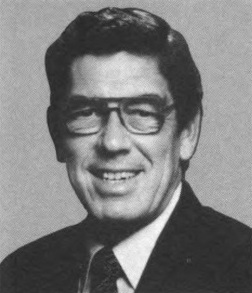
Historical · U.S. Department of Commerce
Bud Brown
Acting
Former Acting United States Secretary of Commerce · U.S. Department of Commerce · 1987–1987
Bud Brown served as Acting United States Secretary of Commerce (1987–1987). The page below collects sourced biographical facts, the appointment record, and provenance for Brown.
Key facts
- Full name
- Bud Brown
- Department
- U.S. Department of Commerce
- Office
- United States Secretary of Commerce
- Status
- Former secretary
- Appointment
- Acting
- Tenure
- 1987–1987
- Confirmed
- —
- Born
- 1927
- Died
- 2022
- First year in office
- 1987
- Dataset version
- 1.20260704
Appointment & service record
United States Secretary of Commerce · 1987–1987
- Department
- U.S. Department of Commerce
- Appointment
- Acting
- Appointing president
- —
- Confirmed
- Not confirmed
Department, appointment type (Senate-confirmed, acting, recess, or designated), appointing president, confirmation status, and service dates are drawn from Wikidata and the White House Cabinet roster.[1][2][3]
Sources
- [1]https://www.wikidata.org/wiki/Q4983802Wikidata · retrieved 2026-07-04
- [2]https://www.whitehouse.gov/administration/cabinet/whitehouse.gov · retrieved 2026-07-04
- [3]https://www.wikidata.org/wiki/Q639738wikidata-cabinet · retrieved 2026-07-04
Biographical narrative
899 words · sourced from the Wikipedia REST extract
Bud Brown was a prominent American public servant and businessman whose career spanned more than five decades. Born into a family with deep roots in journalism and politics, he served as a long‑term member of the United States House of Representatives from Ohio’s Seventh District, later holding senior positions within the Department of Commerce during the Reagan administration. In addition to his federal service, Brown was president and chairman of a newspaper chain that operated for nearly a century, and he remained active in civic organizations after leaving office.
Early life and career
Clarence James “Bud” Brown Jr. entered the world on June 18, 1927, in Columbus, Ohio. His parents were Ethel (née McKinney) and Clarence J. Brown, who would later become a United States Representative himself. Growing up in Washington, D.C., Bud attended Western High School before pursuing higher education at Duke University, from which he graduated in 1947. He continued his studies at Harvard Business School, earning a Master of Business Administration degree in 1949.
Brown’s early adulthood was marked by military service. He joined the United States Navy as part of the V‑12 Navy College Training Program during World War II, serving from 1944 to 1946. After completing his undergraduate and graduate studies, he returned to naval duty for a second tour that spanned the Korean War years, from 1950 to 1953.
While still in school and early in his military career, Brown began working with his father’s family‑owned publishing enterprise, the Brown Publishing Company. He remained involved with the company from a young age through 1953, and after a brief period away, he resumed full participation in 1957, continuing until 2010. The firm operated a network of newspapers across the United States; during its final years it faced challenges brought about by rapid technological changes in media.
In the late 1950s and early 1960s, the Brown family relocated to Urbana, Ohio—approximately ninety miles north of Cincinnati—where the company’s headquarters were situated. From 1965 to 1976, Bud Brown served as president of the publishing firm, later assuming the role of chairman on its board.
Brown entered elective office following a special election that filled the vacancy left by his father’s death in 1965. He represented Ohio’s Seventh Congressional District for eight consecutive terms, serving from November 2, 1965, to January 3, 1983. During this period he also participated as a delegate at several Republican National Conventions (1968, 1972, 1976, and 1984), reflecting his engagement in national party affairs.
In 1982, Brown chose not to seek reelection to the House and instead pursued the governorship of Ohio. His campaign was ultimately unsuccessful, with Dick Celeste winning the election. After this statewide bid, Brown returned to federal service under President Ronald Reagan.
Cabinet tenure
President Reagan appointed Bud Brown as Deputy Secretary of Commerce in 1983, a position he held until 1988. In that capacity he served as the principal assistant to the Secretary and was responsible for overseeing various administrative functions within the department. During his tenure, Brown also stepped into the role of Acting United States Secretary of Commerce in 1987, assuming the department’s leadership responsibilities on an interim basis.
Following his departure from the Department of Commerce, Brown continued to contribute to public service through appointments on federal boards and nonprofit organizations. He served on the board of the Overseas Private Investment Corporation from 1988 to 1989, a federal agency that facilitated investment in foreign markets. Later, he became president and chief executive officer of the United States Capitol Historical Society between 1992 and 1999, where he oversaw efforts to preserve and interpret the history of the nation’s legislative branch.
Legacy
Bud Brown’s career reflects a blend of public service, business leadership, and civic engagement that left lasting impressions on several sectors. In Congress, his long tenure provided continuity for Ohio’s Seventh District, and his decision to run for governor demonstrated a willingness to seek higher office in pursuit of broader state interests. His subsequent federal appointments under the Reagan administration placed him at the heart of commerce policy during a period marked by significant economic transformation.
Brown’s influence extended beyond politics into the realm of journalism. As president and later chairman of the Brown Publishing Company, he guided a newspaper chain that had been a staple of local media for nearly nine decades. The company ultimately ceased operations in 2010, closing a chapter on a family legacy that had begun in the early twentieth century.
In addition to his professional endeavors, Brown’s personal life was rooted in Urbana, Ohio, where he lived with his wife, Joyce Helen (née Eldridge), whom he married on June 11, 1955. The couple raised four children—Beth, Clancy, Cathy, and Roy—who continued aspects of the family’s involvement in publishing and public affairs.
Bud Brown passed away at home in Urbana on January 26, 2022, at the age of 94. His death was attributed to complications arising from COVID‑19. The loss of a figure who had served at both local and national levels resonated within Ohio and beyond, prompting reflections on his contributions to public life.
Through his legislative service, executive leadership in commerce, stewardship of a longstanding family business, and participation in historical preservation efforts, Bud Brown exemplified a commitment to civic duty that spanned multiple generations. His legacy endures in the institutions he helped shape and in the public records that chronicle his decades of service.
Sources & provenance
Every quantitative or attributable claim above carries a per-section [N] marker that resolves to the corresponding URL below. Each entry records the upstream provider, the canonical URL, and the timestamp at which the underlying source was retrieved.
Key facts
- https://www.wikidata.org/wiki/Q4983802Wikidata · retrieved 2026-07-04
- https://www.whitehouse.gov/administration/cabinet/whitehouse.gov · retrieved 2026-07-04
- https://www.wikidata.org/wiki/Q639738wikidata-cabinet · retrieved 2026-07-04
Biographical narrative
- https://en.wikipedia.org/wiki/Bud_Brown_(politician)Wikipedia · retrieved 2026-07-04
Explore the Cabinet
The Cabinet includes the Vice President and the heads of the 15 executive departments. Browse the full roster of current and former secretaries, or explore how the Cabinet fits into the federal government.