
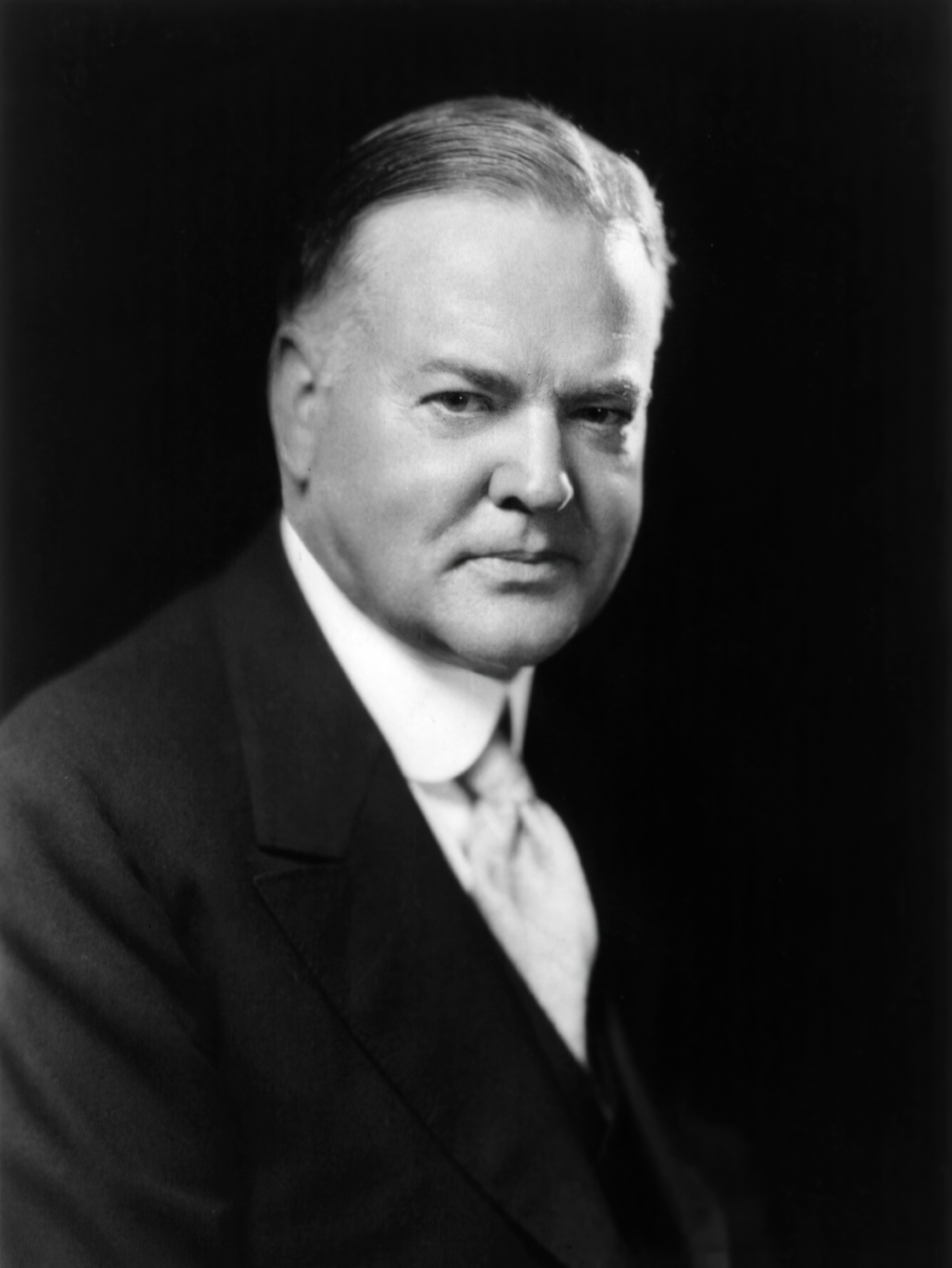
Historical · U.S. Department of Commerce
Herbert Hoover
Former United States Secretary of Commerce · U.S. Department of Commerce · 1921–1928
Herbert Hoover served as United States Secretary of Commerce (1921–1928). The page below collects sourced biographical facts, the appointment record, and provenance for Hoover.
Key facts
- Full name
- Herbert Hoover
- Department
- U.S. Department of Commerce
- Office
- United States Secretary of Commerce
- Status
- Former secretary
- Appointment
- Senate-confirmed
- Tenure
- 1921–1928
- Confirmed
- —
- Born
- 1874
- Died
- 1964
- First year in office
- 1921
- Dataset version
- 1.20260703
Appointment & service record
United States Secretary of Commerce · 1921–1928
- Department
- U.S. Department of Commerce
- Appointment
- Senate-confirmed
- Appointing president
- —
- Confirmed
- —
Department, appointment type (Senate-confirmed, acting, recess, or designated), appointing president, confirmation status, and service dates are drawn from Wikidata and the White House Cabinet roster.[1][2][3]
Sources
- [1]https://www.wikidata.org/wiki/Q35236Wikidata · retrieved 2026-07-03
- [2]https://www.whitehouse.gov/administration/cabinet/whitehouse.gov · retrieved 2026-07-03
- [3]https://www.wikidata.org/wiki/Q639738wikidata-cabinet · retrieved 2026-07-03
Biographical narrative
870 words · sourced from the Wikipedia REST extract
Herbert Clark Hoover served as the United States Secretary of Commerce from 1921 until 1928, a period during which he was confirmed by the Senate and worked under Presidents Warren G. Harding and Calvin Coolidge. His tenure is noted for an unusually active presence within the cabinet, significant involvement in the expansion of air travel and radio technology, and leadership of the federal response to the Great Mississippi Flood of 1927. Prior to his appointment, Hoover had built a career as a mining engineer and businessman, and he later became President of the United States from 1929 to 1933.
Early life and career
Herbert Clark Hoover was born on August 10, 1874, in West Branch, Iowa, into a family that practiced Quakerism. His father, Jesse Hoover, worked as a blacksmith and ran a farm implement store; his mother, Hulda Randall Minthorn, had been raised in Ontario before moving to Iowa. The family’s religious background played a prominent role in the community, with Mrs. Hoover actively involved in local church life.
The death of both parents left young Herbert orphaned at a very early age. After his father died in 1880 and his mother followed four years later, he lived for a time with his uncle Allen Hoover on a nearby farm. In November 1885, he was sent to Newberg, Oregon, where another uncle, John Minthorn—a physician and businessman—provided an environment that emphasized education and work ethic. Although the household was described as cultured, Herbert reportedly resisted many of the chores assigned to him.
He attended Friends Pacific Academy (now George Fox University) but left school at thirteen to take a position in his uncle’s real estate office in Salem, Oregon. While he did not complete high school, he acquired practical skills such as bookkeeping, typing, and mathematics through night classes.
In 1891, Hoover entered Stanford University as part of its inaugural freshman class. He initially pursued mechanical engineering but shifted to geology after working with the department chair, John Casper Branner. During his time at Stanford, he co‑founded a student cooperative boarding house in Romero Hall, an effort aimed at fostering community and economic efficiency. His academic performance was described as moderate; much of his attention was directed toward part‑time employment and campus activities.
After graduating from Stanford, Hoover entered the mining industry. He worked for a London‑based company that operated mines in Australia and China, where he gained experience as an engineer and businessman. Over time, he accumulated significant wealth through these ventures.
The outbreak of World War I marked a turning point in his career. In 1914, Hoover organized and led the Commission for Relief in Belgium, an international effort to supply food to the occupied country. When the United States entered the war in 1917, President Woodrow Wilson appointed him to head the U.S. Food Administration, a role that earned him the moniker “food dictator.” After the war, he directed the American Relief Administration, which provided aid to millions of starving people across Central and Eastern Europe, with a particular focus on Russia.
Cabinet tenure
In 1921, President Warren G. Harding appointed Hoover as Secretary of Commerce. The Senate confirmed his nomination, allowing him to assume office in that capacity. He continued to serve under President Calvin Coolidge after Harding’s death, maintaining the position until 1928.
During his time in the cabinet, Hoover was known for a high level of visibility and activity. His influence extended beyond commerce; he was often described as functioning as an “under‑secretary” to other departments, reflecting his involvement in various policy areas. He played a notable role in advancing air travel and radio technology, helping to shape federal support for these emerging industries.
One of the most significant events during Hoover’s tenure occurred in 1927 when the Great Mississippi Flood devastated large portions of the United States. As Secretary of Commerce, he led the federal response to this disaster, coordinating resources and relief efforts across multiple agencies.
Hoover’s experience in humanitarian work and his business background informed his approach to commerce policy. He emphasized efficiency, coordination among government entities, and support for technological innovation during a period of rapid industrial growth.
Legacy
Herbert Clark Hoover’s service as Secretary of Commerce set precedents for the role of cabinet officials in overseeing national economic development. His active participation across multiple departments demonstrated an expanded scope for secretaries beyond their nominal portfolios. The initiatives he championed—particularly in air travel and radio—contributed to the United States’ emergence as a leader in these fields during the early twentieth century.
The federal response to the Great Mississippi Flood of 1927, coordinated under his leadership, is often cited as an example of effective disaster management at the national level. The experience gained from this event informed subsequent policies related to emergency preparedness and interagency cooperation.
After leaving the cabinet in 1928, Hoover continued to serve the nation in various capacities, eventually becoming President of the United States. His long public service career, which spanned from the early days of his mining work through his later humanitarian efforts, left a lasting imprint on American governance and international aid practices. Hoover passed away on October 20, 1964, concluding a life marked by extensive public service across multiple domains.
Sources & provenance
Every quantitative or attributable claim above carries a per-section [N] marker that resolves to the corresponding URL below. Each entry records the upstream provider, the canonical URL, and the timestamp at which the underlying source was retrieved.
Key facts
- https://www.wikidata.org/wiki/Q35236Wikidata · retrieved 2026-07-03
- https://www.whitehouse.gov/administration/cabinet/whitehouse.gov · retrieved 2026-07-03
- https://www.wikidata.org/wiki/Q639738wikidata-cabinet · retrieved 2026-07-03
Biographical narrative
- https://en.wikipedia.org/wiki/Herbert_HooverWikipedia · retrieved 2026-07-03
Explore the Cabinet
The Cabinet includes the Vice President and the heads of the 15 executive departments. Browse the full roster of current and former secretaries, or explore how the Cabinet fits into the federal government.