
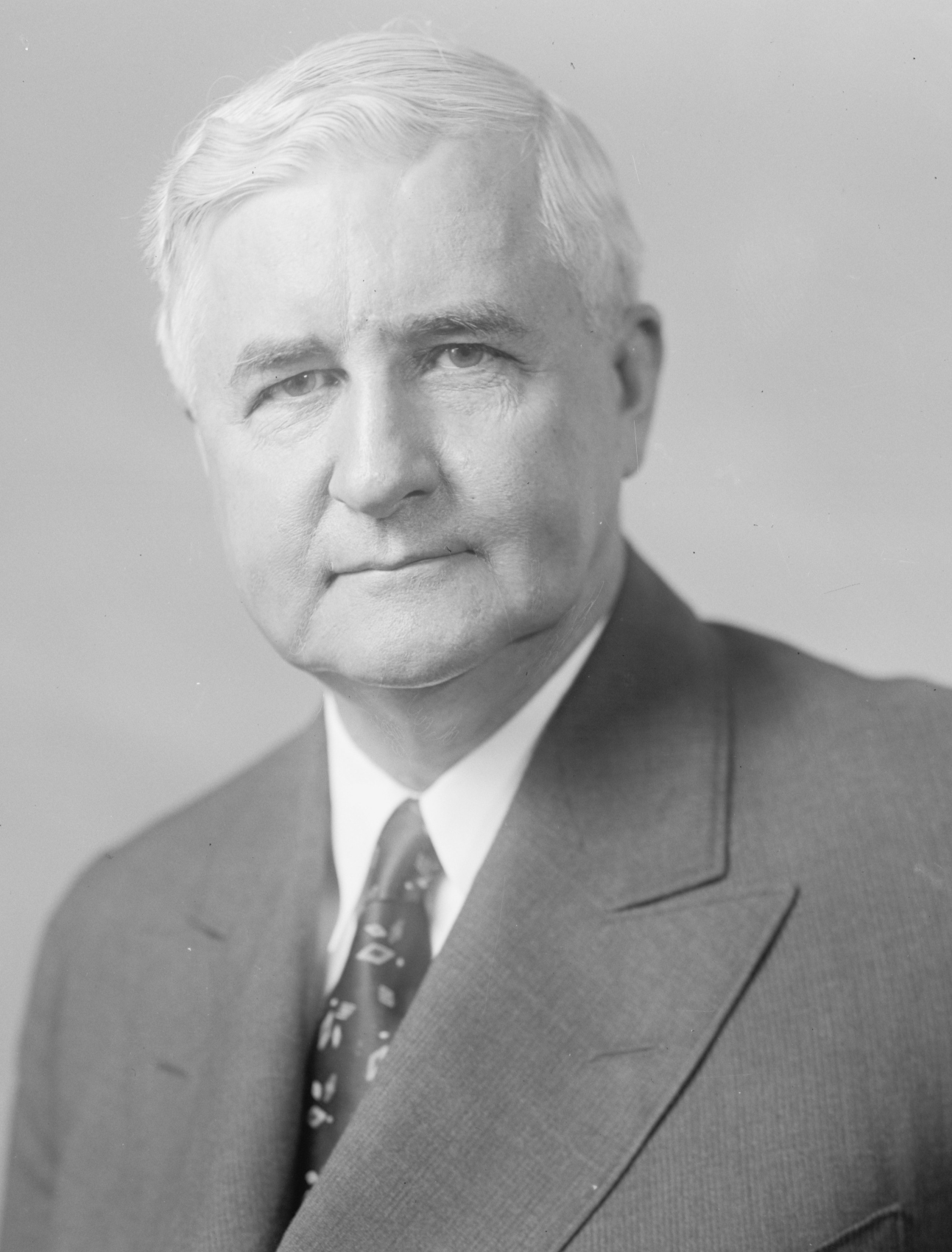
Historical · U.S. Department of Commerce
Jesse H. Jones
Former United States Secretary of Commerce · U.S. Department of Commerce · 1940–1945
Jesse H. Jones served as United States Secretary of Commerce (1940–1945). The page below collects sourced biographical facts, the appointment record, and provenance for Jones.
Key facts
- Full name
- Jesse H. Jones
- Department
- U.S. Department of Commerce
- Office
- United States Secretary of Commerce
- Status
- Former secretary
- Appointment
- Senate-confirmed
- Tenure
- 1940–1945
- Confirmed
- —
- Born
- 1874
- Died
- 1956
- First year in office
- 1940
- Dataset version
- 1.20260703
Appointment & service record
United States Secretary of Commerce · 1940–1945
- Department
- U.S. Department of Commerce
- Appointment
- Senate-confirmed
- Appointing president
- —
- Confirmed
- —
Department, appointment type (Senate-confirmed, acting, recess, or designated), appointing president, confirmation status, and service dates are drawn from Wikidata and the White House Cabinet roster.[1][2][3]
Sources
- [1]https://www.wikidata.org/wiki/Q1511130Wikidata · retrieved 2026-07-03
- [2]https://www.whitehouse.gov/administration/cabinet/whitehouse.gov · retrieved 2026-07-03
- [3]https://www.wikidata.org/wiki/Q639738wikidata-cabinet · retrieved 2026-07-03
Biographical narrative
815 words · sourced from the Wikipedia REST extract
Jesse Holman Jones (April 5 1874 – June 1 1956) was an American businessman and public servant who played a pivotal role in the economic development of Texas and the United States during the first half of the twentieth century. Beginning his career as a young entrepreneur in the lumber industry, he expanded into real estate, banking, and civic projects that shaped Houston’s growth. In federal service, Jones chaired the Reconstruction Finance Corporation and served concurrently as Secretary of Commerce from 1940 to 1945, positions that placed him at the center of national economic policy during the Great Depression and World War II. After leaving Washington, he devoted much of his later life to philanthropy through the Houston Endowment, supporting education, health care, and the arts.
Early life and career
Jesse Holman Jones was born on April 5 1874 in Robertson County, Tennessee, the fourth child of William and Laura Jones. His family’s ancestry traced back to Welsh settlers who had arrived in Virginia in the mid‑seventeenth century before moving northward to North Carolina and eventually westward into Tennessee. Growing up on a farm that cultivated tobacco among other crops, Jones was exposed early to agricultural production and the labor required to manage such an enterprise.
At the age of fourteen, Jones began working at a tobacco factory in Tennessee, gaining experience in manufacturing processes and industrial operations. By nineteen, he had assumed responsibility for his uncle M. T. Jones’s lumberyards, overseeing daily activities and learning the intricacies of timber commerce. When his uncle died five years later, Jones relocated to Houston, Texas, to administer the estate and establish his own business ventures.
In Houston, he founded the South Texas Lumber Company, which quickly expanded as part of a broader portfolio that included real estate development, commercial building projects, and banking interests. His construction activities encompassed mid‑rise office buildings, skyscrapers, hotels, apartments, and movie theaters. A notable project was the Foster Building, which housed the Houston Chronicle; Jones exchanged ownership of this structure for a fifty‑percent share in the newspaper, eventually gaining full control in 1926.
Jones’s civic engagement extended beyond business. He became involved with the Port of Houston and the development of the Houston Ship Channel, leading a consortium of local bankers to purchase public finance bonds that facilitated infrastructure improvements. His leadership earned him appointment as Chair of the Houston Harbor Board, where he oversaw operations and strategic planning for the port.
During World War I, Jones organized fundraising efforts for the American Red Cross in support of servicemen. President Woodrow Wilson appointed him to head a division of the organization from 1917 to 1919, a role that broadened his experience in national service. In 1928, he initiated and coordinated Houston’s bid to host the Democratic National Convention, demonstrating his continued involvement in political and civic affairs.
Cabinet tenure
Jones entered federal service in 1932 when President Herbert Hughes appointed him to the board of the Reconstruction Finance Corporation (RFC), a federal agency created to provide financial support during the Great Depression. The following year, President Franklin D. Roosevelt expanded the RFC’s mandate and promoted Jones to its chairmanship. In this capacity, he oversaw disbursements totaling approximately $50 billion, with a focus on financing railways and munitions factories that were essential for wartime production.
From 1940 until 1945, Jones served as United States Secretary of Commerce while retaining his role as RFC chair. The combination of these positions granted him significant influence over national economic policy during the early years of World War II. His tenure was noted for coordinating industrial expansion and managing commerce-related federal programs. President Roosevelt referred to him informally with a nickname that reflected his prominence within the administration.
Legacy
After concluding his service in Washington, Jones returned to Houston where he and his wife Mary devoted themselves to philanthropic endeavors through the Houston Endowment, a non‑profit corporation they founded in 1937. The foundation’s giving was largely directed toward Texas but also extended to Tennessee and Massachusetts. A substantial portion of their charitable contributions supported educational institutions; notable gifts included funding for a business school at Texas Southern University and the establishment of Jones College at Rice University.
In addition to education, the Endowment provided significant support to hospitals and cultural organizations. Numerous buildings in Houston bear Jones’s name, commemorating his impact on the city’s infrastructure and civic life. Among these is Jones Hall, a prominent music venue located in downtown Houston that continues to serve as a center for performing arts.
Jones passed away on June 1 1956 at the age of 82. His career spanned entrepreneurship, public service, and philanthropy, leaving a lasting imprint on both local and national stages. The breadth of his activities—from lumber and real estate development in Texas to federal economic leadership during critical periods—underscores a legacy characterized by business acumen, civic responsibility, and generous support for community institutions.
Sources & provenance
Every quantitative or attributable claim above carries a per-section [N] marker that resolves to the corresponding URL below. Each entry records the upstream provider, the canonical URL, and the timestamp at which the underlying source was retrieved.
Key facts
- https://www.wikidata.org/wiki/Q1511130Wikidata · retrieved 2026-07-03
- https://www.whitehouse.gov/administration/cabinet/whitehouse.gov · retrieved 2026-07-03
- https://www.wikidata.org/wiki/Q639738wikidata-cabinet · retrieved 2026-07-03
Biographical narrative
- https://en.wikipedia.org/wiki/Jesse_H._JonesWikipedia · retrieved 2026-07-03
Explore the Cabinet
The Cabinet includes the Vice President and the heads of the 15 executive departments. Browse the full roster of current and former secretaries, or explore how the Cabinet fits into the federal government.