
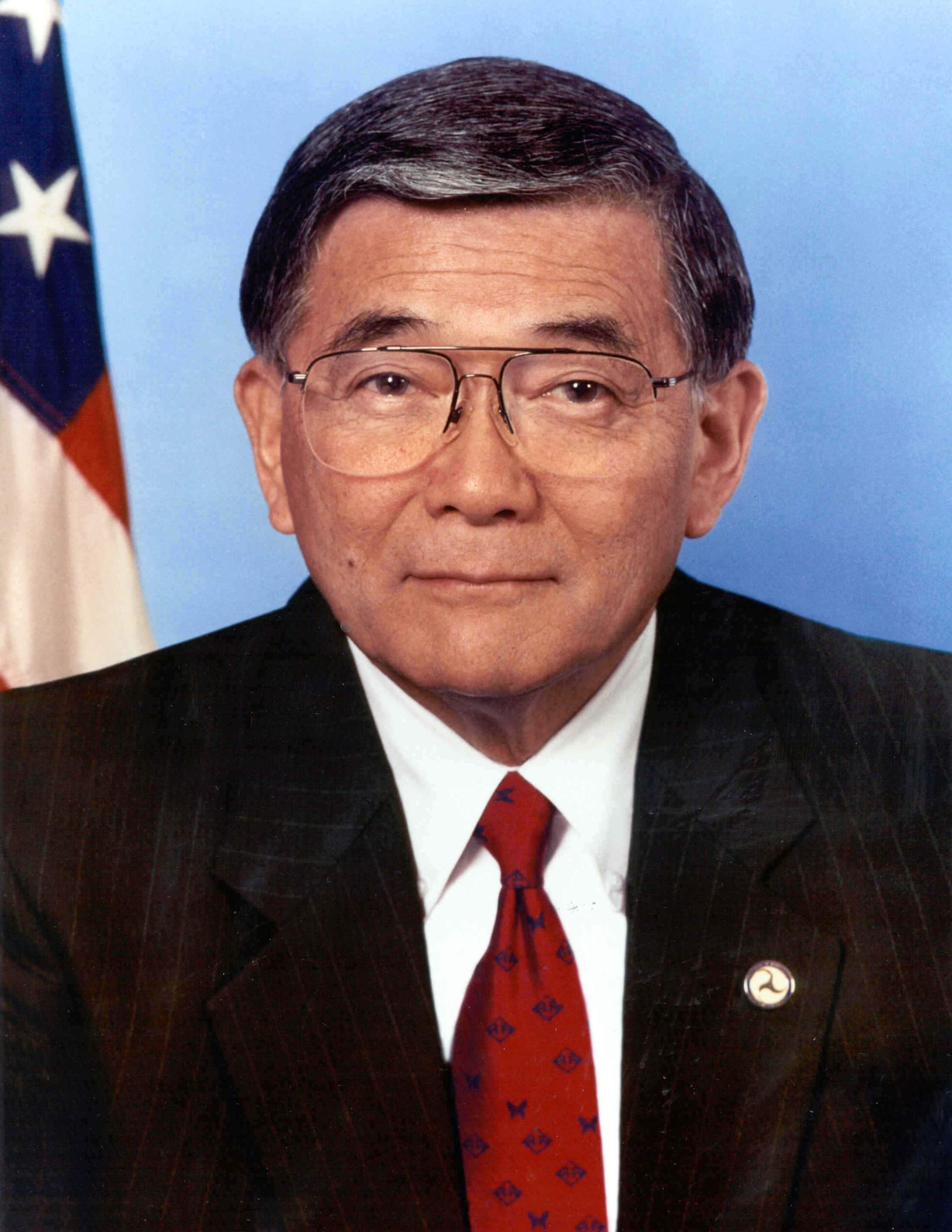
Historical · U.S. Department of Commerce
Norman Mineta
Former United States Secretary of Commerce · U.S. Department of Commerce · 2000–2001
Norman Mineta served as United States Secretary of Commerce (2000–2001). The page below collects sourced biographical facts, the appointment record, and provenance for Mineta.
Key facts
- Full name
- Norman Mineta
- Department
- U.S. Department of Commerce
- Office
- United States Secretary of Commerce
- Status
- Former secretary
- Appointment
- Senate-confirmed
- Tenure
- 2000–2001
- Confirmed
- —
- Born
- 1931
- Died
- 2022
- First year in office
- 2000
- Dataset version
- 1.20260703
Appointment & service record
United States Secretary of Commerce · 2000–2001
- Department
- U.S. Department of Commerce
- Appointment
- Senate-confirmed
- Appointing president
- —
- Confirmed
- —
Department, appointment type (Senate-confirmed, acting, recess, or designated), appointing president, confirmation status, and service dates are drawn from Wikidata and the White House Cabinet roster.[1][2][3]
Sources
- [1]https://www.wikidata.org/wiki/Q553502Wikidata · retrieved 2026-07-03
- [2]https://www.whitehouse.gov/administration/cabinet/whitehouse.gov · retrieved 2026-07-03
- [3]https://www.wikidata.org/wiki/Q639738wikidata-cabinet · retrieved 2026-07-03
Biographical narrative
926 words · sourced from the Wikipedia REST extract
Norman Yoshio Mineta was an American public servant whose career spanned local, federal legislative, and executive roles over more than five decades. Born in San Jose, California, he became the city’s first Japanese‑American mayor, served twenty years as a member of the U.S. House of Representatives from California’s Silicon Valley district, and held cabinet positions under Presidents Bill Clinton and George W. Bush. In 2000–2001 he was confirmed by the Senate to serve as United States Secretary of Commerce, making him the first person of East Asian descent to occupy a U.S. Cabinet office and the highest‑ranking Asian American in the federal executive branch until 2020.
Early life and career
Norman Mineta entered the world on November 12, 1931, in San Jose to parents Kunisaku Mineta and Kane Watanabe, who had emigrated from Japan. Their status as non‑citizen immigrants was constrained by the Immigration Act of 1924, which barred them from naturalization at that time. During World War II, the family was relocated to the Heart Mountain Relocation Center near Cody, Wyoming, where they were interned for several years along with thousands of other Japanese Americans and immigrants. While in the camp, Mineta, a Boy Scout, met Alan Simpson—who would later serve as a U.S. Senator from Wyoming—and the two maintained a friendship that endured throughout their lives.
After the war, Mineta completed his secondary education and earned a degree in business administration from the University of California, Berkeley’s School of Business Administration in 1953. He then joined the United States Army, serving as a military intelligence officer stationed in Japan and South Korea. Following his discharge, he entered the family business by working with the Mineta Insurance Agency.
Mineta’s public service began at the municipal level when he was appointed to fill a vacancy on the San Jose City Council in 1967 by Mayor Ron James. He subsequently won election to the council, served as vice mayor, and ran for mayor in 1971 against fourteen other candidates. Winning every precinct with more than sixty percent of the vote, he became San Jose’s 59th mayor—the first Japanese‑American to lead a major U.S. city. During his four-year term, he ended a long‑standing policy of rapid growth through annexation and established development‑free zones in East and South San Jose. His vice mayor, Janet Gray Hayes, succeeded him when he stepped down in 1975.
Mineta’s legislative career began with his election to the U.S. House of Representatives in 1974 from California’s then‑13th congressional district, a seat that had been held for eleven terms by Republican Charles Gubser. He served continuously until 1995, during which time he chaired several key committees related to transportation and infrastructure. Notably, he led the House Committee on Transportation and Infrastructure from 1992 to 1994, and earlier presided over its aviation subcommittee (1981–1988) and surface transportation subcommittee (1989–1991). His legislative work included authorship of the Intermodal Surface Transportation Efficiency Act and advocacy for increased funding for the Federal Aviation Administration. He also co‑founded the Congressional Asian Pacific American Caucus, serving as its first chair.
After leaving Congress in 1995 to accept a position with Lockheed Martin, Mineta continued his involvement in aviation safety by chairing the National Civil Aviation Review Commission. The commission’s 1997 report issued recommendations that led to reforms within the Federal Aviation Administration aimed at improving efficiency and reducing accident rates.
Cabinet tenure
Mineta’s executive experience culminated when he was appointed United States Secretary of Commerce in 2000, serving until the end of President Bill Clinton’s administration in 2001. His confirmation by the Senate marked a historic moment as he became the first East Asian‑descended individual to hold a U.S. Cabinet post. During his tenure, he oversaw the department’s efforts to promote American trade and economic growth, although specific policy initiatives are not detailed in the available records.
In addition to his role in commerce, Mineta served as United States Secretary of Transportation under President George W. Bush. He was the only Democratic cabinet secretary in that administration. His tenure included oversight of the creation of the Transportation Security Administration in response to the September 11 attacks early in his service. On June 23, 2006, he announced his resignation after more than five years as secretary of transportation, effective July 7, 2006, making him the longest‑serving secretary of transportation in the department’s history. A month later, the public relations firm Hill & Knowlton announced that Mineta would join it as a partner. In 2010, he joined L&L Energy as vice chairman.
The San Jose International Airport bears his name, honoring his contributions to aviation policy and regional development.
Legacy
Norman Mineta’s career left an enduring imprint on both local and national public life. As San Jose’s first Japanese‑American mayor, he broke racial barriers and influenced urban development policies that balanced growth with community preservation. In Congress, his leadership on transportation committees helped shape federal infrastructure policy for decades, while his role in the Civil Liberties Act of 1988 contributed to a formal apology and reparations for Japanese Americans interned during World War II.
His service as Secretary of Commerce represented a milestone for Asian American representation at the highest levels of government. The San Jose International Airport bears his name, honoring his contributions to aviation policy and regional development. Mineta passed away on May 3, 2022, in Edgewater, Maryland, after a heart ailment, at the age of 90. His legacy is reflected in the pathways he forged for future generations of Asian Americans in public office and in the lasting impact of his work on transportation safety and commerce.
Sources & provenance
Every quantitative or attributable claim above carries a per-section [N] marker that resolves to the corresponding URL below. Each entry records the upstream provider, the canonical URL, and the timestamp at which the underlying source was retrieved.
Key facts
- https://www.wikidata.org/wiki/Q553502Wikidata · retrieved 2026-07-03
- https://www.whitehouse.gov/administration/cabinet/whitehouse.gov · retrieved 2026-07-03
- https://www.wikidata.org/wiki/Q639738wikidata-cabinet · retrieved 2026-07-03
Biographical narrative
- https://en.wikipedia.org/wiki/Norman_MinetaWikipedia · retrieved 2026-07-03
Explore the Cabinet
The Cabinet includes the Vice President and the heads of the 15 executive departments. Browse the full roster of current and former secretaries, or explore how the Cabinet fits into the federal government.