
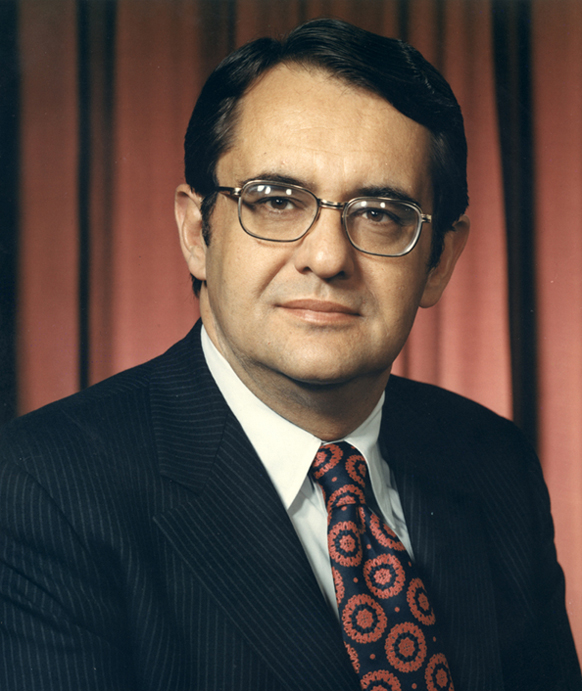
Historical · U.S. Department of Commerce
Peter George Peterson
Former United States Secretary of Commerce · U.S. Department of Commerce · 1972–1973
Peter George Peterson served as United States Secretary of Commerce (1972–1973). The page below collects sourced biographical facts, the appointment record, and provenance for Peterson.
Key facts
- Full name
- Peter George Peterson
- Department
- U.S. Department of Commerce
- Office
- United States Secretary of Commerce
- Status
- Former secretary
- Appointment
- Senate-confirmed
- Tenure
- 1972–1973
- Confirmed
- —
- Born
- 1926
- Died
- 2018
- First year in office
- 1972
- Dataset version
- 1.20260703
Appointment & service record
United States Secretary of Commerce · 1972–1973
- Department
- U.S. Department of Commerce
- Appointment
- Senate-confirmed
- Appointing president
- —
- Confirmed
- —
Department, appointment type (Senate-confirmed, acting, recess, or designated), appointing president, confirmation status, and service dates are drawn from Wikidata and the White House Cabinet roster.[1][2][3]
Sources
- [1]https://www.wikidata.org/wiki/Q456216Wikidata · retrieved 2026-07-03
- [2]https://www.whitehouse.gov/administration/cabinet/whitehouse.gov · retrieved 2026-07-03
- [3]https://www.wikidata.org/wiki/Q639738wikidata-cabinet · retrieved 2026-07-03
Biographical narrative
871 words · sourced from the Wikipedia REST extract
Peter George Peterson was an American investment banker and public servant who served as United States Secretary of Commerce from 1972 to 1973 under President Richard Nixon. Born in Kearney, Nebraska, he rose through the corporate ranks to become chairman and chief executive officer of Bell & Howell and later Lehman Brothers before co‑founding the private equity firm Blackstone Group. In addition to his business career, Peterson held prominent positions on several national boards, including chairmanship of the Council on Foreign Relations, and established philanthropic foundations that focused on fiscal responsibility.
Early life and career
Peter George Peterson entered the world on June 5, 1926, in Kearney, Nebraska, as the eldest child of Venetia “Venet” Paul (née Pavlou) and George Peterson, immigrants from southern Greece. His father had arrived in the United States at 17 years old, worked initially as a dishwasher for Union Pacific Railroad, and eventually opened a Greek diner called Central Café after changing his name to George. From an early age, Peterson assisted with the family business, operating the cash register when he was eight.
Peterson began his higher education at the Massachusetts Institute of Technology but left after a freshman year following an incident involving plagiarism on a term paper. He then enrolled at Northwestern University and its Kellogg School of Management, graduating in 1947 with highest academic honors and summa cum laude recognition. In 1951 he earned an MBA from the University of Chicago Graduate School of Business.
After completing his studies, Peterson joined Market Facts, a Chicago‑based market research firm, as an executive vice president. He later moved to McCann Erickson in 1953, serving as a director for the advertising agency. In 1958, he became executive vice president of Bell & Howell Corporation, a manufacturer of motion picture equipment and related technology. Peterson succeeded Charles H. Percy as chairman and chief executive officer of Bell & Howell in 1963, holding those positions until 1971.
During his tenure at Bell & Howell, Peterson was invited to chair the Commission on Foundations and Private Philanthropy—later known as the Peterson Commission—in 1969. The commission’s recommendations, adopted by the government, required foundations to disburse a minimum proportion of their funds annually, thereby influencing philanthropic policy nationwide.
Cabinet tenure
In 1971, President Richard Nixon appointed Peterson as assistant to the president for international economic affairs. That same year he produced a confidential report that argued the United States was experiencing economic decline under the prevailing world trade order established after World War II. The report suggested that industrial policy could help counteract this trend and was well received by Nixon, influencing the president’s decision in August 1971 to suspend the convertibility of the U.S. dollar into gold, effectively ending the Bretton Woods system.
Peterson’s role as a key economic advisor led to his appointment as United States Secretary of Commerce on January 20, 1972. He served in that capacity for one year, until January 20, 1973. During his tenure he also chaired Nixon’s National Commission on Productivity and was appointed U.S. Chairman of the U.S.–Soviet Commercial Commission. Throughout this period, Peterson expressed concerns about the rising financial debt of the United States, a stance that reflected his broader emphasis on fiscal prudence.
The Senate confirmed Peterson’s appointment as Secretary of Commerce, affirming his position in the cabinet and allowing him to oversee the Department of Commerce’s activities during a pivotal era for U.S. economic policy.
Legacy
After leaving Washington, Peterson returned to the private sector, becoming chairman and chief executive officer of Lehman Brothers from 1973 until 1984. His leadership at Lehman helped shape the firm’s trajectory as a leading investment bank.
In 1985, he co‑founded Blackstone Group with Stephen A. Schwarzman, serving as its chairman for many years. The firm grew into one of the world’s largest private equity and investment management companies, and when it went public in 2007 Peterson received $1.9 billion from the IPO, a portion of which he directed toward philanthropic initiatives.
Peterson also made significant contributions to public affairs through his long‑standing involvement with the Council on Foreign Relations (CFR). He succeeded David Rockefeller as chairman of the CFR in 1985 and held that position until retiring in 2007. In addition, he served as trustee for several cultural and educational institutions, including the Museum of Modern Art and the Rockefeller family’s Japan Society.
His commitment to fiscal responsibility extended into the nonprofit realm with the founding of the Peter G. Peterson Foundation (PGPF) in 2008. The foundation focuses on promoting fiscal austerity and reducing government debt, reflecting Peterson’s enduring concern for economic sustainability.
Peterson also participated in bipartisan efforts aimed at addressing federal budget deficits. He co‑founded the Concord Coalition in 1992, a citizens’ organization that advocates deficit reduction. In 1994 he served as a member of the Bipartisan Commission on Entitlement and Tax Reform, co‑chaired by Senators Bob Kerrey and John Danforth.
He passed away on March 20, 2018, leaving behind a legacy characterized by influential roles in both the private sector and public service, significant contributions to economic policy discourse, and a lasting impact on philanthropic practices. His career spanned investment banking, corporate leadership, government service, and civic engagement, illustrating a multifaceted approach to shaping American economic life.
Sources & provenance
Every quantitative or attributable claim above carries a per-section [N] marker that resolves to the corresponding URL below. Each entry records the upstream provider, the canonical URL, and the timestamp at which the underlying source was retrieved.
Key facts
- https://www.wikidata.org/wiki/Q456216Wikidata · retrieved 2026-07-03
- https://www.whitehouse.gov/administration/cabinet/whitehouse.gov · retrieved 2026-07-03
- https://www.wikidata.org/wiki/Q639738wikidata-cabinet · retrieved 2026-07-03
Biographical narrative
- https://en.wikipedia.org/wiki/Peter_G._PetersonWikipedia · retrieved 2026-07-03
Explore the Cabinet
The Cabinet includes the Vice President and the heads of the 15 executive departments. Browse the full roster of current and former secretaries, or explore how the Cabinet fits into the federal government.