
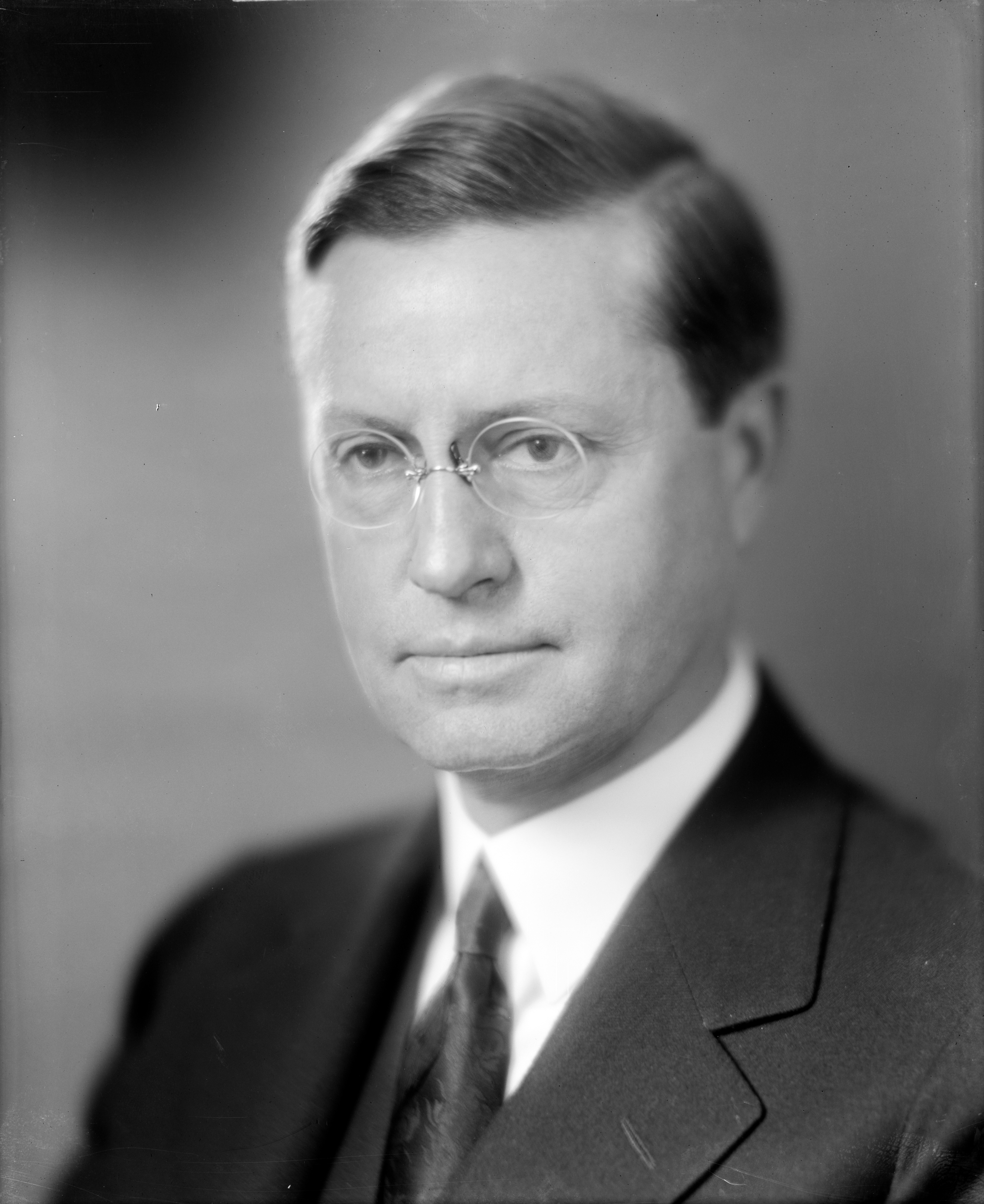
Historical · U.S. Department of Commerce
Roy Dikeman Chapin Sr.
Former United States Secretary of Commerce · U.S. Department of Commerce · 1932–1933
Roy Dikeman Chapin Sr. served as United States Secretary of Commerce (1932–1933). The page below collects sourced biographical facts, the appointment record, and provenance for Sr..
Key facts
- Full name
- Roy Dikeman Chapin Sr.
- Department
- U.S. Department of Commerce
- Office
- United States Secretary of Commerce
- Status
- Former secretary
- Appointment
- Senate-confirmed
- Tenure
- 1932–1933
- Confirmed
- —
- Born
- 1880
- Died
- 1936
- First year in office
- 1932
- Dataset version
- 1.20260704
Appointment & service record
United States Secretary of Commerce · 1932–1933
- Department
- U.S. Department of Commerce
- Appointment
- Senate-confirmed
- Appointing president
- —
- Confirmed
- —
Department, appointment type (Senate-confirmed, acting, recess, or designated), appointing president, confirmation status, and service dates are drawn from Wikidata and the White House Cabinet roster.[1][2][3][4]
Sources
- [1]https://www.wikidata.org/wiki/Q373072Wikidata · retrieved 2026-07-04
- [2]https://www.whitehouse.gov/administration/cabinet/whitehouse.gov · retrieved 2026-07-04
- [3]https://www.wikidata.org/wiki/Q639738wikidata-cabinet · retrieved 2026-07-04
- [4]https://www.commerce.gov/about/history/past-secretariescommerce.gov past-secretaries roster · retrieved 2026-07-04
Biographical narrative
855 words · sourced from the Wikipedia REST extract
Roy Dikeman Chapin Sr. (February 23, 1880 – February 16, 1936) was an American industrialist best known as a co‑founder of the Hudson Motor Company, which later became part of American Motors Corporation (AMC). He also served as United States Secretary of Commerce from August 8, 1932 to March 3, 1933 under President Herbert Hoover. His career spanned early automotive manufacturing, corporate leadership, and a brief period in federal government during the Great Depression.
Early life and career
Chapin was born on February 23, 1880, in Lansing, Michigan, the son of Edward Cornelius Chapin and Ella Rose King. He attended Lansing High School before enrolling at the University of Michigan; however, he left the university in 1901 to pursue a professional opportunity with Olds Motor Works in Detroit. At Olds, he served as general sales manager from 1904 to 1906, a role that involved overseeing the distribution and marketing of the company’s automobiles during a formative period for the industry.
In 1906 Chapin partnered with Edward R. Thomas to establish the E.R. Thomas‑Detroit Company. He acted as treasurer and general manager until 1908, managing the firm’s financial affairs and operational activities while it developed its own automotive products. The experience gained in these early positions prepared him for larger ventures.
In 1908 Chapin led a consortium of businessmen and engineers that founded the Hudson Motor Car Company. The company was named after Detroit merchant Joseph L. Hudson, who supplied the majority of its initial capital. As head of the founding group, Chapin helped shape the company’s early strategy and product line. His leadership contributed to Hudson’s growth into one of the most profitable independent American automobile manufacturers during the 1920s.
Chapin’s entrepreneurial activities continued with the creation of Essex Motors Company in 1918, a subsidiary of Hudson. Essex produced the first affordable mass‑produced enclosed automobile in 1922, a development that helped shift consumer preference from open touring cars toward all‑weather passenger vehicles. By 1929 Hudson‑Essex had become the third largest manufacturer in the United States, behind Chevrolet and Ford.
In addition to his corporate roles, Chapin served as head of the National Automobile Chamber of Commerce beginning in 1927, succeeding Clifton. The position placed him at the center of industry advocacy, where he represented manufacturers’ interests on matters ranging from trade policy to infrastructure development. He also championed the construction of the Lincoln Highway alongside Henry B. Joy of Packard Motors, viewing a professionally designed roadway system as essential for both industry growth and national strength.
Chapin married Inez Tiedeman in 1914; she was the daughter of former Savannah mayor George Tiedeman. The couple had six children. One son, Roy D. Chapin Jr., would later assume leadership positions within Hudson and AMC, continuing the family’s involvement in the automotive sector.
Cabinet tenure
In August 1932, President Herbert Hoover appointed Chapin as United States Secretary of Commerce. His appointment was confirmed by the Senate, and he served until March 1933. During his brief tenure, Chapin attempted to persuade automobile magnate Henry Ford to provide financial assistance to the Union Guardian Trust Company of Detroit in order to prevent its collapse. Ford declined to aid the bank, an event that precipitated a Michigan Bank Holiday. The state‑level bank holiday became part of a broader series of banking closures and ultimately contributed to the passage of the Emergency Banking Act by the Roosevelt administration in 1933.
After leaving the cabinet, Chapin returned to Hudson Motor Company in March 1933. He spent his final years working to keep the company afloat amid the economic hardships of the Great Depression. He died in Detroit on February 16, 1936 and was buried at Woodlawn Cemetery. His position at Hudson was succeeded by A.E. Barit.
Legacy
Chapin’s influence extended beyond automotive manufacturing into architecture and civic development. In 1927 he commissioned architect John Russell Pope—later known for designing the Jefferson Memorial—to create a family residence at 447 Lake Shore Road in Grosse Pointe Farms, Michigan. The grounds were landscaped by Bryant Fleming and featured yew trees imported from England that had been cultivated there for six centuries. Mrs. Chapin occupied the home until her death in 1956; it was then purchased by Henry Ford II and his wife Anne. Ford owned the property until 1983, when he demolished the house and subdivided the land to construct condominiums.
Hudson Motor Company continued to evolve after Chapin’s death. In 1954 Nash Kelvinator acquired Hudson in a friendly merger, forming American Motors Corporation (AMC). AMC operated independently until its acquisition by Chrysler in 1987. Roy D. Chapin Jr., Chapin’s son, served as chairman and chief executive officer of AMC; he led the company through significant expansions, including the acquisition of Kaiser Jeep Corporation in 1970.
Chapin’s contributions to the automotive industry were formally recognized when he was inducted into the Automotive Hall of Fame in 1972. His legacy continued through his grandson William R. Chapin, who became president of the Automotive Hall of Fame in 2010.
Overall, Roy Dikeman Chapin Sr.’s career illustrates a trajectory from early automotive entrepreneurship to national public service and lasting influence on both industry and civic infrastructure.
Sources & provenance
Every quantitative or attributable claim above carries a per-section [N] marker that resolves to the corresponding URL below. Each entry records the upstream provider, the canonical URL, and the timestamp at which the underlying source was retrieved.
Key facts
- https://www.wikidata.org/wiki/Q373072Wikidata · retrieved 2026-07-04
- https://www.whitehouse.gov/administration/cabinet/whitehouse.gov · retrieved 2026-07-04
- https://www.wikidata.org/wiki/Q639738wikidata-cabinet · retrieved 2026-07-04
- https://www.commerce.gov/about/history/past-secretariescommerce.gov past-secretaries roster · retrieved 2026-07-04
Biographical narrative
- https://en.wikipedia.org/wiki/Roy_D._ChapinWikipedia · retrieved 2026-07-04
Explore the Cabinet
The Cabinet includes the Vice President and the heads of the 15 executive departments. Browse the full roster of current and former secretaries, or explore how the Cabinet fits into the federal government.