
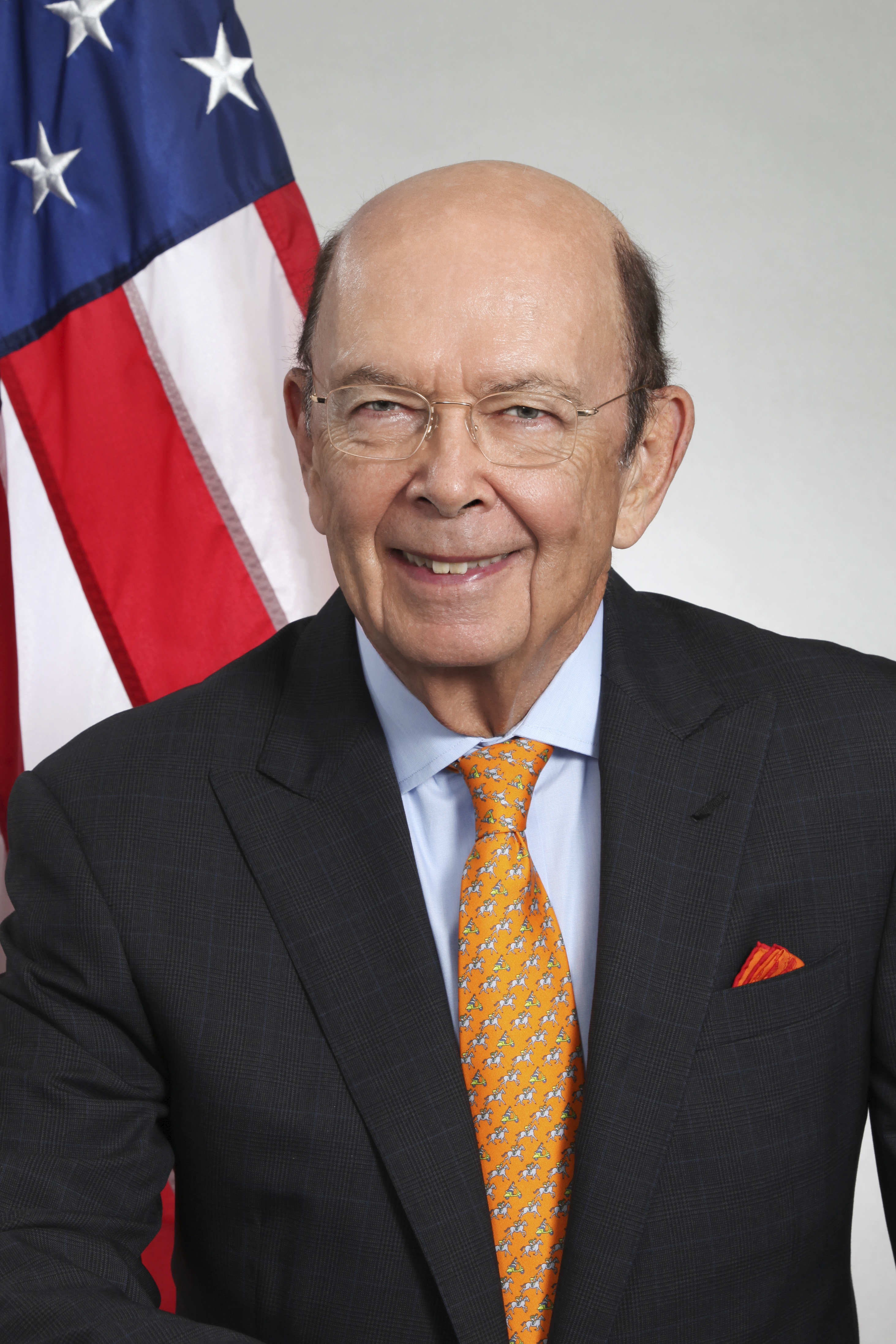
Historical · U.S. Department of Commerce
Wilbur L. Ross Jr.
Former United States Secretary of Commerce · U.S. Department of Commerce · 2017–2021
Wilbur L. Ross Jr. served as United States Secretary of Commerce (2017–2021). The page below collects sourced biographical facts, the appointment record, and provenance for Jr..
Key facts
- Full name
- Wilbur L. Ross Jr.
- Department
- U.S. Department of Commerce
- Office
- United States Secretary of Commerce
- Status
- Former secretary
- Appointment
- Senate-confirmed
- Tenure
- 2017–2021
- Confirmed
- —
- Born
- 1937
- Died
- —
- First year in office
- 2017
- Dataset version
- 1.20260703
Appointment & service record
United States Secretary of Commerce · 2017–2021
- Department
- U.S. Department of Commerce
- Appointment
- Senate-confirmed
- Appointing president
- —
- Confirmed
- —
Department, appointment type (Senate-confirmed, acting, recess, or designated), appointing president, confirmation status, and service dates are drawn from Wikidata and the White House Cabinet roster.[1][2][3]
Sources
- [1]https://www.wikidata.org/wiki/Q8000233Wikidata · retrieved 2026-07-03
- [2]https://www.whitehouse.gov/administration/cabinet/whitehouse.gov · retrieved 2026-07-03
- [3]https://www.wikidata.org/wiki/Q639738wikidata-cabinet · retrieved 2026-07-03
Biographical narrative
1,128 words · sourced from the Wikipedia REST extract
Wilbur Louis Ross Jr., born on November 28, 1937, is an American businessman who served as the 39th United States Secretary of Commerce from 2017 to 2021. Prior to his cabinet appointment, he built a career in corporate finance and restructuring, most notably at Rothschild & Co and later through his own firm WL Ross & Co. His tenure in government was marked by his status as the oldest first‑time Cabinet appointee in U.S. history, and his confirmation by the Senate underscored bipartisan support for his experience in turning around distressed companies.
Early life and career
Ross grew up in North Bergen, New Jersey, a suburb of the city that would later become central to his professional life. His parents were Wilbur Louis Ross, a lawyer who became a judge, and Agnes (née O'Neill), an Irish‑American educator who had served as valedictorian at Sacred Heart Academy in Hoboken before teaching third grade for four decades. The family’s emphasis on education was reflected in Ross’s own academic path: he attended Xavier High School, a Catholic preparatory institution in Manhattan, where he participated in athletics and school clubs.
After graduating from high school in 1955, Ross earned a bachelor’s degree at Yale College in 1959. While there, he edited a literary magazine and worked on the campus radio station, experiences that nurtured his early interest in writing. A course in English required him to produce a thousand words by ten a.m. each day; after two weeks of struggling to find material, he withdrew from the class. Yale’s faculty adviser helped secure a summer position on Wall Street, which proved pivotal for Ross’s future career.
He continued his education at Harvard Business School, obtaining an MBA in 1961. The combination of a liberal arts background and rigorous business training would later inform his approach to corporate restructuring.
Ross entered the professional world in 1963 with Wood, Struthers & Winthrop (later known as WL Ross & Co), where he was involved in liquidating the venture capital affiliate’s portfolio. He then moved to Faulkner, Dawkins & Sullivan, an institutional securities research firm, rising to president of its investment banking division before the company was sold to Shearson Lehman.
In 1976, Ross joined Rothschild & Co’s New York office as head of its bankruptcy restructuring advisory practice. Over the next two decades he became a leading figure in corporate turnarounds, representing investors and creditors in high‑profile cases such as Drexel Burnham Lambert, Texaco, Public Service of New Hampshire (now Eversource Energy), and Eastern Air Lines. His work earned him the nickname “King of Bankruptcy” among industry peers.
During the 1980s, Ross advised Donald Trump’s Atlantic City casino interests, helping negotiate deals that allowed Trump to retain control of his properties amid foreclosure threats from lenders. In addition, he served as an adviser to New York City Mayor Rudy Giuliani on privatization matters and was appointed by President Bill Clinton to the board of the U.S. Russia Investment Fund.
In 1997, Ross launched a $200 million distressed‑securities fund under Rothschild & Co’s umbrella, achieving a 15.2% return in its first year. By April 2000, he founded WL Ross & Co as an independent firm and raised $450 million to acquire the fund from Rothschild & Co and expand its investment mandate. The new company quickly became known for aggressive restructuring strategies across multiple industries.
Ross’s most notable corporate ventures began with the creation of International Steel Group (ISG) in 2002, a holding that acquired assets from bankrupt steel manufacturers such as Ling‑Temco‑Vought and Bethlehem Steel. He negotiated low purchase prices—$11 per ton of capacity for LTV versus $200 per ton on the market—and secured support from labor unions to preserve jobs. ISG was sold to Mittal Steel in 2005 for $4.5 billion, yielding a 12.5‑fold return on Ross’s original investment and earning him a seat on Mittal’s board.
In textiles, Ross combined Burlington Industries with Cone Mills in 2004 to form International Textile Group (ITG). He also acquired Safety Components International in 2006 and later settled a shareholder lawsuit for $81 million. ITG was sold to Platinum Equity in 2016.
Ross expanded into automotive components through the formation of International Automotive Components Group (IAC) in 2006, which purchased Lear Corporation’s European operations and North American interiors business. IAC also acquired divisions from Collins & Aikman and invested in Oxford Automotive, a company that later merged with Wagon Automotive.
Throughout his career, Ross held leadership roles on more than 100 boards across multiple countries, demonstrating a broad influence on global corporate governance.
Cabinet tenure
Ross was nominated by President Donald Trump to serve as United States Secretary of Commerce in 2017. At the time of his appointment, he was 79 years old, making him the oldest individual to enter the cabinet for the first time in U.S. history. The Senate confirmed his nomination, reflecting bipartisan recognition of his business experience.
During his four-year tenure, Ross oversaw the Department of Commerce’s efforts to promote American trade and investment abroad, support domestic economic development initiatives, and manage the agency’s statistical functions. He worked with industry stakeholders and foreign partners to advance U.S. commercial interests in a rapidly changing global economy. His leadership style was described as pragmatic, drawing on his extensive background in restructuring distressed companies to guide the department through complex challenges.
Ross stepped down from the cabinet at the end of President Trump’s term in January 2021, concluding his public service after more than a decade of private‑sector experience.
Legacy
Wilbur Ross’s legacy is most strongly associated with his reputation as a turnaround specialist. His work at Rothschild & Co and WL Ross & Co earned him recognition for rescuing numerous companies from bankruptcy, often preserving jobs and revitalizing industries such as steel, textiles, and automotive components. The high returns generated by his investments—particularly the sale of International Steel Group to Mittal Steel—demonstrated his ability to identify undervalued assets and execute complex restructurings.
Ross’s influence extended beyond individual companies; he helped shape broader industry trends through strategic acquisitions and labor negotiations. His approach to restructuring emphasized collaboration with creditors, employees, and government agencies, setting a precedent for how distressed firms could be managed in the United States.
In public office, Ross brought his private‑sector perspective to federal commerce policy. He was credited with fostering stronger ties between U.S. businesses and international markets, supporting export promotion initiatives, and ensuring that the Department of Commerce remained responsive to the needs of American manufacturers and entrepreneurs.
Overall, Ross’s career reflects a blend of financial acumen, strategic vision, and public‑service commitment. His impact on corporate restructuring practices continues to be felt in industries he helped revive, while his tenure as Secretary of Commerce remains part of the broader narrative of U.S. economic policy during the late 2010s.
Sources & provenance
Every quantitative or attributable claim above carries a per-section [N] marker that resolves to the corresponding URL below. Each entry records the upstream provider, the canonical URL, and the timestamp at which the underlying source was retrieved.
Key facts
- https://www.wikidata.org/wiki/Q8000233Wikidata · retrieved 2026-07-03
- https://www.whitehouse.gov/administration/cabinet/whitehouse.gov · retrieved 2026-07-03
- https://www.wikidata.org/wiki/Q639738wikidata-cabinet · retrieved 2026-07-03
Biographical narrative
- https://en.wikipedia.org/wiki/Wilbur_RossWikipedia · retrieved 2026-07-03
Explore the Cabinet
The Cabinet includes the Vice President and the heads of the 15 executive departments. Browse the full roster of current and former secretaries, or explore how the Cabinet fits into the federal government.