
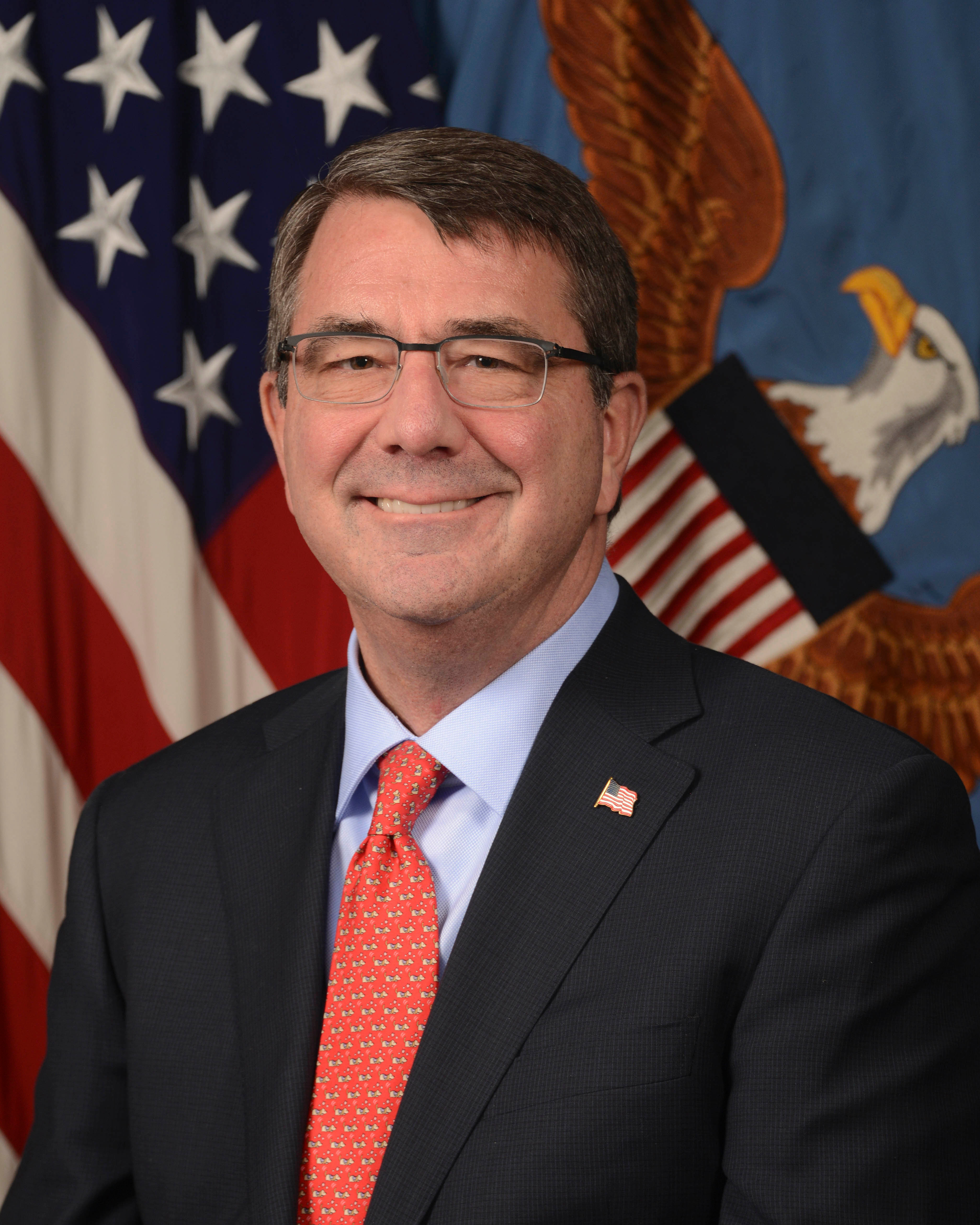
Historical · U.S. Department of Defense
Ash Carter
Former United States Secretary of Defense · U.S. Department of Defense · 2015–2017
Ash Carter served as United States Secretary of Defense (2015–2017). The page below collects sourced biographical facts, the appointment record, and provenance for Carter.
Key facts
- Full name
- Ash Carter
- Department
- U.S. Department of Defense
- Office
- United States Secretary of Defense
- Status
- Former secretary
- Appointment
- Senate-confirmed
- Tenure
- 2015–2017
- Confirmed
- —
- Born
- 1954
- Died
- 2022
- First year in office
- 2015
- Dataset version
- 1.20260703
Appointment & service record
United States Secretary of Defense · 2015–2017
- Department
- U.S. Department of Defense
- Appointment
- Senate-confirmed
- Appointing president
- —
- Confirmed
- —
Department, appointment type (Senate-confirmed, acting, recess, or designated), appointing president, confirmation status, and service dates are drawn from Wikidata and the White House Cabinet roster.[1][2][3]
Sources
- [1]https://www.wikidata.org/wiki/Q4806029Wikidata · retrieved 2026-07-03
- [2]https://www.whitehouse.gov/administration/cabinet/whitehouse.gov · retrieved 2026-07-03
- [3]https://www.wikidata.org/wiki/Q639738wikidata-cabinet · retrieved 2026-07-03
Biographical narrative
1,033 words · sourced from the Wikipedia REST extract
Ash Carter was an American scholar and public servant who served as the United States Secretary of Defense from February 2015 to January 2017. Prior to his cabinet appointment, he held a long career in academia and defense policy, including roles as Assistant Secretary of Defense for International Security Policy during the Clinton administration and Deputy Secretary of Defense under President Obama. After leaving Washington, he directed the Belfer Center for Science & International Affairs at Harvard’s Kennedy School until his death in 2022.
Early life and career
Ash Carter was born on September 24, 1954, in Philadelphia, Pennsylvania. His father, William Stanley Carter Jr., had served as a World War II veteran and later worked as a neurologist and psychiatrist for the United States Navy; he also chaired a department at Abington Memorial Hospital. His mother, Anne Baldwin Carter, taught English. The family lived in Abington, where Carter grew up on Wheatsheaf Lane. He was one of four children, with siblings that included author Cynthia DeFelice.
Carter’s early education took place at Highland Elementary School (class of 1966) and Abington Senior High School (class of 1972). While at high school he participated in athletics—wrestling, lacrosse, and cross‑country running—and served as president of the Honor Society. In 1989 his alma mater inducted him into its Hall of Fame.
After high school, Carter attended Yale College, where he pursued a double major in physics and medieval history. He graduated summa cum laude and was elected to Phi Beta Kappa. His senior thesis, “Quarks, Charm and the Psi Particle,” appeared in the Yale Scientific Magazine in 1975. During his undergraduate years he also worked as an experimental research associate at Fermilab (1975) and Brookhaven National Laboratory (1976), contributing to quark research.
Carter was awarded a Rhodes Scholarship, which led him to the University of Oxford. He earned a Doctor of Philosophy in theoretical physics in 1979, with a dissertation on hard processes in perturbative QCD supervised by Christopher Llewellyn Smith at St John’s College. Following his doctorate he served as a postdoctoral fellow at Rockefeller University (1979–1980), where he investigated time‑reversal invariance and dynamical symmetry breaking. In collaboration with A. I. Sanda, he coauthored papers on CP violation in B meson decays that helped lay theoretical groundwork for future B factories.
From 1982 to 1984 Carter was a research fellow at the MIT Center for International Studies. While there he produced a public report evaluating the feasibility of President Reagan’s “Star Wars” missile defense initiative, concluding it could not protect the United States from a Soviet nuclear attack.
In 1984 Carter joined Harvard University’s John F. Kennedy School of Government as an assistant professor. He progressed to associate professor (1986–1988) and then became a full professor while serving as associate director of the Center for Science and International Affairs (1988–1990). In 1990 he was appointed director of that center, a position he held until 1993. During his tenure at Harvard he chaired the International and Global Affairs faculty and served as Ford Foundation Professor of Science and International Affairs. He also co‑directed the Preventive Defense Project in partnership with Stanford University.
Cabinet tenure
Carter’s transition from academia to government began in 1993 when President Bill Clinton appointed him Assistant Secretary of Defense for International Security Policy, a role he held until 1996. In that capacity he oversaw strategic affairs related to weapons of mass destruction, nuclear policy—including the U.S. arsenal and missile defenses—, and the 1994 Nuclear Posture Review. He was involved in key international agreements such as the 1994 Agreed Framework with North Korea, the 1995 extension of the Non‑Proliferation Treaty, and negotiations for the Comprehensive Nuclear Test Ban Treaty in 1996. Carter also directed the Nunn–Lugar Cooperative Threat Reduction program and Project Sapphire, which facilitated the removal of nuclear weapons from former Soviet republics. His responsibilities extended to establishing defense and intelligence relationships with post‑Soviet states and chairing NATO’s High Level Group on counter‑proliferation.
During President Barack Obama’s first term Carter served as Under Secretary of Defense for Acquisition, Technology and Logistics, followed by a tenure as Deputy Secretary of Defense until December 2013. In February 2015 he was nominated to succeed Chuck Hagel as the United States Secretary of Defense. The Senate confirmed his appointment; he served in that role through the remainder of the Obama administration, concluding his term in January 2017.
As secretary, Carter implemented several significant policy changes. He lifted the ban on transgender individuals serving as officers in the U.S. military and, in 2016, opened all military occupations to women without exception. His leadership also earned him multiple honors: five awards of the Department of Defense Distinguished Public Service Medal, the Chief of Staff of the Joint Chiefs of Staff’s Joint Distinguished Civilian Service Award, and the Defense Intelligence Medal.
After leaving Washington, Carter returned to Harvard, where he directed the Belfer Center for Science & International Affairs at the Kennedy School. In that capacity he continued to influence policy discussions on science, technology, and national security.
Legacy
Ash Carter’s career bridged scientific research, academic scholarship, and high‑level defense policymaking. His early work in theoretical physics contributed to foundational studies of quark behavior and CP violation. As a scholar at Harvard, he shaped the study of international affairs through both teaching and leadership of key research centers.
In government, his stewardship of nuclear policy during the 1990s helped guide U.S. strategy on weapons proliferation and post‑Cold War security. His tenure as Secretary of Defense was marked by efforts to modernize the armed forces’ personnel policies, notably expanding opportunities for transgender service members and women across all military roles. The awards he received—particularly the Department of Defense Distinguished Public Service Medal awarded five times—reflect recognition from his peers for significant contributions to national security.
Carter authored eleven books and more than a hundred scholarly articles covering topics in physics, technology, national security, and management. His writings have been cited by policymakers, academics, and practitioners alike.
In 2025, President Joe Biden posthumously awarded Carter the Presidential Medal of Freedom, acknowledging his lifelong service to the United States. He passed away on October 24, 2022, leaving a legacy that spans scientific inquiry, academic leadership, and transformative defense policy.
Sources & provenance
Every quantitative or attributable claim above carries a per-section [N] marker that resolves to the corresponding URL below. Each entry records the upstream provider, the canonical URL, and the timestamp at which the underlying source was retrieved.
Key facts
- https://www.wikidata.org/wiki/Q4806029Wikidata · retrieved 2026-07-03
- https://www.whitehouse.gov/administration/cabinet/whitehouse.gov · retrieved 2026-07-03
- https://www.wikidata.org/wiki/Q639738wikidata-cabinet · retrieved 2026-07-03
Biographical narrative
- https://en.wikipedia.org/wiki/Ash_CarterWikipedia · retrieved 2026-07-03
Explore the Cabinet
The Cabinet includes the Vice President and the heads of the 15 executive departments. Browse the full roster of current and former secretaries, or explore how the Cabinet fits into the federal government.