
Historical · U.S. Department of Defense
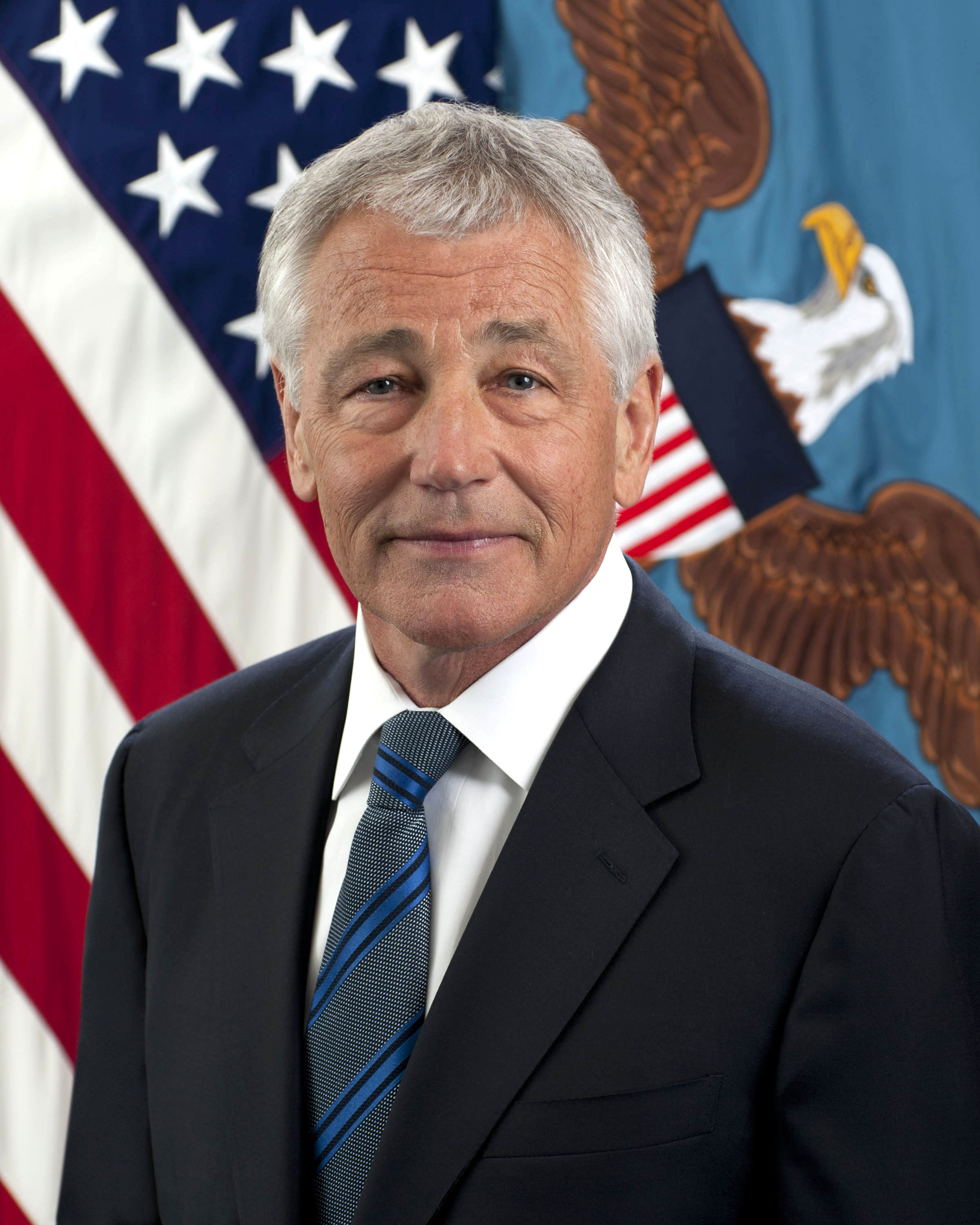
Chuck Hagel
Former United States Secretary of Defense · U.S. Department of Defense · 2013–2015
Chuck Hagel served as United States Secretary of Defense (2013–2015). The page below collects sourced biographical facts, the appointment record, and provenance for Hagel.
Key facts
- Full name
- Chuck Hagel
- Department
- U.S. Department of Defense
- Office
- United States Secretary of Defense
- Status
- Former secretary
- Appointment
- Senate-confirmed
- Tenure
- 2013–2015
- Confirmed
- —
- Born
- 1946
- Died
- —
- First year in office
- 2013
- Dataset version
- 1.20260703
Appointment & service record
United States Secretary of Defense · 2013–2015
- Department
- U.S. Department of Defense
- Appointment
- Senate-confirmed
- Appointing president
- —
- Confirmed
- —
Department, appointment type (Senate-confirmed, acting, recess, or designated), appointing president, confirmation status, and service dates are drawn from Wikidata and the White House Cabinet roster.[1][2][3]
Sources
- [1]https://www.wikidata.org/wiki/Q381670Wikidata · retrieved 2026-07-03
- [2]https://www.whitehouse.gov/administration/cabinet/whitehouse.gov · retrieved 2026-07-03
- [3]https://www.wikidata.org/wiki/Q639738wikidata-cabinet · retrieved 2026-07-03
Biographical narrative
1,025 words · sourced from the Wikipedia REST extract
Charles Timothy Hagel (born October 4, 1946) is an American politician and Army veteran who served as the 24th United States Secretary of Defense from 2013 to 2015 during President Barack Obama’s administration. Prior to his cabinet appointment, he represented Nebraska in the U.S. Senate for twelve years and held a variety of roles in business, military service, and public affairs.
Early life and career
Hagel was born in North Plateau, Nebraska, into a family with German, Irish, and Polish ancestry. He grew up in several Nebraskan towns—including Ainsworth, Rushville, Scottsbluff, Terrytown, York, and Columbus—where he became the eldest of four brothers. His father, a World War II veteran, died unexpectedly on Christmas morning in 1962 when Hagel was sixteen years old.
He graduated from St. Bonaventure High School (now Scotus Central Catholic High School) in Columbus in 1964. After attending the Brown Institute for radio and television until 1966, he earned a Bachelor of General Studies with a concentration in history from the University of Nebraska Omaha in 1971, completing his education with assistance from the Veterans Administration under the GI Bill.
Hagel voluntarily enlisted in the United States Army during the Vietnam War, choosing to serve rather than accept a draft board recommendation that he pursue college. From 1967 to 1968 he served as an infantry squad leader in the 9th Infantry Division, holding the rank of sergeant (E‑5). He was awarded the Vietnamese Cross of Gallantry, two Purple Hearts, the Army Commendation Medal, and the Combat Infantryman Badge for his service. His younger brother Tom also served in Vietnam; the brothers are noted as being among the few American siblings to serve together in the same infantry squad.
After leaving active duty, Hagel worked as a radio newscaster and talk show host in Omaha from 1969 to 1971 while completing his degree. In 1971 he joined the staff of Congressman John Y. McCollister (R‑NE) and served there until 1977. He then spent four years lobbying for Firestone Tire and Rubber Company. In 1980, Hagel organized the successful presidential campaign of former California governor Ronald Reagan. Following Reagan’s inauguration, he was appointed deputy administrator of the Veterans Administration, a position he resigned from in 1982 after disagreements with VA Administrator Robert P. Nimmo over funding priorities.
After leaving government service, Hagel entered the private sector. He co‑founded Vanguard Cellular, a mobile phone carrier that became a significant source of his personal wealth. While at Vanguard, he also served as president and chief executive officer of the United Service Organizations (USO) and the Private Sector Council, deputy director and chief operating officer of the 1990 G7 Summit, and held board or advisory positions with organizations such as the American Red Cross, the Eisenhower World Affairs Institute, Bread for the World, and the Ripon Society. He chaired the Agent Orange Settlement Fund and was a member of the Council on Foreign Relations.
In 1992 Hagel returned to Nebraska, where he became president of the McCarthy Group, LLC, an investment banking firm. He also served as chairman and chief executive officer of American Information Systems Inc., later known as Election Systems & Software—a computerized voting machine manufacturer co‑owned by the McCarthy Group and the Omaha World‑Herald. Hagel resigned from the board of this company on March 15, 1995 to pursue a political campaign.
Hagel entered elective office in 1996 when he was elected to the U.S. Senate representing Nebraska. He served from 1997 until 2009, being re‑elected in 2002 and choosing not to run again in 2008. During his time in the Senate, he held leadership roles on several committees and contributed to national policy discussions on defense and intelligence matters.
Cabinet tenure
On January 7, 2013 President Barack Obama nominated Hagel to serve as Secretary of Defense. The nomination was reviewed by the Senate Armed Services Committee, which approved it on February 12, 2013 with a vote of 14–11. On February 14, 2013, Senate Republicans did not join Democrats in voting for cloture, preventing the debate from ending and requiring additional review; this marked the first time a nominee for Secretary of Defense was filibustered.
On February 26, 2013, the full Senate voted to invoke cloture on Hagel’s nomination and confirmed him with a vote of 58–41. He assumed office the following day, February 27, 2013, succeeding Leon Panetta who had stepped down. During his tenure as Secretary of Defense, Hagel also served as chairman of the President’s Intelligence Advisory Board from 2009 to 2013, bringing his experience in intelligence and national security to the cabinet.
On November 24, 2014 it was announced that Hagel would resign following conflicts within the administration, particularly relating to issues concerning ISIL. He stepped down on December 1, 2015, concluding a brief but eventful period at the top of the Department of Defense.
Legacy
Hagel’s career spans military service, legislative work, business leadership, and executive government responsibilities. His experience as an infantry squad leader in Vietnam, decorated with two Purple Hearts and other honors, informed his perspective on defense matters throughout his public life. In the Senate he was known for engaging in bipartisan discussions on national security and intelligence policy, a focus that carried into his later role as chairman of the President’s Intelligence Advisory Board.
As Secretary of Defense, Hagel faced challenges related to emerging threats, including the rise of ISIL, which contributed to internal disagreements within the administration. His confirmation process was historically significant for being the first filibuster of a defense secretary nominee, reflecting heightened scrutiny of appointments during that period. Although his tenure lasted just over two years, it highlighted the complexities of balancing military readiness with evolving geopolitical threats.
Beyond his governmental service, Hagel’s business ventures—particularly in telecommunications and election technology—demonstrated an entrepreneurial approach to private sector leadership. His involvement with non‑profit organizations such as the USO and the American Red Cross underscored a continued commitment to veteran affairs and humanitarian efforts.
Overall, Charles Hagel’s public record reflects a blend of military experience, legislative participation, executive oversight, and business acumen. His contributions to defense policy, intelligence coordination, and veterans’ advocacy remain part of his enduring legacy in American public service.
Sources & provenance
Every quantitative or attributable claim above carries a per-section [N] marker that resolves to the corresponding URL below. Each entry records the upstream provider, the canonical URL, and the timestamp at which the underlying source was retrieved.
Key facts
- https://www.wikidata.org/wiki/Q381670Wikidata · retrieved 2026-07-03
- https://www.whitehouse.gov/administration/cabinet/whitehouse.gov · retrieved 2026-07-03
- https://www.wikidata.org/wiki/Q639738wikidata-cabinet · retrieved 2026-07-03
Biographical narrative
- https://en.wikipedia.org/wiki/Chuck_HagelWikipedia · retrieved 2026-07-03
Explore the Cabinet
The Cabinet includes the Vice President and the heads of the 15 executive departments. Browse the full roster of current and former secretaries, or explore how the Cabinet fits into the federal government.