
Historical · U.S. Department of Education
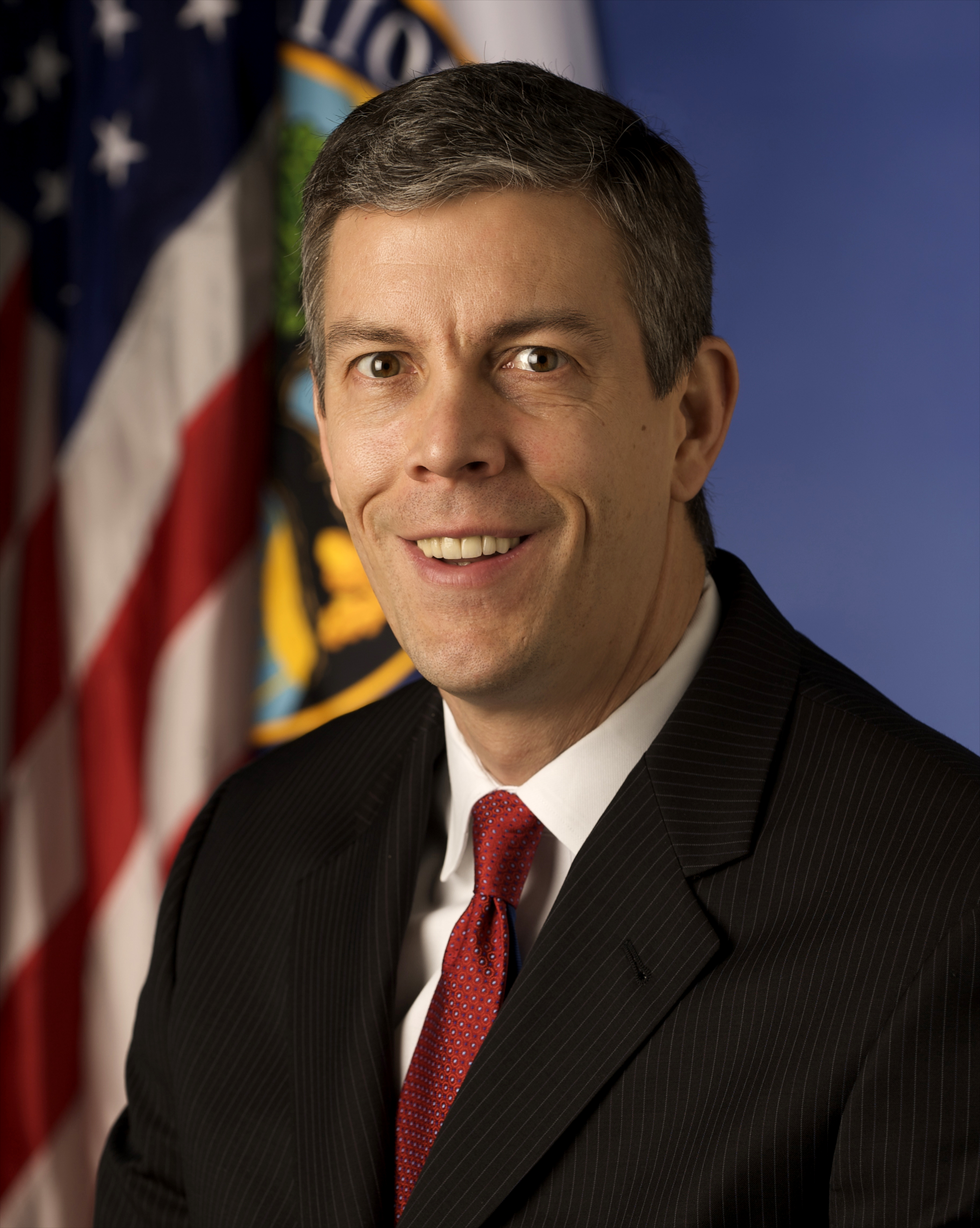
Arne Duncan
Former United States Secretary of Education · U.S. Department of Education · 2009–2016
Arne Duncan served as United States Secretary of Education (2009–2016). The page below collects sourced biographical facts, the appointment record, and provenance for Duncan.
Key facts
- Full name
- Arne Duncan
- Department
- U.S. Department of Education
- Office
- United States Secretary of Education
- Status
- Former secretary
- Appointment
- Senate-confirmed
- Tenure
- 2009–2016
- Confirmed
- —
- Born
- 1964
- Died
- —
- First year in office
- 2009
- Dataset version
- 1.20260703
Appointment & service record
United States Secretary of Education · 2009–2016
- Department
- U.S. Department of Education
- Appointment
- Senate-confirmed
- Appointing president
- —
- Confirmed
- —
Department, appointment type (Senate-confirmed, acting, recess, or designated), appointing president, confirmation status, and service dates are drawn from Wikidata and the White House Cabinet roster.[1][2][3]
Sources
- [1]https://www.wikidata.org/wiki/Q349922Wikidata · retrieved 2026-07-03
- [2]https://www.whitehouse.gov/administration/cabinet/whitehouse.gov · retrieved 2026-07-03
- [3]https://www.wikidata.org/wiki/Q639738wikidata-cabinet · retrieved 2026-07-03
Biographical narrative
1,001 words · sourced from the Wikipedia REST extract
Arne Duncan is an American educator who served as the ninth United States Secretary of Education from 2009 to 2016 under President Barack Obama. Prior to his federal appointment, he led Chicago Public Schools as chief executive officer for eight years, where he implemented reforms aimed at improving teacher quality and addressing failing schools. Throughout his career, Duncan has combined experience in education administration with a background in professional basketball, using the sport as a means of community engagement and networking.
Early life and career
Arne Starkey Duncan was born on November 6, 1964, in the Hyde Park neighborhood of Chicago. His parents were Susan and Starkey Duncan; his father taught psychology at the University of Chicago, while his mother founded a tutoring center that operated out of a church basement in the Kenwood–Oakland area of the South Side. From an early age, Duncan assisted his mother with tutoring students and played basketball alongside them. The tutoring center faced threats from street gangs, and when Duncan was six years old it was firebombed after the church pastor declined to allow weapons to be stored there.
Duncan attended the University of Chicago Laboratory Schools before enrolling at Harvard College, where he studied sociology. Standing 6 ft 5 in, he joined the Harvard basketball team in his sophomore year and served as co‑captain during his senior season. He earned recognition as a first‑team Academic All‑American and completed a senior thesis titled “The values, aspirations and opportunities of the urban underclass,” for which he conducted research through his mother’s tutoring program.
After graduating from Harvard, Duncan pursued professional basketball. He played for the Rhode Island Gulls in the United States and later moved to Australia in 1987. While there, he joined the Eastside Spectres of the National Basketball League during the 1988–89 seasons, averaging 24.1 points per game in his first season and 28.6 points in the second. In 1991 he played for Latrobe in the North‑West Tasmania League. During his time in Australia, Duncan earned the nickname “the Cobra,” tutored wards of the state, and met his future wife Karen; together they have two children.
In 1992, Duncan returned to Chicago and became director of the Ariel Education Initiative, a tutoring program he co‑founded with his sister. The initiative received funding from financier John Rogers, and the pair later established a charter school based on its model. By 1998, Duncan had advanced to Deputy Chief of Staff for the Chicago Public Schools district under then‑superintendent Paul Vallas, where he oversaw the magnet school program.
Duncan’s personal connections with local leaders grew through shared basketball activities. He developed friendships with state senator Barack Obama—who would later become president—and others such as John Rogers and Craig Robinson by playing pick‑up games. Beginning in 2003, Duncan participated in the Hoop It Up three‑on‑three competition; he won nine of eleven championships between 2003 and 2014, often partnering with Rogers and Robinson.
Mayor Richard M. Daley appointed Duncan as chief executive officer of Chicago Public Schools in 2001. In that role, he championed policies designed to raise teacher quality and reform underperforming schools. He was responsible for selecting new schools under the city’s Renaissance 2010 initiative. Initially, his strategy involved closing failing schools; by 2006 he shifted to replacing staff while keeping schools open. In 2008, Duncan became the sole education official in the district to sign petitions both supporting school improvement and advocating social reform aimed at assisting students.
Supporters of Duncan’s leadership highlighted gains in elementary math and reading proficiency as well as increased high‑school graduation and scholarship rates. Critics, however, objected to his expansion of charter schools and certain reforms that they perceived as overreaching.
Cabinet tenure
In 2009, President Barack Obama nominated Duncan to serve as United States Secretary of Education. The Senate confirmed him, making him the ninth person to hold the position. During his federal tenure, Duncan focused on broadening the use of standardized testing, expanding charter schools, and promoting national learning standards such as Common Core. He oversaw the Race to the Top program, which provided grants and exemptions from the No Child Left Behind Act for states that adopted these policies.
Initially, Duncan’s agenda received bipartisan support; however, his emphasis on testing as a tool for evaluating teacher performance drew criticism from teachers’ unions. Members of the opposing party also accused him of government overreach. Despite these challenges, he expanded student financial aid and loan forgiveness programs. Nevertheless, he was unable to implement certain higher‑education initiatives, including regulation of for‑profit colleges or the creation of a federal rating system for universities.
In 2015, Duncan resigned from his cabinet position to relocate back to Chicago with his family. After leaving office, he directed efforts toward anti‑violence programs in the city. Throughout his tenure at the Department of Education, Duncan continued to play basketball, using the sport as a means of building relationships with Chicago politicians and community leaders.
Legacy
Arne Duncan’s career reflects a blend of educational administration and athletic engagement. As chief executive officer of Chicago Public Schools, he implemented reforms that many credit with improving academic outcomes for elementary students and increasing graduation rates among high‑schoolers. His federal service was marked by an emphasis on standardized assessment, charter school expansion, and the adoption of national learning standards, culminating in the Race to the Top competition.
Duncan’s initiatives drew both support and opposition; while some praised his efforts to broaden access to higher education through increased financial aid, others criticized the reliance on testing for teacher evaluation and perceived government overreach. After leaving the Department of Education, he returned to Chicago to focus on community safety initiatives, continuing his long‑standing commitment to educational improvement and public service.
His background as a professional basketball player—both in the United States and abroad—remains an integral part of his identity, influencing his approach to teamwork, leadership, and community outreach. Through these varied experiences, Duncan has contributed to shaping contemporary discussions on education policy and reform at both local and national levels.
Sources & provenance
Every quantitative or attributable claim above carries a per-section [N] marker that resolves to the corresponding URL below. Each entry records the upstream provider, the canonical URL, and the timestamp at which the underlying source was retrieved.
Key facts
- https://www.wikidata.org/wiki/Q349922Wikidata · retrieved 2026-07-03
- https://www.whitehouse.gov/administration/cabinet/whitehouse.gov · retrieved 2026-07-03
- https://www.wikidata.org/wiki/Q639738wikidata-cabinet · retrieved 2026-07-03
Biographical narrative
- https://en.wikipedia.org/wiki/Arne_DuncanWikipedia · retrieved 2026-07-03
Explore the Cabinet
The Cabinet includes the Vice President and the heads of the 15 executive departments. Browse the full roster of current and former secretaries, or explore how the Cabinet fits into the federal government.