
Historical · U.S. Department of Energy
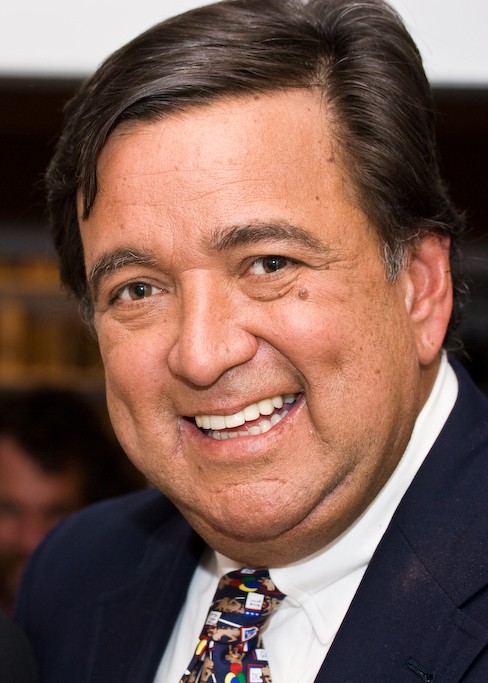
Bill Richardson
Former United States Secretary of Energy · U.S. Department of Energy · 1998–2001
Bill Richardson served as United States Secretary of Energy (1998–2001). The page below collects sourced biographical facts, the appointment record, and provenance for Richardson.
Key facts
- Full name
- Bill Richardson
- Department
- U.S. Department of Energy
- Office
- United States Secretary of Energy
- Status
- Former secretary
- Appointment
- Senate-confirmed
- Tenure
- 1998–2001
- Confirmed
- —
- Born
- 1947
- Died
- 2023
- First year in office
- 1998
- Dataset version
- 1.20260703
Appointment & service record
United States Secretary of Energy · 1998–2001
- Department
- U.S. Department of Energy
- Appointment
- Senate-confirmed
- Appointing president
- —
- Confirmed
- —
Department, appointment type (Senate-confirmed, acting, recess, or designated), appointing president, confirmation status, and service dates are drawn from Wikidata and the White House Cabinet roster.[1][2][3]
Sources
- [1]https://www.wikidata.org/wiki/Q311782Wikidata · retrieved 2026-07-03
- [2]https://www.whitehouse.gov/administration/cabinet/whitehouse.gov · retrieved 2026-07-03
- [3]https://www.wikidata.org/wiki/Q639738wikidata-cabinet · retrieved 2026-07-03
Biographical narrative
1,137 words · sourced from the Wikipedia REST extract
Bill Richardson was a prominent public servant whose career spanned the United States Congress, the federal cabinet, state governance, and international diplomacy. Born in 1947, he served as the thirty‑first United States Secretary of Energy from 1998 to 2001 under President Bill Clinton, later becoming the governor of New Mexico from 2003 to 2011. Throughout his life Richardson engaged in legislative work on natural resources and Native American affairs, represented New Mexico at the United Nations, chaired national political conventions, and carried out humanitarian missions abroad. He died on September 1, 2023.
Early life and career
William Blaine Richardson III entered the world on November 15, 1947, in Pasadena, California. His father, William Blaine Richardson Jr., was an American bank executive of Anglo‑American and Mexican ancestry who had worked for what is now Citibank in Mexico; his mother, María Luisa López‑Collada Márquez, was a Mexican-born daughter of a Mexican mother and a Spanish father from Villaviciosa, Asturias. The family’s decision to have Richardson born in California stemmed from his father's desire that he be born within the United States.
Richardson spent his childhood on a hacienda in the Coyoacán borough of Mexico City, where he was raised as a Roman Catholic. At thirteen, his parents sent him to the United States for secondary education at Middlesex School in Concord, Massachusetts, an experience that introduced him to baseball; he played as a pitcher there and continued the sport at Tufts University after enrolling in 1966. While at Tufts, Richardson pursued studies in French and political science, earning a bachelor’s degree in 1970. He remained active on campus, serving as a member and later president of the Delta Tau Delta fraternity. The following year he completed a master’s degree in international affairs from the Fletcher School of Law and Diplomacy.
In 1972, Richardson married Barbara Flavin, whom he had met during high school in Concord. Their marriage followed her graduation from Wheaton College. The couple would later have children together.
Richardson entered public service shortly after completing his education. From 1971 to 1973 he worked for Republican Congressman F. Bradford Morse of Massachusetts. In 1974, he joined the State Department under Secretary Henry Kissinger as a congressional relations officer during the Nixon administration. Between 1976 and 1978 he served on staff for the Senate Foreign Relations Committee.
In 1978 Richardson relocated to Santa Fe, New Mexico, where he would establish his long‑term political career. He first ran for the United States House of Representatives in 1980 in New Mexico’s 1st congressional district but was narrowly defeated by incumbent Republican Manuel Lujan. Two years later, in 1982, he successfully won election to the newly created third district, which encompassed much of northern New Mexico. Richardson represented that district for fourteen years, from January 3, 1983, until his resignation on December 31, 1997.
During his congressional tenure, Richardson chaired several influential groups and committees. He served as chair of the Congressional Hispanic Caucus during the 98th Congress (1984‑85) and later as chair of the House Natural Resources Subcommittee on Native American Affairs in the 103rd Congress (1993‑94). In these roles he sponsored legislation that addressed key issues for Indigenous communities, including the American Indian Religious Freedom Act Amendments of 1994, the Indian Dams Safety Act, the Tribal Self‑Governance Act, and the Jicarilla Apache Tribe Water Rights Settlement Act. His work on Native American affairs earned him recognition from Mexico’s government; he was awarded the Aztec Eagle Award, the country’s highest honor for a foreigner.
Richardson also served as a deputy majority whip in the House, positioning him within the Democratic leadership. Through his legislative work and bipartisan cooperation, he developed a close professional relationship with then‑presidential candidate Bill Clinton. Their collaboration extended to international diplomacy; Clinton dispatched Richardson on several missions, including a 1995 trip to Baghdad where Richardson negotiated with Saddam Hussein to secure the release of two American aerospace workers.
Cabinet tenure
In 1998 President Clinton nominated Richardson for the position of United States Secretary of Energy. The Senate confirmed him, and he served in that capacity until 2001. During his time at the Department of Energy, Richardson oversaw federal policies related to energy production, research, and national security. His appointment placed him among the senior officials responsible for shaping U.S. energy strategy during the late 1990s.
In December 2008, Richardson was nominated by President Barack Obama to serve as Secretary of Commerce in the first Obama administration. However, he withdrew from consideration a month later amid an investigation into possible improper business dealings. The inquiry was subsequently dropped, but it had already affected his public standing and curtailed further cabinet prospects.
Beyond his cabinet service, Richardson continued to engage in diplomatic work. He served as United States ambassador to the United Nations during the Clinton administration, representing American interests on a global stage. His international experience extended into the 21st century; he advised U.S. officials on matters related to North Korea and visited the country multiple times, participating in efforts to secure the release of American detainees. In addition, Richardson undertook private humanitarian missions, one of which successfully secured the release of U.S. journalist Danny Fenster from a Myanmar prison in November 2021.
After his federal service, Richardson returned to state politics. He was elected governor of New Mexico in 2002 and served two terms from January 2003 until January 2011, becoming the state's thirtieth governor. During his governorship he chaired the Democratic Governors Association and presided over the 2004 Democratic National Convention.
Legacy
Bill Richardson’s career reflects a broad engagement with public service across multiple levels of government. His legislative record in Congress emphasized natural resource management and Indigenous rights, producing laws that addressed water rights, dam safety, and tribal self‑governance. As Secretary of Energy, he contributed to the administration’s energy policy agenda during a period marked by technological innovation and shifting global markets.
Richardson’s diplomatic activities—spanning negotiations with Middle Eastern leaders, representation at the United Nations, and humanitarian missions in North Korea and Myanmar—demonstrate his continued commitment to international affairs beyond elected office. His efforts to secure the release of American detainees and journalists underscore a focus on human rights within foreign policy contexts.
At the state level, Richardson’s tenure as governor saw him navigate New Mexico’s economic and social challenges while maintaining leadership roles in national Democratic organizations. His involvement with the Democratic Governors Association and the 2004 Democratic National Convention positioned him as an influential figure within his party’s national structure, even though he himself was not identified by a political affiliation.
Richardson passed away on September 1, 2023, leaving behind a legacy characterized by bipartisan collaboration, advocacy for Native American communities, stewardship of energy resources, and persistent engagement in global humanitarian efforts. His multifaceted career continues to be referenced in discussions of U.S. energy policy, congressional leadership, and diplomatic outreach.
Sources & provenance
Every quantitative or attributable claim above carries a per-section [N] marker that resolves to the corresponding URL below. Each entry records the upstream provider, the canonical URL, and the timestamp at which the underlying source was retrieved.
Key facts
- https://www.wikidata.org/wiki/Q311782Wikidata · retrieved 2026-07-03
- https://www.whitehouse.gov/administration/cabinet/whitehouse.gov · retrieved 2026-07-03
- https://www.wikidata.org/wiki/Q639738wikidata-cabinet · retrieved 2026-07-03
Biographical narrative
- https://en.wikipedia.org/wiki/Bill_RichardsonWikipedia · retrieved 2026-07-03
Explore the Cabinet
The Cabinet includes the Vice President and the heads of the 15 executive departments. Browse the full roster of current and former secretaries, or explore how the Cabinet fits into the federal government.