
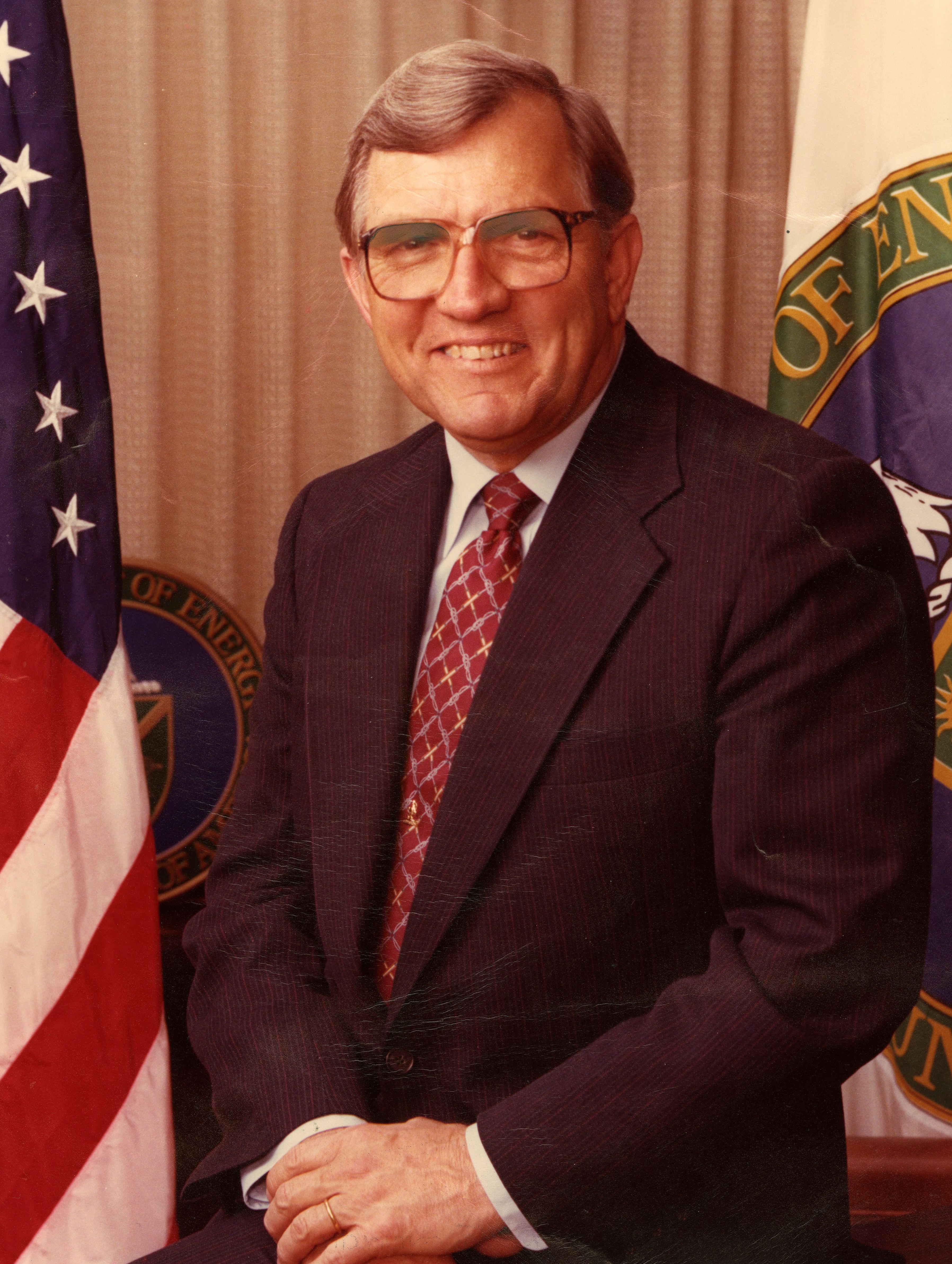
Historical · U.S. Department of Energy
James B. Edwards
Former United States Secretary of Energy · U.S. Department of Energy · 1981–1982
James B. Edwards served as United States Secretary of Energy (1981–1982). The page below collects sourced biographical facts, the appointment record, and provenance for Edwards.
Key facts
- Full name
- James B. Edwards
- Department
- U.S. Department of Energy
- Office
- United States Secretary of Energy
- Status
- Former secretary
- Appointment
- Senate-confirmed
- Tenure
- 1981–1982
- Confirmed
- —
- Born
- 1927
- Died
- 2014
- First year in office
- 1981
- Dataset version
- 1.20260703
Appointment & service record
United States Secretary of Energy · 1981–1982
- Department
- U.S. Department of Energy
- Appointment
- Senate-confirmed
- Appointing president
- —
- Confirmed
- —
Department, appointment type (Senate-confirmed, acting, recess, or designated), appointing president, confirmation status, and service dates are drawn from Wikidata and the White House Cabinet roster.[1][2][3]
Sources
- [1]https://www.wikidata.org/wiki/Q888950Wikidata · retrieved 2026-07-03
- [2]https://www.whitehouse.gov/administration/cabinet/whitehouse.gov · retrieved 2026-07-03
- [3]https://www.wikidata.org/wiki/Q639738wikidata-cabinet · retrieved 2026-07-03
Biographical narrative
801 words · sourced from the Wikipedia REST extract
James Burrows Edwards (June 24 1927 – December 26 2014) was an American dentist, politician, and public administrator who served as the first Republican governor of South Carolina since the Reconstruction era and later held federal office as United States Secretary of Energy under President Ronald Reagan. His career spanned military service during World War II, a professional practice in oral surgery, state legislative work, executive leadership at the state level, and national administration of energy policy.
Early life and career
Edwards was born on June 24 1927 in Hawthorne, Florida. During World War II he served as an officer in the United States Maritime Service and continued his naval service afterward with the United States Naval Reserve. He pursued higher education at the College of Charleston, earning a bachelor’s degree in 1950; while there he was initiated into Pi Kappa Phi fraternity. Edwards then attended the University of Louisville, where he received a Doctor of Dental Medicine (DMD) in 1955. Following his graduation, he completed a dental internship at the University of Pennsylvania.
In 1960, Edwards returned to Charleston and established a private practice that specialized in oral surgery. Over the subsequent years he held various positions related to dentistry within the local community, contributing to professional organizations and educational initiatives associated with the field.
Edwards entered politics in 1970 when he became chairman of the Republican Party of South Carolina’s 1st congressional district. That same year he supported Republican gubernatorial nominee U.S. Representative Albert Watson for South Carolina’s 2nd congressional district. Edwards publicly expressed concerns about the nomination of Clement Haynsworth to the United States Supreme Court, alleging that Democratic opponent John C. West had acted covertly against the nomination; these claims were part of a broader political discourse at the time.
In 1971 Edwards sought elective office in a special election for South Carolina’s 1st congressional district, created by the death of long‑time Democrat L. Mendel Rivers. Although he lost narrowly to Mendel Jackson Davis—a former staffer of Rivers—his campaign raised his profile sufficiently that he was subsequently elected as a Republican state senator representing white‑majority Charleston County.
Two years later, in 1973, Edwards entered the gubernatorial race. In the Republican primary he defeated General William Westmoreland, and in the general election he won against Democratic Congressman William Jennings Bryan Dorn of South Carolina’s 3rd congressional district. His victory made him the first Republican governor of the state since Daniel Henry Chamberlain in 1876. The election occurred during a period of national turbulence, with the Watergate scandal and ongoing opposition to the Vietnam War influencing political dynamics across the country.
South Carolina governors were prohibited from serving consecutive terms at that time; consequently Edwards did not seek reelection in 1978. After his gubernatorial term he maintained a close friendship with his Democratic predecessor John C. West, despite earlier public disagreements over judicial nominations and policy positions.
Cabinet tenure
In 1981 President Ronald Reagan appointed Edwards as United States Secretary of Energy. The Senate confirmed the appointment; Edwards served in this federal role until 1983. During his tenure he oversaw the Department of Energy’s operations, which included management of national energy policy, nuclear safety, and scientific research programs.
After resigning from the cabinet position, Edwards accepted the presidency of the Medical University of South Carolina (MUSC). He held that post for seventeen years, guiding the institution through periods of growth and development in medical education and research. In 1997 he was inducted into the South Carolina Hall of Fame, recognizing his contributions to state public life.
In 2008 Edwards publicly endorsed Mitt Romney for the Republican presidential nomination, reflecting his continued engagement with national politics even after leaving office.
Legacy
Edwards’ legacy is reflected in several honors and memorials that bear his name. In 1994 the South Carolina legislature renamed a portion of the Mark Clark Expressway—specifically the segment crossing the Wando River—as the James B. Edwards Bridge, commemorating his service to the state’s infrastructure and transportation planning. In 2010, the Medical University of South Carolina dedicated its new dental building and renamed its dental school the James B. Edwards College of Dental Medicine, acknowledging his professional roots in dentistry and his leadership at MUSC.
Edwards passed away on December 26 2014 at his home in Mount Pleasant, South Carolina, from complications related to a stroke. He was 87 years old. His death marked the loss of a figure who bridged local professional practice, state governance, and federal administration during a transformative period in American political history.
Through his pioneering role as a Republican governor in a historically Democratic state, his stewardship of national energy policy, and his long‑term leadership at a major medical university, James B. Edwards left an enduring imprint on both South Carolina’s public institutions and the broader landscape of U.S. governmental administration.
Sources & provenance
Every quantitative or attributable claim above carries a per-section [N] marker that resolves to the corresponding URL below. Each entry records the upstream provider, the canonical URL, and the timestamp at which the underlying source was retrieved.
Key facts
- https://www.wikidata.org/wiki/Q888950Wikidata · retrieved 2026-07-03
- https://www.whitehouse.gov/administration/cabinet/whitehouse.gov · retrieved 2026-07-03
- https://www.wikidata.org/wiki/Q639738wikidata-cabinet · retrieved 2026-07-03
Biographical narrative
- https://en.wikipedia.org/wiki/James_B._EdwardsWikipedia · retrieved 2026-07-03
Explore the Cabinet
The Cabinet includes the Vice President and the heads of the 15 executive departments. Browse the full roster of current and former secretaries, or explore how the Cabinet fits into the federal government.