
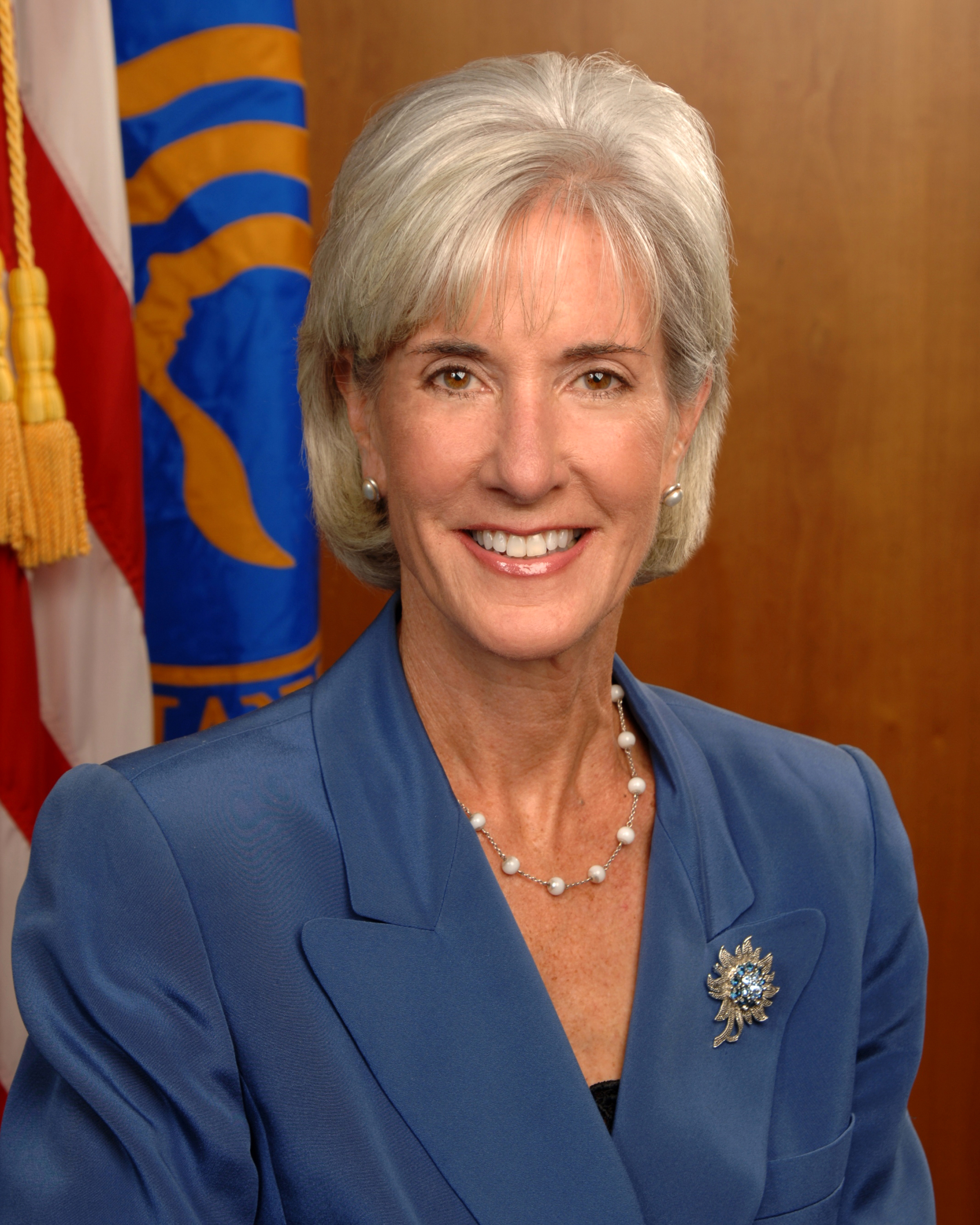
Historical · U.S. Department of Health and Human Services
Kathleen Sebelius
Former United States Secretary of Health and Human Services · U.S. Department of Health and Human Services · 2009–2014
Kathleen Sebelius served as United States Secretary of Health and Human Services (2009–2014). The page below collects sourced biographical facts, the appointment record, and provenance for Sebelius.
Key facts
- Full name
- Kathleen Sebelius
- Department
- U.S. Department of Health and Human Services
- Office
- United States Secretary of Health and Human Services
- Status
- Former secretary
- Appointment
- Senate-confirmed
- Tenure
- 2009–2014
- Confirmed
- —
- Born
- 1948
- Died
- —
- First year in office
- 2009
- Dataset version
- 1.20260703
Appointment & service record
United States Secretary of Health and Human Services · 2009–2014
- Department
- U.S. Department of Health and Human Services
- Appointment
- Senate-confirmed
- Appointing president
- —
- Confirmed
- —
Department, appointment type (Senate-confirmed, acting, recess, or designated), appointing president, confirmation status, and service dates are drawn from Wikidata and the White House Cabinet roster.[1][2][3]
Sources
- [1]https://www.wikidata.org/wiki/Q27677Wikidata · retrieved 2026-07-03
- [2]https://www.whitehouse.gov/administration/cabinet/whitehouse.gov · retrieved 2026-07-03
- [3]https://www.wikidata.org/wiki/Q639738wikidata-cabinet · retrieved 2026-07-03
Biographical narrative
1,037 words · sourced from the Wikipedia REST extract
Kathleen Sebelius is an American public servant who has held several high‑profile leadership positions in state and federal government, most notably as the 21st United States Secretary of Health and Human Services from 2009 to 2014. Prior to her cabinet service, she was a long‑time legislator and executive in Kansas, serving first in the state House of Representatives, then as Insurance Commissioner, and ultimately as the state's governor from 2003 until 2009. Her career has been marked by a focus on fiscal responsibility, public health oversight, and bipartisan collaboration.
Early life and career
Born on May 15, 1948, in Cincinnati, Ohio, Sebelius grew up in a family that operated funeral homes and was active in local politics. Her father, John J. Gilligan, served as a city councilor before being elected to Congress for one term and later becoming governor of Ohio when she was 21 years old. The family’s Catholic background and Irish heritage were part of her early upbringing.
Sebelius attended the Summit Country Day School in Cincinnati and earned a Bachelor of Arts degree in political science from Trinity Washington University in Washington, D.C. She continued her education at the University of Kansas, where she obtained a Master of Public Administration. In 1974 she relocated to Kansas, setting the stage for her future public service career.
Her first professional role in the state was as executive director and chief lobbyist for the Kansas Trial Lawyers Association from 1977 until 1986. This experience provided her with insight into legal advocacy and policy development at the state level.
In 1986, Sebelius entered elective office by winning a seat in the Kansas House of Representatives representing Topeka. She was re‑elected in 1988, 1990, and 1992, serving four consecutive terms. During her tenure she chaired the Federal and State Affairs Committee and was known for her support of pro‑choice positions.
In 1991 Sebelius sought leadership within the House by running for Majority Leader; she was not elected to that position. She also endorsed Gary Hart in the 1988 presidential election, reflecting her engagement with national politics even while serving at the state level.
When the opportunity arose in 1994 to run for Kansas Insurance Commissioner—a role traditionally held by Republicans—Sebelius won the office, becoming the first Democrat in more than a century to hold that position. She entered the role with an annual budget of $11.7 million and implemented significant reforms, including rejecting campaign contributions from the insurance industry and blocking a proposed merger involving Blue Cross Blue Shield of Kansas. Her tenure was noted for reducing the department’s budget to $10 million by 2002 and cutting expenditures on contracted services after uncovering overbilling practices.
In recognition of her public service achievements while serving as Insurance Commissioner, Governing Magazine named her one of its Public Officials of the Year in 2001.
Sebelius entered statewide executive office when she was elected governor of Kansas in 2002. Her campaign emphasized protecting school budgets from cuts, avoiding tax increases, and conducting a comprehensive review of state government operations. She raised $4 million for her campaign—a record for Kansas fundraising at that time—and defeated Republican candidate Tim Shallenburger with 53% of the vote. The election made Sebelius and her father the first father‑daughter pair to both serve as governors in United States history.
During her first term (2003–2007), Sebelius was widely regarded as a popular governor, ranking tied for 20th in national popularity polls in early 2006. She received recognition from Time magazine as one of the five best governors in America that year, citing her elimination of a $1.1 billion debt inherited at inauguration, her efforts to eliminate wasteful spending, and her strong support for public education—all achieved without raising taxes. The publication also highlighted her bipartisan approach in a state dominated by Republican legislators.
In 2006 Sebelius announced her re‑election campaign and selected former Kansas Republican Party chair Mark Parkinson as her running mate for lieutenant governor after he switched parties to become a Democrat. She faced Republican State Senator Jim Barnett in the general election, winning with a comfortable margin according to multiple polls. Her second term continued to focus on fiscal prudence, education funding, and health insurance regulation.
Cabinet tenure
In 2009 President Barack Obama appointed Sebelius as Secretary of Health and Human Services. The United States Senate confirmed her appointment; she served in that capacity until 2014. During her tenure, she oversaw the implementation of a major federal health reform initiative aimed at expanding coverage and improving public health infrastructure. Her leadership involved coordinating with state agencies, managing large program budgets, and ensuring compliance with new regulatory standards.
Sebelius’s time as secretary was marked by efforts to streamline operations within the department, enhance data systems for tracking health outcomes, and promote preventive care initiatives across the nation. She worked closely with other federal agencies and stakeholders to address public health challenges such as chronic disease management and emergency preparedness.
Legacy
Kathleen Sebelius’s career has left a lasting imprint on both Kansas state government and national policy. As governor she is credited with eliminating a substantial state debt, strengthening public education funding, and fostering a bipartisan environment that allowed for pragmatic governance in a politically divided legislature. Her tenure as Insurance Commissioner demonstrated a commitment to transparency and consumer protection within the insurance industry.
At the federal level, her stewardship of the Department of Health and Human Services during a pivotal period of health reform contributed to significant changes in how health services are delivered and financed across the United States. She played a key role in bringing new coverage options to millions of Americans and improving the department’s capacity to respond to public health emergencies.
Beyond her official duties, Sebelius has remained active in civic life. She served as chair‑emerita of the Democratic Governors Association, becoming the first woman to hold that position, and later became CEO of Sebelius Resources LLC, applying her experience in governance and policy to private sector initiatives.
Her legacy is characterized by a blend of fiscal conservatism, commitment to public welfare, and an ability to navigate complex political landscapes. Whether at the state or federal level, Sebelius’s work has been noted for its emphasis on accountability, efficiency, and broad-based collaboration.
Sources & provenance
Every quantitative or attributable claim above carries a per-section [N] marker that resolves to the corresponding URL below. Each entry records the upstream provider, the canonical URL, and the timestamp at which the underlying source was retrieved.
Key facts
- https://www.wikidata.org/wiki/Q27677Wikidata · retrieved 2026-07-03
- https://www.whitehouse.gov/administration/cabinet/whitehouse.gov · retrieved 2026-07-03
- https://www.wikidata.org/wiki/Q639738wikidata-cabinet · retrieved 2026-07-03
Biographical narrative
- https://en.wikipedia.org/wiki/Kathleen_SebeliusWikipedia · retrieved 2026-07-03
Explore the Cabinet
The Cabinet includes the Vice President and the heads of the 15 executive departments. Browse the full roster of current and former secretaries, or explore how the Cabinet fits into the federal government.