
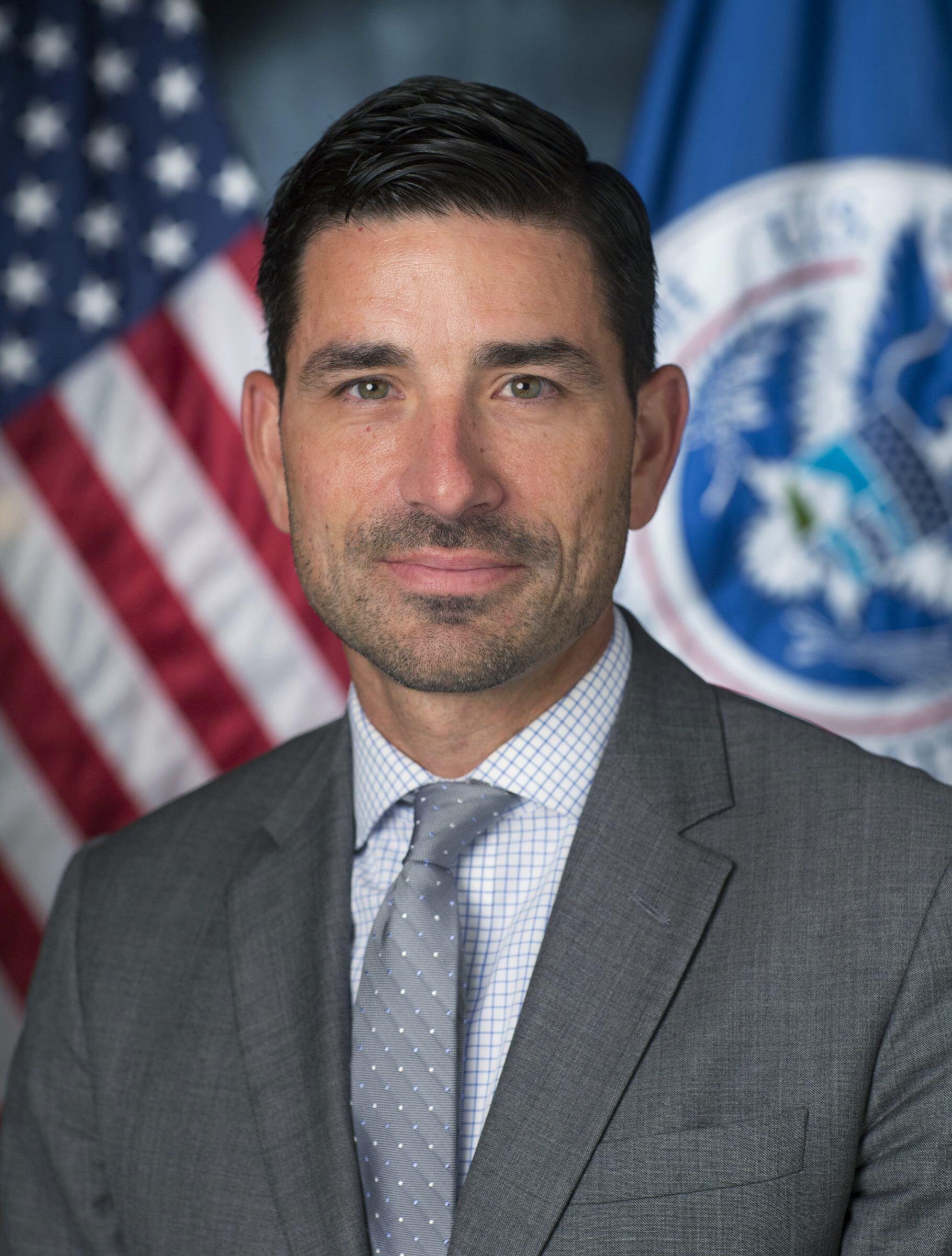
Historical · U.S. Department of Homeland Security
Chad Wolf
Former United States Secretary of Homeland Security · U.S. Department of Homeland Security · 2019–2021
Chad Wolf served as United States Secretary of Homeland Security (2019–2021). The page below collects sourced biographical facts, the appointment record, and provenance for Wolf.
Key facts
- Full name
- Chad Wolf
- Department
- U.S. Department of Homeland Security
- Office
- United States Secretary of Homeland Security
- Status
- Former secretary
- Appointment
- Senate-confirmed
- Tenure
- 2019–2021
- Confirmed
- —
- Born
- 1976
- Died
- —
- First year in office
- 2019
- Dataset version
- 1.20260704
Appointment & service record
United States Secretary of Homeland Security · 2019–2021
- Department
- U.S. Department of Homeland Security
- Appointment
- Senate-confirmed
- Appointing president
- —
- Confirmed
- —
Department, appointment type (Senate-confirmed, acting, recess, or designated), appointing president, confirmation status, and service dates are drawn from Wikidata and the White House Cabinet roster.[1][2][3]
Sources
- [1]https://www.wikidata.org/wiki/Q72044313Wikidata · retrieved 2026-07-04
- [2]https://www.whitehouse.gov/administration/cabinet/whitehouse.gov · retrieved 2026-07-04
- [3]https://www.wikidata.org/wiki/Q639738wikidata-cabinet · retrieved 2026-07-04
Biographical narrative
904 words · sourced from the Wikipedia REST extract
Chad Fredrick Wolf is an American former government official who served as the United States Secretary of Homeland Security from 2019 to early 2021. Born on June 21, 1976, he rose through a series of roles within the Department of Homeland Security (DHS) and its predecessor agencies before being appointed by President Donald J. Trump to lead the department during a period marked by significant legal scrutiny over his appointment.
Early life and career
Wolf was born in Jackson, Mississippi, to parents James B. Wolf and Cinda Thompson Wolf. He spent much of his childhood in Plano, Texas, where he attended Plano East Senior High School. After graduation, he earned a tennis scholarship that enabled him to enroll at Collin College. He later transferred to Southern Methodist University, completing a Bachelor of Arts degree in history. In 2013, Wolf expanded his professional credentials by obtaining a non‑credit certificate in contract management from Villanova University.
Wolf’s early career involved legislative and executive branch work. He served as a staffer for Republican U.S. Senators Phil Gramm and Kay Bailey Hutchison before spending two and a half years with Senator Chuck Hagel. From 2002 to 2005, he worked within the Transportation Security Administration (TSA), ultimately becoming Assistant Administrator for Transportation Security Policy in 2005. During this period, he first collaborated with Kirstjen Nielsen, who would later become DHS Secretary.
In October 2005, Wolf transitioned to the private sector as vice president and senior director at Wexler & Walker, a lobbying firm that represented clients seeking contracts from the TSA. He remained in that role until 2016, during which time he helped secure procurement agreements for his clients.
Wolf returned to federal service in March 2017 when President Trump appointed him chief of staff at the TSA. After four months, he was promoted to DHS Deputy Chief of Staff and served as the principal aide to Deputy Secretary Elaine Duke. In July 2017, Wolf became chief of staff to DHS Secretary Kirstjen Nielsen. According to congressional testimony, his responsibilities were limited to providing information to Nielsen rather than shaping policy decisions such as the family separation program; he later indicated that he supported the President’s decision when an executive order was issued to halt that practice.
Subsequently, Wolf was appointed Assistant Secretary of Homeland Security for Strategy, Plans, Analysis and Risk—a Senior Executive Service position that does not require Senate confirmation. He also served concurrently as Acting Under Secretary of Homeland Security for Strategy, Policy, and Plans. In February 2019, President Trump nominated him to serve permanently in the under secretary role; his confirmation hearing took place in June 2019.
Cabinet tenure
Wolf’s most prominent federal service came when he was named acting United States Secretary of Homeland Security on November 1, 2019, following the departure of Kevin McAleenan. The appointment was structured to avoid designating him as a principal officer from a non‑confirmed position; it relied on his status as confirmed Under Secretary. Wolf was officially confirmed in that role by the Senate on November 13, 2019, with a vote tally of 54–41, and he was sworn in as acting secretary the same day.
During his tenure, Wolf oversaw DHS operations amid heightened scrutiny over the legality of his appointment. On August 14, 2020, the Government Accountability Office concluded that Wolf had become acting secretary improperly. Subsequent federal court rulings echoed this assessment, declaring his appointment unlawful and invalidating a number of orders he issued on procedural grounds.
In November 2020, a district judge ruled that Wolf’s appointment was not an exercise of legal authority and overturned several of his directives. The same month, the Department of Justice announced that President Trump would nominate Wolf for permanent confirmation as Secretary of Homeland Security; the nomination was formally submitted to the Senate on September 10, 2020. However, in January 2021, following a series of court decisions and mounting legal challenges, President Trump withdrew Wolf’s nomination on January 6. Wolf resigned from his position on January 11, 2021.
Wolf’s period as acting secretary was marked by significant controversy over the chain of command within DHS and the application of the Homeland Security Act of 2002 versus the Federal Vacancies Reform Act of 1998. The legal disputes centered on whether the department had followed proper procedures for placing an individual in the line of succession and whether his authority to act as secretary was consistent with statutory requirements.
Legacy
Chad Wolf’s service at the helm of DHS is remembered primarily for the legal challenges that surrounded his appointment and tenure. His experience illustrates the complexities of executive appointments, especially when acting officials are placed in senior roles without direct Senate confirmation. The courts’ rulings against his appointment underscored the importance of adhering to statutory succession protocols within federal agencies.
Beyond the controversies, Wolf’s career reflects a trajectory through both legislative staff positions and high‑level DHS leadership roles. His work as chief of staff to TSA and later to Secretary Nielsen positioned him at key decision points during the Trump administration, including matters related to border security policies and the deployment of federal law enforcement forces in various cities.
Wolf’s resignation in early 2021 closed a chapter marked by intense scrutiny over appointment procedures and executive authority. His legacy within DHS serves as a reference point for future discussions about the legal frameworks governing acting appointments and the responsibilities of senior officials in maintaining agency continuity during transitions.
Sources & provenance
Every quantitative or attributable claim above carries a per-section [N] marker that resolves to the corresponding URL below. Each entry records the upstream provider, the canonical URL, and the timestamp at which the underlying source was retrieved.
Key facts
- https://www.wikidata.org/wiki/Q72044313Wikidata · retrieved 2026-07-04
- https://www.whitehouse.gov/administration/cabinet/whitehouse.gov · retrieved 2026-07-04
- https://www.wikidata.org/wiki/Q639738wikidata-cabinet · retrieved 2026-07-04
Biographical narrative
- https://en.wikipedia.org/wiki/Chad_WolfWikipedia · retrieved 2026-07-04
Explore the Cabinet
The Cabinet includes the Vice President and the heads of the 15 executive departments. Browse the full roster of current and former secretaries, or explore how the Cabinet fits into the federal government.