
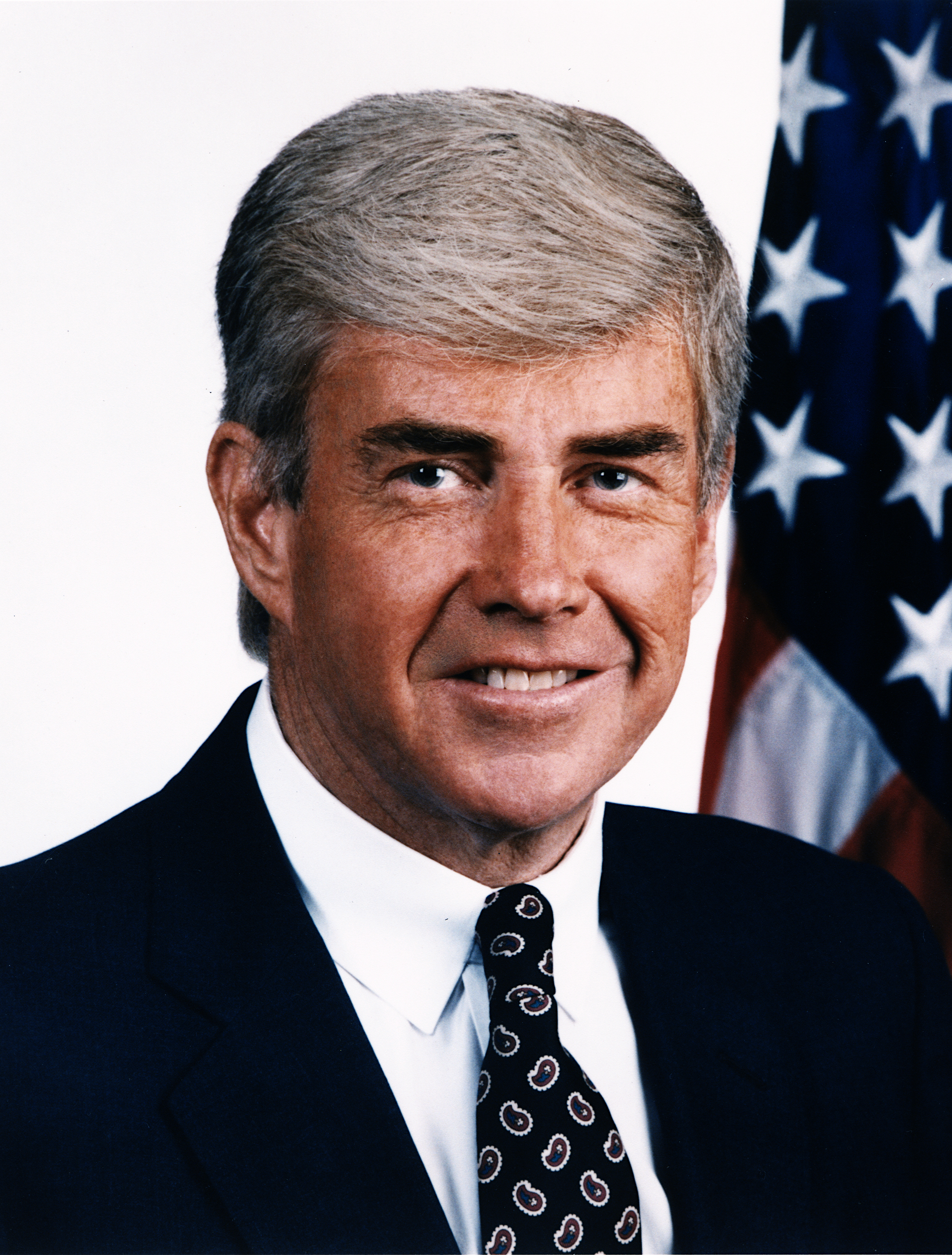
Historical · U.S. Department of Housing and Urban Development
Jack Kemp
Former United States Secretary of Housing and Urban Development · U.S. Department of Housing and Urban Development · 1989–1993
Jack Kemp served as United States Secretary of Housing and Urban Development (1989–1993). The page below collects sourced biographical facts, the appointment record, and provenance for Kemp.
Key facts
- Full name
- Jack Kemp
- Department
- U.S. Department of Housing and Urban Development
- Office
- United States Secretary of Housing and Urban Development
- Status
- Former secretary
- Appointment
- Senate-confirmed
- Tenure
- 1989–1993
- Confirmed
- —
- Born
- 1935
- Died
- 2009
- First year in office
- 1989
- Dataset version
- 1.20260703
Appointment & service record
United States Secretary of Housing and Urban Development · 1989–1993
- Department
- U.S. Department of Housing and Urban Development
- Appointment
- Senate-confirmed
- Appointing president
- —
- Confirmed
- —
Department, appointment type (Senate-confirmed, acting, recess, or designated), appointing president, confirmation status, and service dates are drawn from Wikidata and the White House Cabinet roster.[1][2][3]
Sources
- [1]https://www.wikidata.org/wiki/Q357676Wikidata · retrieved 2026-07-03
- [2]https://www.whitehouse.gov/administration/cabinet/whitehouse.gov · retrieved 2026-07-03
- [3]https://www.wikidata.org/wiki/Q639738wikidata-cabinet · retrieved 2026-07-03
Biographical narrative
826 words · sourced from the Wikipedia REST extract
Jack French Kemp (July 13 1935 – May 2 2009) was an American public servant whose career spanned professional football, congressional leadership, and federal cabinet service. After a decade as a quarterback in the American Football League, he represented New York’s 27th congressional district for nine terms before being appointed by President George H. W. Bush as the ninth United States Secretary of Housing and Urban Development, a post he held from 1989 to 1993. Following his cabinet tenure, Kemp remained active in public life through commentary, board service, authorship, and advocacy for retired athletes, and was posthumously awarded the Presidential Medal of Freedom by President Barack Obama.
Early life and career
Jack French Kemp was born on July 13 1935 in Los Angeles, California. He grew up as one of four sons in a middle‑class family that operated a trucking business founded by his father, Paul Robert Kemp Sr., which expanded from a single truck to fourteen over the years. His mother, Frances Elizabeth (née Pope), worked as a social worker and Spanish teacher. The Kemps attended the Church of Christ, Scientist while living in the predominantly Jewish Wilshire district of West Los Angeles; Kemp later became an advocate for Jewish causes.
Kemp’s early education took place at Fairfax High School on Melrose Avenue, where he was surrounded by classmates from diverse backgrounds, including several who would become notable figures in music and sports. He worked alongside his brothers at his father’s trucking company during high school while maintaining a strong interest in athletics, particularly football.
After graduating in 1953, Kemp enrolled at Occidental College, attracted by the institution’s use of professional football formations that he believed would prepare him for a career as a quarterback. At Occidental, he excelled both on the field and in the classroom. He played multiple positions—quarterback, defensive back, place kicker, and punter—and also set records as a javelin thrower. In 1955 and 1956, he led the football team to respectable season records and earned recognition as a Little All‑America player when he surpassed 1,100 passing yards in one season, topping national small‑college statistics.
Upon completing his undergraduate studies with a degree in physical education, Kemp pursued graduate work in economics at Long Beach State University and California Western University. During this period, from 1958 to 1962, he served in the United States Army Reserve, fulfilling his military obligations while continuing his academic pursuits.
Kemp’s professional football career began when he joined the American Football League as a quarterback for the Buffalo Bills. He later played for the Los Angeles/San Diego Chargers. Over the ten years of the AFL’s existence, Kemp appeared in all five championship games and was selected to seven All‑Star games. In 1965, he earned the AFL Most Valuable Player award after leading the Bills to a second consecutive championship. His leadership on the field extended beyond performance; he co‑founded the AFL Players Association and served as its president for five terms.
After retiring from football in the early 1970s, Kemp transitioned into politics. He was elected to the U.S. House of Representatives in 1971, representing New York’s 27th congressional district. Over nine consecutive terms, he focused on economic issues, advocating for low taxes and supply‑side policies. His legislative work also touched on social matters, including positions on abortion and immigration reform. Kemp’s economic philosophy was influenced by the Chicago school and supply‑side economics; he is noted as an influence upon Ronald Reagan’s political agenda and as a key architect of the Economic Recovery Tax Act of 1981, commonly known as the Kemp–Roth tax cut.
Cabinet tenure
In 1989, President George H. W. Bush nominated Kemp to serve as the United States Secretary of Housing and Urban Development. The Senate confirmed his appointment, allowing him to assume leadership of the department that oversees federal housing policy and community development programs. During his four‑year term, which concluded in 1993, Kemp directed HUD’s efforts to address national housing needs under the administration’s broader economic agenda. He oversaw initiatives aimed at expanding affordable housing options and promoting urban revitalization projects across the country.
Legacy
Following his departure from the cabinet, Kemp continued to influence public discourse through a variety of roles. He served on corporate and nonprofit boards, lending his experience to both private enterprises and community organizations. Kemp authored, co‑authored, and edited several books that reflected his interests in economics, politics, and sports.
His lifelong passion for football remained evident; he promoted the sport at multiple levels and advocated for the welfare of retired professional players. In recognition of his public service and contributions to national life, President Barack Obama awarded him the Presidential Medal of Freedom posthumously in 2009.
Jack Kemp passed away on May 2 2009, leaving behind a legacy that spanned athletics, legislative work, federal administration, and civic engagement. His career exemplifies a trajectory from professional athlete to influential public servant, marked by consistent involvement in shaping economic policy and community development initiatives.
Sources & provenance
Every quantitative or attributable claim above carries a per-section [N] marker that resolves to the corresponding URL below. Each entry records the upstream provider, the canonical URL, and the timestamp at which the underlying source was retrieved.
Key facts
- https://www.wikidata.org/wiki/Q357676Wikidata · retrieved 2026-07-03
- https://www.whitehouse.gov/administration/cabinet/whitehouse.gov · retrieved 2026-07-03
- https://www.wikidata.org/wiki/Q639738wikidata-cabinet · retrieved 2026-07-03
Biographical narrative
- https://en.wikipedia.org/wiki/Jack_KempWikipedia · retrieved 2026-07-03
Explore the Cabinet
The Cabinet includes the Vice President and the heads of the 15 executive departments. Browse the full roster of current and former secretaries, or explore how the Cabinet fits into the federal government.