
Historical · U.S. Department of Labor
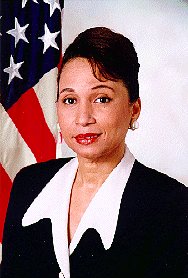
Alexis Herman
Former United States Secretary of Labor · U.S. Department of Labor · 1997–2001
Alexis Herman served as United States Secretary of Labor (1997–2001). The page below collects sourced biographical facts, the appointment record, and provenance for Herman.
Key facts
- Full name
- Alexis Herman
- Department
- U.S. Department of Labor
- Office
- United States Secretary of Labor
- Status
- Former secretary
- Appointment
- Senate-confirmed
- Tenure
- 1997–2001
- Confirmed
- —
- Born
- 1947
- Died
- 2025
- First year in office
- 1997
- Dataset version
- 1.20260703
Appointment & service record
United States Secretary of Labor · 1997–2001
- Department
- U.S. Department of Labor
- Appointment
- Senate-confirmed
- Appointing president
- —
- Confirmed
- —
Department, appointment type (Senate-confirmed, acting, recess, or designated), appointing president, confirmation status, and service dates are drawn from Wikidata and the White House Cabinet roster.[1][2][3]
Sources
- [1]https://www.wikidata.org/wiki/Q292340Wikidata · retrieved 2026-07-03
- [2]https://www.whitehouse.gov/administration/cabinet/whitehouse.gov · retrieved 2026-07-03
- [3]https://www.wikidata.org/wiki/Q639738wikidata-cabinet · retrieved 2026-07-03
Biographical narrative
845 words · sourced from the Wikipedia REST extract
Alexis Margaret Herman (July 16 1947 – April 26 2025) served as the 23rd United States Secretary of Labor from 1997 to 2001 under President Bill Clinton. In that capacity she became the first Black American to hold the position, overseeing federal labor policy and workforce development during a period marked by significant economic change. Prior to her cabinet appointment, Herman had built a career in public service and nonprofit work focused on expanding employment opportunities for women and minorities, and later continued to influence national policy through corporate board memberships.
Early life and career
Herman was born in Mobile, Alabama, the daughter of Alex Herman, who became the state’s first Black ward leader, and Gloria Caponis, a schoolteacher. Raised in a Catholic household, she attended parochial schools during an era when public education remained racially segregated. Her parents chose Heart of Mary High School partly because its faculty included white nuns and priests, which they believed would expose her to greater diversity. As a sophomore, Herman was suspended after questioning the Archdiocese’s exclusion of Black students from religious pageants that allowed white students to participate; she was later readmitted following objections from classmates’ parents.
After high school, Herman pursued higher education at Edgewood College in Madison, Wisconsin, and Spring Hill College in Mobile before transferring to Xavier University of Louisiana. She joined the Gamma Alpha Chapter of Delta Sigma Theta sorority and earned a Bachelor of Arts degree in sociology in 1969.
Returning to Mobile, she worked to desegregate the parochial schools she had attended. She then served as a social worker with Catholic Charities in Pascagoula, Mississippi, where she advocated for shipyard training programs that would benefit unskilled Black laborers. In Atlanta, Georgia, Herman became director of the Southern Regional Council’s Black Women’s Employment Program, which sought to place minority women into managerial and technical positions.
Later, as a consultant at RTP—a New‑York–based firm—she led initiatives that created apprenticeships for women in nontraditional occupations. It was during this time that she met Ray Marshall, who would later become the Labor Secretary under President Jimmy Carter. When Carter assumed office in 1977, he and Marshall invited Herman to serve as director of the Department of Labor’s Women’s Bureau. At age 29, she became the youngest person ever appointed to that post, where she worked to expand business opportunities for women and encouraged major corporations such as Coca‑Cola, Delta Air Lines, and General Motors to prioritize diversity in their hiring practices.
Following the end of the Carter administration, Herman founded her own consulting firm, A.M. Herman & Associates. The firm advised corporations on marketing, management, training programs, and organizational strategy. She also managed Jesse Jackson’s convention teams during his 1984 and 1988 presidential campaigns for the Democratic Party, which led to her appointment as chief of staff to Democratic National Committee Chairman Ronald H. Brown. In that role she later served as vice chair of the 1992 Democratic National Convention.
Cabinet tenure
After President Bill Clinton’s election in 1992, Herman was appointed deputy director of the Presidential Transition Office and subsequently became director of the White House Office of Public Liaison. In this capacity she managed relationships with interest groups, organized informal gatherings to promote White House initiatives, and cultivated support from organizations such as the National Association for the Advancement of Colored People and the Congressional Black Caucus. Her outreach efforts also extended to the business community in advance of the administration’s trade negotiations, including the North American Free Trade Agreement.
In 1996, Clinton announced Herman’s nomination to replace outgoing Secretary Robert Reich. The Senate confirmation process experienced delays; however, she was ultimately confirmed and served as Secretary of Labor from 1997 until 2001. During her tenure she oversaw federal labor policy during a period of economic expansion and addressed issues related to workforce development, employment standards, and labor relations.
After leaving the cabinet, Herman remained active in public life. She continued to support Democratic political causes while also serving on corporate boards, including those of Coca‑Cola and Toyota. Her post‑government career reflected her longstanding commitment to bridging business interests with social equity objectives.
Legacy
Alexis Herman’s appointment as Secretary of Labor marked a historic milestone as the first Black woman to hold that office. Her career trajectory—from grassroots advocacy in Mobile to national leadership—illustrated a sustained focus on expanding employment opportunities for women and minorities. In the Department of Labor, she championed initiatives aimed at workforce development and diversity within corporate hiring practices.
Beyond her cabinet service, Herman’s influence extended into the private sector through board memberships that allowed her to shape corporate strategies related to labor and community engagement. Her work in public liaison roles helped forge connections between government agencies, civil‑rights organizations, and business leaders, thereby fostering a collaborative approach to policy implementation.
Herman passed away on April 26 2025, leaving behind a legacy of pioneering leadership and dedicated service to the American workforce. Her contributions continue to be referenced by scholars studying labor policy, gender equity in employment, and the role of minority leaders within federal agencies.
Sources & provenance
Every quantitative or attributable claim above carries a per-section [N] marker that resolves to the corresponding URL below. Each entry records the upstream provider, the canonical URL, and the timestamp at which the underlying source was retrieved.
Key facts
- https://www.wikidata.org/wiki/Q292340Wikidata · retrieved 2026-07-03
- https://www.whitehouse.gov/administration/cabinet/whitehouse.gov · retrieved 2026-07-03
- https://www.wikidata.org/wiki/Q639738wikidata-cabinet · retrieved 2026-07-03
Biographical narrative
- https://en.wikipedia.org/wiki/Alexis_HermanWikipedia · retrieved 2026-07-03
Explore the Cabinet
The Cabinet includes the Vice President and the heads of the 15 executive departments. Browse the full roster of current and former secretaries, or explore how the Cabinet fits into the federal government.