
Historical · U.S. Department of Labor
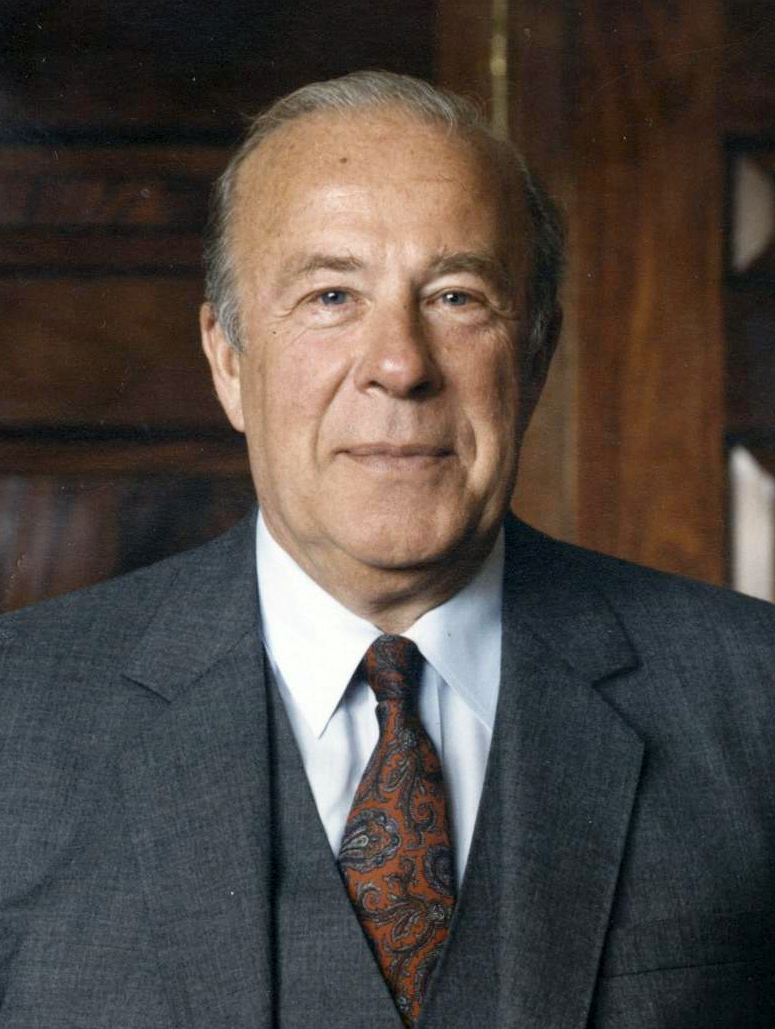
George Shultz
Former United States Secretary of Labor · U.S. Department of Labor · 1969–1970
George Shultz served as United States Secretary of Labor (1969–1970). The page below collects sourced biographical facts, the appointment record, and provenance for Shultz.
Key facts
- Full name
- George Shultz
- Department
- U.S. Department of Labor
- Office
- United States Secretary of Labor
- Status
- Former secretary
- Appointment
- Senate-confirmed
- Tenure
- 1969–1970
- Confirmed
- —
- Born
- 1920
- Died
- 2021
- First year in office
- 1969
- Dataset version
- 1.20260703
Appointment & service record
United States Secretary of Labor · 1969–1970
- Department
- U.S. Department of Labor
- Appointment
- Senate-confirmed
- Appointing president
- —
- Confirmed
- —
Department, appointment type (Senate-confirmed, acting, recess, or designated), appointing president, confirmation status, and service dates are drawn from Wikidata and the White House Cabinet roster.[1][2][3]
Sources
- [1]https://www.wikidata.org/wiki/Q313411Wikidata · retrieved 2026-07-03
- [2]https://www.whitehouse.gov/administration/cabinet/whitehouse.gov · retrieved 2026-07-03
- [3]https://www.wikidata.org/wiki/Q639738wikidata-cabinet · retrieved 2026-07-03
Biographical narrative
847 words · sourced from the Wikipedia REST extract
George Pratt Shultz was an American economist, businessman, diplomat, and statesman whose career spanned academia, business, and public service. Born in 1920, he served as United States Secretary of Labor from 1969 to 1970 under President Richard Nixon, later holding additional Cabinet positions including Secretary of the Treasury and Secretary of State during the Reagan administration. Shultz’s work influenced labor policy, economic management, and foreign relations before his death in February 2021.
Early life and career
George Pratt Shultz entered the world on December 13, 1920, in New York City as the only child of Margaret Lennox (née Pratt) and Birl Earl Shultz. He was raised in Englewood, New Jersey, where his family’s great‑grandfather had immigrated from Germany during the mid‑nineteenth century. After attending local public schools, Shultz transferred to the Englewood School for Boys (now Dwight‑Englewood School) through his second year of high school and completed his secondary education at Loomis Chaffee School in Windsor, Connecticut, graduating in 1938.
Shultz pursued higher education at Princeton University, earning a bachelor’s degree cum laude in economics with a minor in public and international affairs. His senior thesis examined the agricultural impact of the Tennessee Valley Authority, for which he conducted on‑site research. He graduated with honors in 1942. From that year until 1945, Shultz served as an artillery officer in the United States Marine Corps, attaining the rank of captain. During his service he saw action with the 7th Defense Battalion at Nanumea and later joined the U.S. Army’s 81st Infantry Division during the Battle of Angaur (Peleliu).
After World War II, Shultz returned to academia, earning a Ph.D. in industrial economics from the Massachusetts Institute of Technology in 1949. He taught in MIT’s Department of Economics and Sloan School of Management from 1948 to 1957, taking a leave of absence in 1955 to serve as a senior staff economist on President Dwight D. Eisenhower’s Council of Economic Advisers. In 1957 he joined the University of Chicago Graduate School of Business as a professor of industrial relations and served as dean from 1962 to 1968. Influenced by scholars such as Milton Friedman and George Stigler, Shultz developed a strong commitment to free‑market principles during his time in Chicago.
In 1969, President Richard Nixon appointed Shultz as United States Secretary of Labor, marking the beginning of his Cabinet career.
Cabinet tenure
Shultz’s tenure as Secretary of Labor lasted from 1969 until 1970. Confirmed by the Senate, he confronted a significant labor dispute involving longshoremen during a strike that had been halted by a Taft–Hartley injunction. Drawing on his academic background, Shultz allowed the parties involved to negotiate directly, leading to a resolution.
During this period, Shultz implemented the Philadelphia Plan, which required construction contractors who refused to employ black workers to adopt measures to increase minority employment. This policy represented the first instance in which the federal government applied racial quotas as a tool of civil‑rights enforcement.
After his service at Labor, Shultz became the inaugural director of the Office of Management and Budget in 1970, a position he held until 1972 when he was appointed Secretary of the Treasury under President Nixon. In that role, he supported measures aimed at revitalizing the economy, including actions that contributed to the end of the Bretton Woods system.
Following his departure from the Nixon administration in May 1974, Shultz entered the private sector as an executive with Bechtel Group, eventually becoming president and director. His experience in business and public service led President Ronald Reagan to appoint him Secretary of State in 1982, a post he held until 1989. In that capacity, Shultz advocated for engagement with Soviet leader Mikhail Gorbachev, contributing to a thaw in U.S.–Soviet relations, and opposed the diversion of aid to certain foreign conflicts.
Legacy
George Shultz’s career left an imprint across multiple domains. His early work at Labor introduced federal racial quotas through the Philadelphia Plan, setting a precedent for government involvement in civil‑rights enforcement. As Treasury Secretary, he played a role in economic policy shifts that ended the Bretton Woods monetary arrangement. In foreign affairs, his tenure as Secretary of State helped shape U.S. relations with the Soviet Union during the final years of the Cold War.
After leaving public office in 1989, Shultz remained active in business and advisory roles. He served on the boards of Bechtel and the Charles Schwab Corporation, contributed to the Global Commission on Drug Policy, participated in California Governor Arnold Schwarzenegger’s Economic Recovery Council, and held positions with institutions such as the Hoover Institution, the Institute for International Economics, and the Washington Institute for Near East Policy. Beginning in 2013, he championed a revenue‑neutral carbon fee and dividend as an economically sound approach to addressing climate change.
Shultz also sat on the board of Theranos, a company that later faced scrutiny over its technology claims. His grandson, Tyler Shultz, worked at Theranos before becoming a whistleblower regarding the firm’s fraudulent practices.
George Pratt Shultz passed away on February 6, 2021, leaving behind a legacy characterized by significant contributions to labor policy, economic management, and international diplomacy.
Sources & provenance
Every quantitative or attributable claim above carries a per-section [N] marker that resolves to the corresponding URL below. Each entry records the upstream provider, the canonical URL, and the timestamp at which the underlying source was retrieved.
Key facts
- https://www.wikidata.org/wiki/Q313411Wikidata · retrieved 2026-07-03
- https://www.whitehouse.gov/administration/cabinet/whitehouse.gov · retrieved 2026-07-03
- https://www.wikidata.org/wiki/Q639738wikidata-cabinet · retrieved 2026-07-03
Biographical narrative
- https://en.wikipedia.org/wiki/George_ShultzWikipedia · retrieved 2026-07-03
Explore the Cabinet
The Cabinet includes the Vice President and the heads of the 15 executive departments. Browse the full roster of current and former secretaries, or explore how the Cabinet fits into the federal government.