
Historical · U.S. Department of Labor
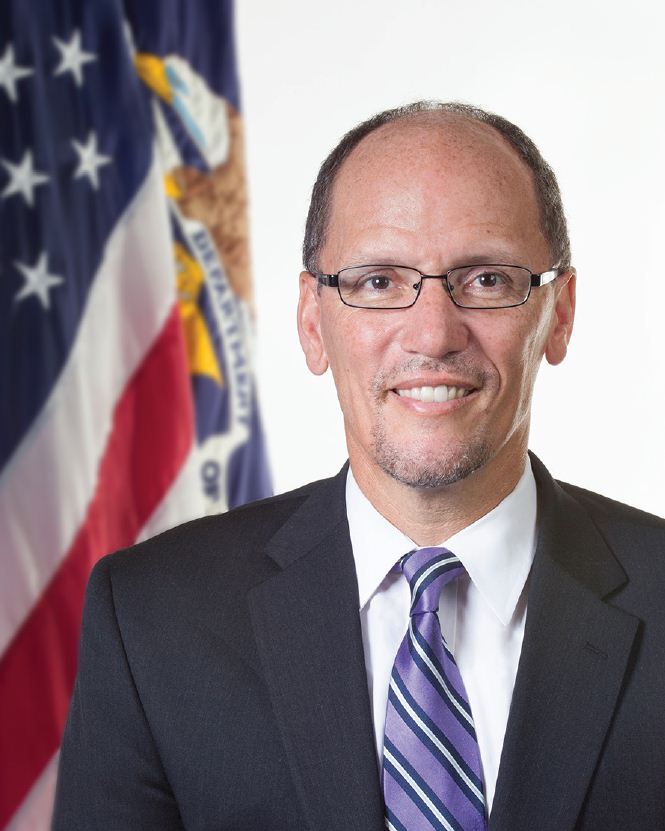
Thomas Perez
Former United States Secretary of Labor · U.S. Department of Labor · 2013–2017
Thomas Perez served as United States Secretary of Labor (2013–2017). The page below collects sourced biographical facts, the appointment record, and provenance for Perez.
Key facts
- Full name
- Thomas Perez
- Department
- U.S. Department of Labor
- Office
- United States Secretary of Labor
- Status
- Former secretary
- Appointment
- Senate-confirmed
- Tenure
- 2013–2017
- Confirmed
- —
- Born
- 1961
- Died
- —
- First year in office
- 2013
- Dataset version
- 1.20260703
Appointment & service record
United States Secretary of Labor · 2013–2017
- Department
- U.S. Department of Labor
- Appointment
- Senate-confirmed
- Appointing president
- —
- Confirmed
- —
Department, appointment type (Senate-confirmed, acting, recess, or designated), appointing president, confirmation status, and service dates are drawn from Wikidata and the White House Cabinet roster.[1][2][3]
Sources
- [1]https://www.wikidata.org/wiki/Q7793121Wikidata · retrieved 2026-07-03
- [2]https://www.whitehouse.gov/administration/cabinet/whitehouse.gov · retrieved 2026-07-03
- [3]https://www.wikidata.org/wiki/Q639738wikidata-cabinet · retrieved 2026-07-03
Biographical narrative
963 words · sourced from the Wikipedia REST extract
Thomas Edward Perez is an American attorney and public servant who held the position of United States Secretary of Labor from 2013 to 2017. Born in Buffalo, New York, he pursued higher education at Brown University, Harvard Law School, and the John F. Kennedy School of Government before embarking on a career that spanned federal civil‑rights prosecution, legislative advising, state government leadership, and national cabinet service. After his tenure as Secretary of Labor, Perez continued to serve in high‑profile roles, including chairing the Democratic National Committee and acting as senior advisor to President Joe Biden.
Early life and career
Thomas Edward Perez was born on October 7, 1961, in Buffalo, New York, to parents Grace (née Altagracia Brache Bernard) and Dr. Rafael Antonio de Jesús Pérez Lara. His father had immigrated from the Dominican Republic, earned U.S. citizenship after enlisting in the Army following World War II, and practiced medicine first in Atlanta before moving to Buffalo where he worked at a Veterans Affairs hospital. Grace arrived in the United States in 1930; her family had been forced to remain in the country after her father was declared an enemy of the state by the Dominican Republic’s regime. Perez is the youngest of five siblings, all of whom pursued careers as physicians except for him.
Perez attended Christ the King in Amherst, New York, until eighth grade and graduated from Canisius High School, a Jesuit boys’ school in Buffalo, in 1979. He earned a Bachelor of Arts in international relations and political science from Brown University in 1983, where he joined Sigma Chi fraternity. To support his studies, he worked as a trash collector and in a warehouse while receiving scholarships and Pell Grants.
In 1987, Perez graduated cum laude with a Juris Doctor from Harvard Law School and also completed a Master of Public Policy at the John F. Kennedy School of Government. While still a student, he clerked for Attorney General Edwin Meese. After law school, he served as a clerk to Judge Zita Weinshienk of the United States District Court for the District of Colorado from 1987 to 1989.
From 1989 through 1995, Perez worked in the Department of Justice’s Civil Rights Division as a federal prosecutor and later as Deputy Assistant Attorney General for Civil Rights under Attorney General Janet Reno. He chaired an interagency Worker Exploitation Task Force that coordinated efforts to protect workers across multiple agencies.
Between 1995 and 1998, he served as principal adviser on civil rights, criminal justice, and constitutional matters to Senator Ted Kennedy of Massachusetts. During the final two years of President Clinton’s second term, Perez directed the Office for Civil Rights at the Department of Health and Human Services.
In addition to his federal roles, Perez taught law at the University of Maryland School of Law from 2001 to 2007, focusing on clinical programs and health‑law issues. He also held part‑time faculty positions at George Washington University’s School of Public Health.
Perez entered local politics in 2002 when he was elected to Montgomery County (Maryland) Council representing the 5th District, which includes Silver Spring, Kensington, Takoma Park, and Wheaton. He defeated fellow Democrat Sally Sternbach in the primary with support from labor groups such as the AFL–CIO, then won the general election against Republican Dennis E. Walsh by a wide margin. During his council tenure he served on committees for Health and Human Services, Transportation, and the Environment, and held the position of council president from 2004 to 2006.
In January 2007, Maryland Governor Martin O’Malley appointed Perez as secretary of the Maryland Department of Labor, Licensing and Regulation. He remained in that role until his nomination to the federal cabinet.
Cabinet tenure
President Barack Obama nominated Thomas Perez for United States Secretary of Labor in 2013. The Senate confirmed him, and he served in that capacity from 2013 through 2017. During his term, Perez brought a background steeped in civil‑rights enforcement and labor protection to the department’s leadership. His experience as a federal prosecutor, a civil‑rights adviser to a senator, and a state labor secretary informed his approach to overseeing national employment policies and workplace standards.
Perez’s tenure coincided with the final years of President Obama’s administration. He worked within the broader context of federal efforts to promote fair labor practices, enforce occupational safety regulations, and support workforce development initiatives. While specific policy actions are not detailed in this summary, his confirmation by the Senate and subsequent service as Secretary of Labor underscore his role in shaping national labor policy during that period.
Legacy
After completing his cabinet service, Thomas Perez continued to influence public policy and political organization at both state and national levels. In 2017 he was elected chair of the Democratic National Committee, a position he held until 2021. During his chairmanship, he worked closely with party leadership on organizational matters and election strategy.
Perez also served as United States Assistant Attorney General for Civil Rights from 2009 to 2013, before his cabinet appointment, where he oversaw federal enforcement of civil‑rights laws across a range of contexts.
In the years following his DNC chairmanship, Perez remained active in public service. He was a Georgetown University Politics Fellow in 2021 and ran as the Democratic nominee for Maryland governor in 2022, though he did not secure the nomination. In June 2023, he joined the Biden administration as senior advisor to President Joe Biden and director of the White House Office of Intergovernmental Affairs, serving until 2025.
Thomas Perez’s career reflects a sustained commitment to civil rights, labor protections, and public governance across multiple levels of government. His progression from federal prosecutor to state secretary, local councilor, cabinet secretary, party chair, and senior presidential advisor illustrates a broad engagement with the mechanisms that shape American public policy.
Sources & provenance
Every quantitative or attributable claim above carries a per-section [N] marker that resolves to the corresponding URL below. Each entry records the upstream provider, the canonical URL, and the timestamp at which the underlying source was retrieved.
Key facts
- https://www.wikidata.org/wiki/Q7793121Wikidata · retrieved 2026-07-03
- https://www.whitehouse.gov/administration/cabinet/whitehouse.gov · retrieved 2026-07-03
- https://www.wikidata.org/wiki/Q639738wikidata-cabinet · retrieved 2026-07-03
Biographical narrative
- https://en.wikipedia.org/wiki/Tom_PerezWikipedia · retrieved 2026-07-03
Explore the Cabinet
The Cabinet includes the Vice President and the heads of the 15 executive departments. Browse the full roster of current and former secretaries, or explore how the Cabinet fits into the federal government.