
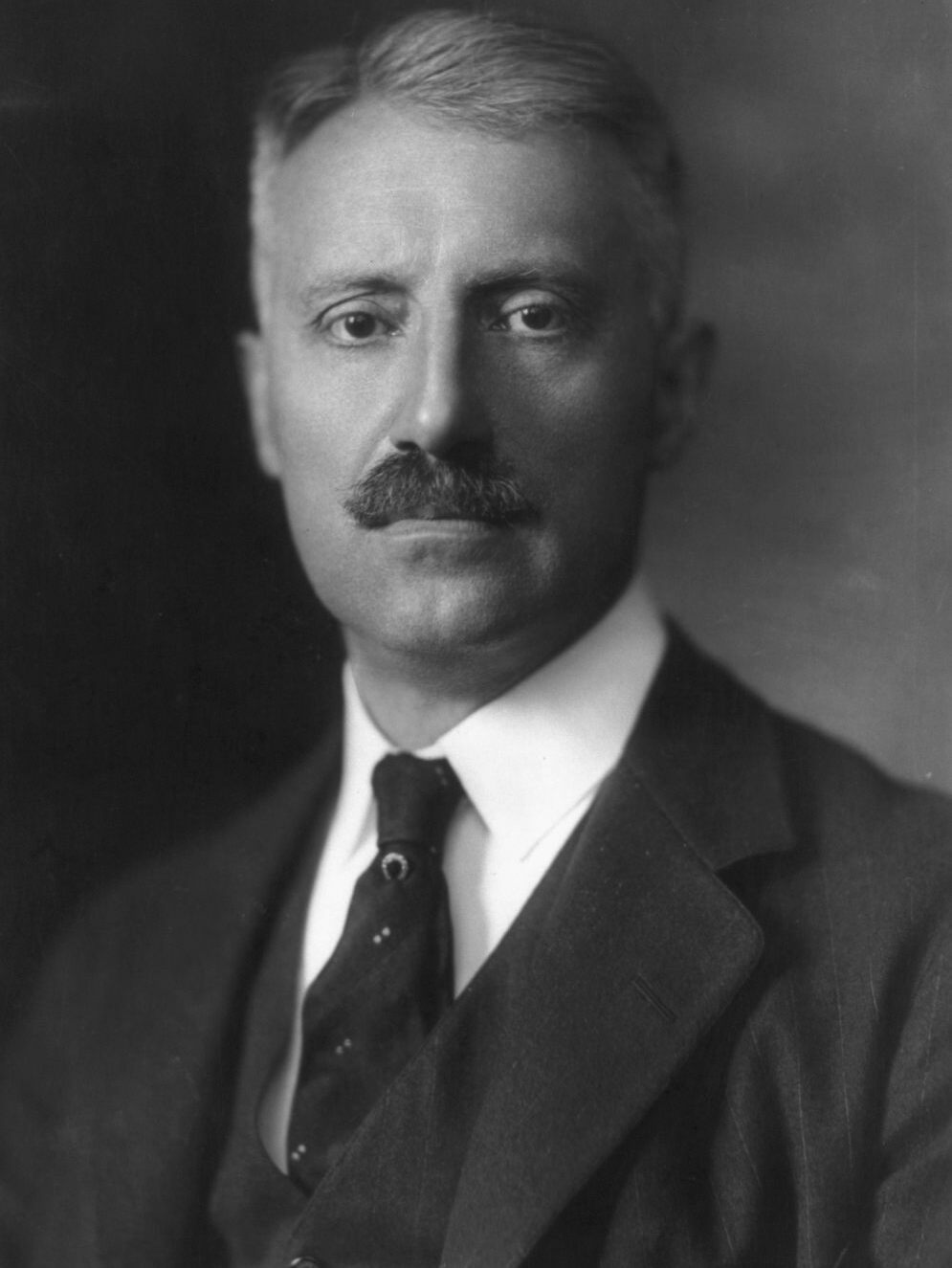
Historical · U.S. Department of State
Bainbridge Colby
Former United States Secretary of State · U.S. Department of State · 1920–1921
Bainbridge Colby served as United States Secretary of State (1920–1921). The page below collects sourced biographical facts, the appointment record, and provenance for Colby.
Key facts
- Full name
- Bainbridge Colby
- Department
- U.S. Department of State
- Office
- United States Secretary of State
- Status
- Former secretary
- Appointment
- Senate-confirmed
- Tenure
- 1920–1921
- Confirmed
- —
- Born
- 1869
- Died
- 1950
- First year in office
- 1920
- Dataset version
- 1.20260703
Appointment & service record
United States Secretary of State · 1920–1921
- Department
- U.S. Department of State
- Appointment
- Senate-confirmed
- Appointing president
- —
- Confirmed
- —
Department, appointment type (Senate-confirmed, acting, recess, or designated), appointing president, confirmation status, and service dates are drawn from Wikidata and the White House Cabinet roster.[1][2][3]
Sources
- [1]https://www.wikidata.org/wiki/Q708024Wikidata · retrieved 2026-07-03
- [2]https://www.whitehouse.gov/administration/cabinet/whitehouse.gov · retrieved 2026-07-03
- [3]https://www.wikidata.org/wiki/Q639738wikidata-cabinet · retrieved 2026-07-03
Biographical narrative
879 words · sourced from the Wikipedia REST extract
Bainbridge Colby was an American lawyer and public servant who played a prominent role in early twentieth‑century politics. A graduate of Williams College and Columbia Law School, he practiced law in New York before entering elective office as a member of the state assembly. He became involved with the Progressive movement that emerged during the 1912 election cycle and served in various capacities during World War I, including on the United States Shipping Board and as a special assistant to the Attorney General. In 1920 he was appointed by President Woodrow Wilson to serve as Secretary of State, a position he held until the end of Wilson’s term in March 1921. After leaving Washington, Colby returned to private legal practice and remained active in political debates throughout the interwar period.
Early life and career
Bainbridge Colby was born on 22 December 1869 in St. Louis, Missouri. He earned an undergraduate degree from Williams College, where he was inducted into Phi Beta Kappa, before pursuing legal studies at Columbia Law School and New York Law School, graduating in 1892. Admitted to the bar of New York State, Colby established a private practice that would later attract high‑profile clients such as Mark Twain.
Colby’s entry into public office came with his election to the New York State Assembly representing the 29th district of New York County in 1901. He served one term through 1902, during which he participated in legislative deliberations on state matters. His political ambitions extended beyond the state level; in 1914 and again in 1916 he ran for the United States Senate from New York as a candidate of the Progressive Party, though both campaigns were unsuccessful.
The outbreak of World War I saw Colby appointed to the United States Shipping Board, where he contributed to wartime logistics. In 1917 he served as a special assistant to the Attorney General in an antitrust case and represented the United States at the Inter‑Allied Conference held in Paris that same year, gaining exposure to international diplomacy despite lacking formal diplomatic experience.
Cabinet tenure
President Woodrow Wilson appointed Colby Secretary of State on 23 March 1920 after dismissing his predecessor for insubordination. The appointment was notable because Colby had no prior diplomatic service; nevertheless, he was confirmed by the Senate and served from February 1920 until March 1921, when Wilson’s presidency concluded.
During his tenure, Colby carried out several key actions that reflected both Wilsonian ideals and the geopolitical realities of the post‑war era. On 26 August 1920, shortly after the ratification of the Nineteenth Amendment, he issued an official proclamation declaring the amendment part of the Constitution, thereby formalizing women’s suffrage nationwide.
In December 1920 Colby embarked on a goodwill cruise aboard the battleship *Florida* to South America. The voyage was intended as a gesture of friendly relations with Latin American nations and laid groundwork for what would later be known as a “Good Neighbor” policy. His advocacy for amicable engagement in the Western Hemisphere was consistent with Wilson’s broader vision of cooperative internationalism.
Colby also articulated a firm stance toward Soviet Russia. He publicly declared that the United States could not recognize the existing Russian government, citing concerns over its adherence to principles of honor and good faith. While he supported the League of Nations, his position on Russia reflected the prevailing American skepticism toward Bolshevik governance at the time.
Colby’s service concluded when Wilson left office on 4 March 1921. The Library of Congress preserves a collection of Colby’s documents from this period, providing insight into his administrative activities and correspondence.
Legacy
After leaving Washington, Colby returned to private legal practice, continuing to represent clients until the end of his career. He briefly partnered with former President Wilson in an attorney‑client relationship that lasted until 1923. His involvement in public affairs extended beyond the law; he served as a chief spokesman for a minority delegation at the 1924 Democratic National Convention, advocating against the inclusion of a platform plank denouncing the Ku Klux Klan by name.
Colby’s political engagement persisted into the 1930s. He was an active member of the American Liberty League, an organization composed of affluent Democrats who opposed New Deal policies. In the 1936 presidential election he supported Republican candidate Alf Landon over incumbent Franklin Roosevelt, reflecting his conservative stance on economic and governmental issues.
On a personal level, Colby married twice. His first marriage to Nathalie Sedgwick in 1895 produced three children: Katherine Sedgwick Colby, Nathalie Sedgwick Colby, and Frances Bainbridge Colby. The couple divorced in 1928 after a contentious settlement that included a monthly payment to prevent further public criticism by Nathalie. Less than a year later he married Anne Ahlstrand Ely, who shared his interests in suffrage and other progressive causes.
Colby died on 11 April 1950. His career spanned law, state legislation, wartime administration, and the highest level of diplomatic service in the United States. While his tenure as Secretary of State was brief, it intersected with pivotal moments in American foreign policy, including the formal recognition of women’s suffrage, early efforts toward improved relations with Latin America, and a cautious approach to Soviet Russia. His post‑cabinet activities continued to shape political discourse during the interwar period, underscoring his lasting influence on both legal practice and public affairs.
Sources & provenance
Every quantitative or attributable claim above carries a per-section [N] marker that resolves to the corresponding URL below. Each entry records the upstream provider, the canonical URL, and the timestamp at which the underlying source was retrieved.
Key facts
- https://www.wikidata.org/wiki/Q708024Wikidata · retrieved 2026-07-03
- https://www.whitehouse.gov/administration/cabinet/whitehouse.gov · retrieved 2026-07-03
- https://www.wikidata.org/wiki/Q639738wikidata-cabinet · retrieved 2026-07-03
Biographical narrative
- https://en.wikipedia.org/wiki/Bainbridge_ColbyWikipedia · retrieved 2026-07-03
Explore the Cabinet
The Cabinet includes the Vice President and the heads of the 15 executive departments. Browse the full roster of current and former secretaries, or explore how the Cabinet fits into the federal government.