
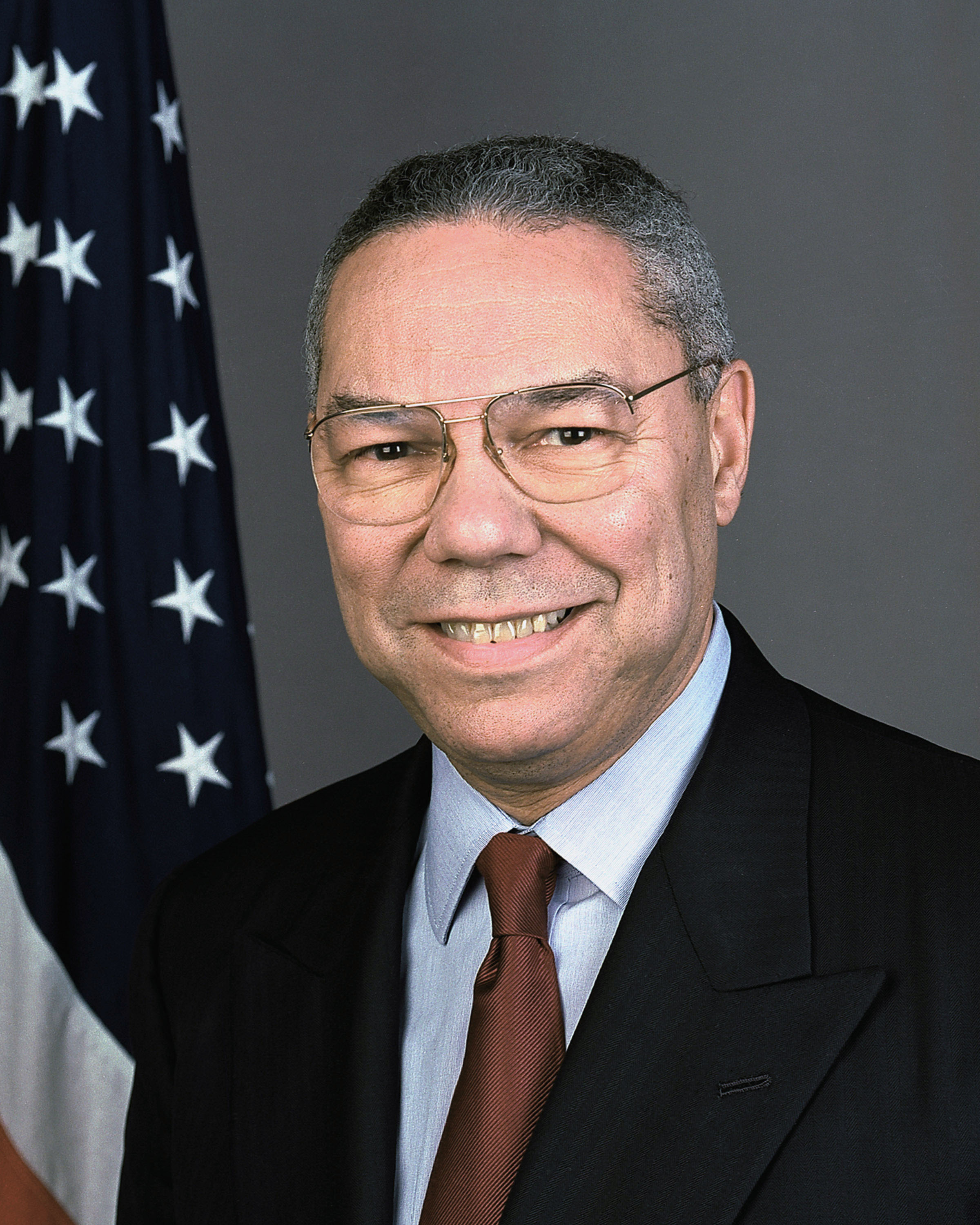
Historical · U.S. Department of State
Colin Powell
Former United States Secretary of State · U.S. Department of State · 2001–2005
Colin Powell served as United States Secretary of State (2001–2005). The page below collects sourced biographical facts, the appointment record, and provenance for Powell.
Key facts
- Full name
- Colin Powell
- Department
- U.S. Department of State
- Office
- United States Secretary of State
- Status
- Former secretary
- Appointment
- Senate-confirmed
- Tenure
- 2001–2005
- Confirmed
- —
- Born
- 1937
- Died
- 2021
- First year in office
- 2001
- Dataset version
- 1.20260703
Appointment & service record
United States Secretary of State · 2001–2005
- Department
- U.S. Department of State
- Appointment
- Senate-confirmed
- Appointing president
- —
- Confirmed
- —
Department, appointment type (Senate-confirmed, acting, recess, or designated), appointing president, confirmation status, and service dates are drawn from Wikidata and the White House Cabinet roster.[1][2][3]
Sources
- [1]https://www.wikidata.org/wiki/Q150851Wikidata · retrieved 2026-07-03
- [2]https://www.whitehouse.gov/administration/cabinet/whitehouse.gov · retrieved 2026-07-03
- [3]https://www.wikidata.org/wiki/Q639738wikidata-cabinet · retrieved 2026-07-03
Biographical narrative
816 words · sourced from the Wikipedia REST extract
Colin Powell was an American military officer, diplomat, and public servant who served as the United States Secretary of State from 2001 to 2005. A four‑star general in the Army, he held senior defense positions—including National Security Advisor and Chairman of the Joint Chiefs of Staff—before entering the civilian cabinet under President George W. Bush. Powell’s appointment made him the first Black American to occupy the Secretary of State post, a milestone that highlighted his prominence within the federal executive branch.
Early life and career
Colin Luther Powell was born on April 5, 1937, in Harlem, New York City. His parents were Jamaican immigrants; Maud Ariel (née McKoy) worked as a seamstress while Luther Theophilus Powell served as a shipping clerk. Raised in the South Bronx, Powell attended Morris High School, graduating in 1954. While still in high school he worked at a local baby furniture store and interacted with Eastern European Jewish shopkeepers; these experiences broadened his cultural exposure and introduced him to Yiddish. He also served as a Shabbos goy, assisting Orthodox families with tasks on the Sabbath.
After high school, Powell entered the City College of New York (CCNY) in 1955, where he pursued a Bachelor of Science degree in geology, graduating in 1958. During his college years he joined the Reserve Officers’ Training Corps (ROTC), a decision he later described as one of the happiest moments of his life. His dedication to ROTC earned him distinction as the first chairman to receive an Army commission through that program. Upon graduation in 1958, he was commissioned as a second lieutenant in the United States Army.
Powell’s military career spanned thirty‑five years and included a variety of command and staff assignments. He rose through the ranks to become a four‑star general. Notable positions held include commander of U.S. Army Forces Command in 1989, National Security Advisor from 1987 to 1989, and Chairman of the Joint Chiefs of Staff from 1989 until 1993. In these roles he oversaw numerous military operations and crises, such as the invasion of Panama in 1989 and Operation Desert Storm during the Persian Gulf War (1990‑1991). His experiences contributed to the formulation of what became known as the Powell Doctrine, a framework that emphasizes clear national security objectives, overwhelming force, and broad public support before initiating armed conflict.
Beyond his military service, Powell pursued further education. He earned an MBA from George Washington University in 1971 and received an honorary Doctor of Public Service degree in 1990, recognizing his contributions to national defense and public affairs.
Cabinet tenure
In 2001, President George W. Bush nominated Powell for the position of Secretary of State, a nomination that was confirmed by the United States Senate. He served as the 65th Secretary of State until 2005, during which time he became the first Black American to hold the office and one of the highest‑ranking African Americans in the federal executive branch.
During his tenure, Powell represented U.S. foreign policy interests at the United Nations Security Council and other international forums. He delivered a presentation outlining the rationale for the Iraq War; however, he later acknowledged that the speech contained substantial inaccuracies. His resignation followed President Bush’s reelection in 2004, after which he stepped down from the cabinet role.
Legacy
Powell’s legacy is multifaceted, encompassing military doctrine, diplomatic service, and public engagement. The Powell Doctrine remains a reference point for discussions about the conditions under which the United States may engage militarily abroad. His tenure as Secretary of State broke racial barriers in the U.S. foreign affairs apparatus, setting a precedent that would be followed by subsequent appointments.
Throughout his life, Powell received numerous military honors, including the Purple Heart. He was also awarded several civilian distinctions: the Presidential Medal of Freedom twice, the Congressional Gold Medal, the Presidential Citizens Medal, and the Secretary’s Distinguished Service Award. These accolades reflected recognition from both the defense establishment and the broader civic community.
After retiring from public office, Powell authored an autobiography titled *My American Journey* in 1995 and later published *It Worked for Me: In Life and Leadership* in 2012. He remained active as a speaker, addressing audiences across the United States and abroad, and chaired America’s Promise, a national initiative focused on educational opportunity.
In the 2016 presidential election, Powell was not a candidate but received three electoral votes from faithless electors in Washington State for President of the United States—a symbolic gesture reflecting his enduring influence. He passed away on October 18, 2021, due to complications related to COVID‑19 while undergoing treatment for a form of blood cancer that had compromised his immune system.
Powell’s career bridged military command and diplomatic leadership, marking him as one of the most prominent figures in late twentieth‑century American public service. His contributions continue to inform discussions on national security strategy, civil‑military relations, and the role of diversity within the highest levels of government.
Sources & provenance
Every quantitative or attributable claim above carries a per-section [N] marker that resolves to the corresponding URL below. Each entry records the upstream provider, the canonical URL, and the timestamp at which the underlying source was retrieved.
Key facts
- https://www.wikidata.org/wiki/Q150851Wikidata · retrieved 2026-07-03
- https://www.whitehouse.gov/administration/cabinet/whitehouse.gov · retrieved 2026-07-03
- https://www.wikidata.org/wiki/Q639738wikidata-cabinet · retrieved 2026-07-03
Biographical narrative
- https://en.wikipedia.org/wiki/Colin_PowellWikipedia · retrieved 2026-07-03
Explore the Cabinet
The Cabinet includes the Vice President and the heads of the 15 executive departments. Browse the full roster of current and former secretaries, or explore how the Cabinet fits into the federal government.