
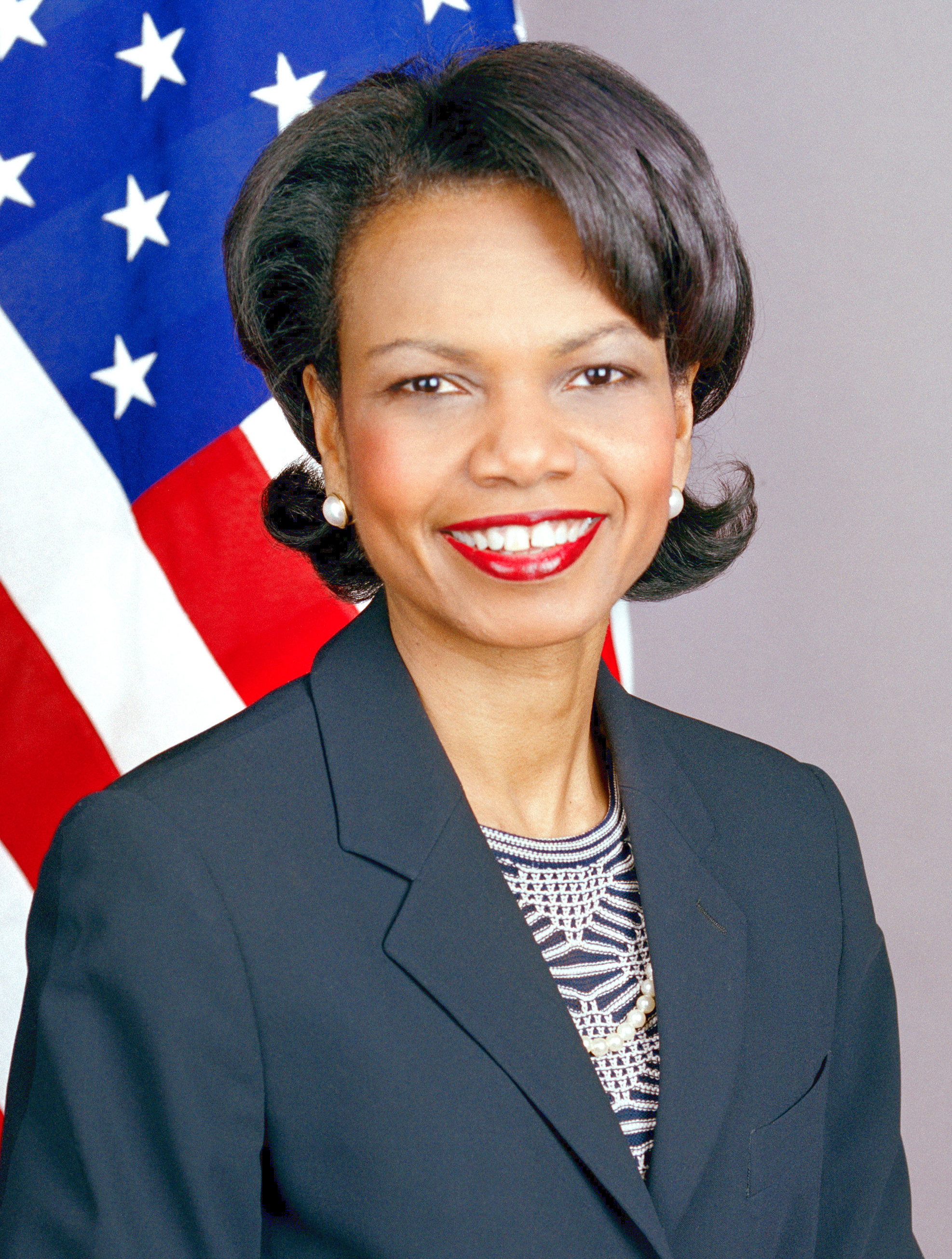
Historical · U.S. Department of State
Condoleezza Rice
Former United States Secretary of State · U.S. Department of State · 2005–2009
Condoleezza Rice served as United States Secretary of State (2005–2009). The page below collects sourced biographical facts, the appointment record, and provenance for Rice.
Key facts
- Full name
- Condoleezza Rice
- Department
- U.S. Department of State
- Office
- United States Secretary of State
- Status
- Former secretary
- Appointment
- Senate-confirmed
- Tenure
- 2005–2009
- Confirmed
- —
- Born
- 1954
- Died
- —
- First year in office
- 2005
- Dataset version
- 1.20260703
Appointment & service record
United States Secretary of State · 2005–2009
- Department
- U.S. Department of State
- Appointment
- Senate-confirmed
- Appointing president
- —
- Confirmed
- —
Department, appointment type (Senate-confirmed, acting, recess, or designated), appointing president, confirmation status, and service dates are drawn from Wikidata and the White House Cabinet roster.[1][2][3]
Sources
- [1]https://www.wikidata.org/wiki/Q47216Wikidata · retrieved 2026-07-03
- [2]https://www.whitehouse.gov/administration/cabinet/whitehouse.gov · retrieved 2026-07-03
- [3]https://www.wikidata.org/wiki/Q639738wikidata-cabinet · retrieved 2026-07-03
Biographical narrative
834 words · sourced from the Wikipedia REST extract
Condoleezza Rice is an American diplomat, scholar, and former government official who served as the United States Secretary of State from 2005 to 2009. Prior to that role she was the National Security Advisor under President George W. Bush from 2001 to 2005. After leaving public office she returned to academia, holding senior positions at Stanford University, including director of the Hoover Institution since 2020.
Early life and career
Rice was born on November 14, 1954 in Birmingham, Alabama, into a family that lived on the campus of Stillman College, a historically black institution. Her mother, Angelena Rice (née Ray), taught high‑school science, music, and oratory, while her father, John Wesley Rice Jr., served as a guidance counselor, Presbyterian minister, and dean of students at the college. The family name “Condoleezza” derives from the Italian musical term *con dolcezza*, meaning “with sweetness.” Genetic testing later revealed that she has African, European, and Asian or Native American ancestry.
In 1967 the Rices relocated to Denver, Colorado, where Rice attended St. Mary’s Academy, an all‑girls Catholic high school in Cherry Hills Village. She graduated at age sixteen in 1971. Her initial academic focus was music; she studied piano from a young age and even pursued concert pianist aspirations into her teenage years. However, after taking an international politics course taught by Josef Korbel—father of future Secretary of State Madeleine Albright—Rice’s interests shifted toward the Soviet Union and global affairs.
She enrolled at the University of Denver, where she earned a B.A. in political science cum laude in 1974 and was inducted into Phi Beta Kappa. She continued her graduate studies at the University of Notre Dame, obtaining an M.A. in political science in 1975. In 1981 Rice completed a Ph.D. in international studies at the School of International Studies, University of Denver.
Rice’s early professional experience began with an internship in the Bureau of Educational and Cultural Affairs of the State Department during President Jimmy Carter’s administration in 1977. She later served on the National Security Council as the Soviet and Eastern Europe affairs advisor to President George H.W. Bush from 1989 to 1991, a period that encompassed the dissolution of the Soviet Union and German reunification.
After her government service she pursued an academic fellowship at Stanford University, where she eventually became provost from 1993 to 1999. Her tenure at Stanford was marked by significant contributions to political science scholarship and university administration. In December 2000 she joined the George W. Bush administration as National Security Advisor, a position she held until 2005.
Cabinet tenure
Rice’s appointment as Secretary of State in 2005 made her the first African‑American woman to hold that office, following Colin Powell who had served from 2001 to 2005. She was confirmed by the Senate and served under President George W. Bush through 2009. During her time in Washington, she introduced a diplomatic strategy known as Transformational Diplomacy, aimed at expanding democratic governance worldwide, with particular emphasis on the Greater Middle East. The policy encountered challenges, including political developments in Palestinian elections and the continued support of authoritarian regimes by key U.S. allies such as Saudi Arabia and Egypt.
In addition to her foreign‑policy responsibilities, Rice chaired the board of directors for the Millennium Challenge Corporation, a U.S. government agency that administers aid programs designed to promote economic growth and good governance in developing countries.
Rice’s tenure also involved engagement with various international organizations and bilateral negotiations, though specific policy outcomes are beyond the scope of this summary. She concluded her service as Secretary of State at the end of President Bush’s second term in 2009, after which she returned to Stanford University.
Legacy
Following her departure from government, Rice resumed an academic career at Stanford. In March 2009 she became a political science professor and the Thomas and Barbara Stephenson Senior Fellow on Public Policy at the Hoover Institution. She joined the faculty of the Stanford Graduate School of Business in September 2010 and served as director of its Global Center for Business and the Economy.
In January 2020 it was announced that Rice would succeed Thomas W. Gilligan as director of the Hoover Institution, a position she assumed on September 1, 2020. In addition to her academic leadership, she has held directorships in several private enterprises, including C3 AI and Makena Capital Management. She also served on the board of Dropbox from 2014 until 2021.
Rice’s career is notable for breaking multiple racial and gender barriers within the U.S. federal government. As Secretary of State, she was the highest‑ranking African American in the executive branch during her tenure, a status that remained until the election of President Barack Obama in 2008. She also held the distinction of being the first woman to serve as National Security Advisor.
Her contributions to diplomatic practice and academic scholarship have been recognized by peers across the political spectrum. The policies she championed—particularly Transformational Diplomacy—and her leadership roles at Stanford continue to influence discussions on international relations, governance, and public policy.
Sources & provenance
Every quantitative or attributable claim above carries a per-section [N] marker that resolves to the corresponding URL below. Each entry records the upstream provider, the canonical URL, and the timestamp at which the underlying source was retrieved.
Key facts
- https://www.wikidata.org/wiki/Q47216Wikidata · retrieved 2026-07-03
- https://www.whitehouse.gov/administration/cabinet/whitehouse.gov · retrieved 2026-07-03
- https://www.wikidata.org/wiki/Q639738wikidata-cabinet · retrieved 2026-07-03
Biographical narrative
- https://en.wikipedia.org/wiki/Condoleezza_RiceWikipedia · retrieved 2026-07-03
Explore the Cabinet
The Cabinet includes the Vice President and the heads of the 15 executive departments. Browse the full roster of current and former secretaries, or explore how the Cabinet fits into the federal government.