
Historical · U.S. Department of State
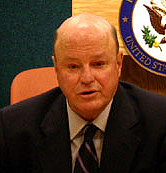
Frank G. Wisner
Acting
Former Acting United States Secretary of State · U.S. Department of State · 1993–1993
Frank G. Wisner served as Acting United States Secretary of State (1993–1993). The page below collects sourced biographical facts, the appointment record, and provenance for Wisner.
Key facts
- Full name
- Frank G. Wisner
- Department
- U.S. Department of State
- Office
- United States Secretary of State
- Status
- Former secretary
- Appointment
- Acting
- Tenure
- 1993–1993
- Confirmed
- —
- Born
- 1938
- Died
- 2025
- First year in office
- 1993
- Dataset version
- 1.20260704
Appointment & service record
United States Secretary of State · 1993–1993
- Department
- U.S. Department of State
- Appointment
- Acting
- Appointing president
- —
- Confirmed
- Not confirmed
Department, appointment type (Senate-confirmed, acting, recess, or designated), appointing president, confirmation status, and service dates are drawn from Wikidata and the White House Cabinet roster.[1][2][3]
Sources
- [1]https://www.wikidata.org/wiki/Q981007Wikidata · retrieved 2026-07-04
- [2]https://www.whitehouse.gov/administration/cabinet/whitehouse.gov · retrieved 2026-07-04
- [3]https://www.wikidata.org/wiki/Q639738wikidata-cabinet · retrieved 2026-07-04
Biographical narrative
1,015 words · sourced from the Wikipedia REST extract
Frank George Wisner II (July 2, 1938 – February 24, 2025) was an American diplomat and businessman who briefly served as the United States Secretary of State in 1993. His career spanned more than three decades in the Foreign Service, during which he held a series of diplomatic postings across Africa, Asia, and the Middle East. After leaving government service, Wisner became active in private‑sector boards and nonprofit organizations that focused on international affairs and security.
Early life and career
Wisner was born in New York City to Mary Knowles Fritchey, a philanthropist, and Frank Wisner (1909–1965), who had worked for the Central Intelligence Agency. He entered the United States Department of State as a Foreign Service Officer in December 1961. His early assignments placed him at key posts in the developing world. He served as vice consul at the American Consulate General in Tangier, Morocco, and later as third secretary at the U.S. Embassy in Algiers, Algeria.
In 1964 Wisner was assigned to Saigon, South Vietnam, where he worked for the Agency for International Development as a rural development officer until 1969. Upon his return to Washington, he became the officer in charge of Tunisian affairs. From 1971 to 1973 he served as first secretary at the U.S. Embassy in Tunis, Tunisia, and from 1973 to 1974 held the same position in Dacca (now Dhaka), Bangladesh.
Between 1974 and 1975 Wisner directed the Office of Plans and Management within the Bureau of Public Affairs. In late 1975 he was appointed Deputy Director of the President’s Indo‑China Task Force, a role that involved coordinating U.S. policy toward China during a period of diplomatic thaw. The following year, at the start of the Carter administration, he served under Secretary Cyrus Vance as Deputy Executive Secretary of the Department of State.
Wisner’s overseas service continued with several ambassadorial appointments. He was United States Ambassador to Zambia from 1979 to 1982, where he acted as a key liaison for the Constructive Engagement policy promoted by Assistant Secretary of State Chester Crocker. His work helped restore bilateral relations after a 1980 espionage incident at the U.S. embassy in Lusaka and contributed to the February 1984 Lusaka Conference that addressed conflicts in Angola and Namibia.
After Zambia, Wisner served as Ambassador to Egypt from 1986 to 1991, then as Ambassador to the Philippines from 1991 to 1992. His final diplomatic posting was as Ambassador to India between 1994 and 1997. In each of these roles he managed complex bilateral relationships and represented U.S. interests in regions of strategic importance.
Cabinet tenure
On January 20, 1993, following the resignation of acting Secretary Arnold Kanter at noon, Wisner assumed the duties of United States Secretary of State for a brief period that day. His service as acting secretary lasted until Warren Christopher was confirmed by the Senate and sworn in later that same day. During this interim, Wisner performed the responsibilities associated with the office while awaiting the formal appointment of his successor.
After leaving government service in 1997, Wisner continued to engage with international affairs through private‑sector roles. He worked as an international‑affairs advisor at Squire Patton Boggs in Washington, D.C., and served on the boards of several corporations, including a subsidiary of Enron and American International Group (AIG). In 2002 he co‑chaired an independent working group that developed recommendations for the United States’ potential post‑conflict role in Iraq. The group’s published guidance emphasized establishing law and order through retraining the Iraqi army, prioritizing humanitarian assistance, and avoiding the appointment of exiled opposition leaders to dominant positions within a new government.
Wisner also contributed to nonprofit organizations focused on security and diplomacy. He was an advisory board member for the Partnership for a Secure America, served as chairman of the board of trustees of International House in New York City from 2012, and sat on the advisory boards of the National Security Network and Refugees International. Additionally, he held positions on the boards of EOG Resources, Ergo (a global intelligence firm), and The Arab Gulf States Institute in Washington, where he served as chair of the board of directors.
In early 2011, President Barack Obama sent Wisner to Egypt at the suggestion of Secretary of State Hillary Clinton. His mission was to deliver a personal appeal to Egyptian President Hosni Mubarak, urging him to resign in order to facilitate an orderly transition amid widespread protests. The effort did not result in Mubarak’s resignation. A few days later, after violent reprisals against democracy activists, Wisner spoke at a security conference in Europe and expressed the view that Mubarak should remain in office for stability. The State Department disavowed those remarks, stating that Wisner was not acting as an envoy but rather conveying certain administration views. President Obama later recalled his displeasure with Wisner’s comments in his memoirs, indicating that he had instructed Secretary Clinton to instruct Wisner to refrain from speaking publicly on the matter.
Legacy
Frank G. Wisner’s career reflects a sustained engagement with U.S. diplomacy across multiple continents and through several administrations. His early work in Africa, Asia, and the Middle East laid the groundwork for his later ambassadorial appointments, where he managed complex bilateral relationships during periods of significant regional change. As acting Secretary of State, even briefly, he fulfilled the responsibilities of the office at a pivotal moment in U.S. foreign‑policy leadership.
Beyond his diplomatic service, Wisner’s post‑government activities demonstrate continued involvement in shaping international policy and security discourse. His participation on corporate boards, advisory councils, and nonprofit organizations contributed to discussions on energy, finance, refugee assistance, and regional security. The working group he co‑chaired in 2002 offered a framework for U.S. engagement in Iraq that has informed subsequent policy debates.
Wisner’s death from lung cancer on February 24, 2025, at the age of 86, marked the end of a life characterized by long‑standing public service and private‑sector influence in matters of international affairs. His contributions to diplomacy, particularly his roles in Zambia, Egypt, the Philippines, and India, remain part of the broader narrative of U.S. engagement with key regions during the late twentieth century.
Sources & provenance
Every quantitative or attributable claim above carries a per-section [N] marker that resolves to the corresponding URL below. Each entry records the upstream provider, the canonical URL, and the timestamp at which the underlying source was retrieved.
Key facts
- https://www.wikidata.org/wiki/Q981007Wikidata · retrieved 2026-07-04
- https://www.whitehouse.gov/administration/cabinet/whitehouse.gov · retrieved 2026-07-04
- https://www.wikidata.org/wiki/Q639738wikidata-cabinet · retrieved 2026-07-04
Biographical narrative
- https://en.wikipedia.org/wiki/Frank_G._WisnerWikipedia · retrieved 2026-07-04
Explore the Cabinet
The Cabinet includes the Vice President and the heads of the 15 executive departments. Browse the full roster of current and former secretaries, or explore how the Cabinet fits into the federal government.