
Historical · U.S. Department of State
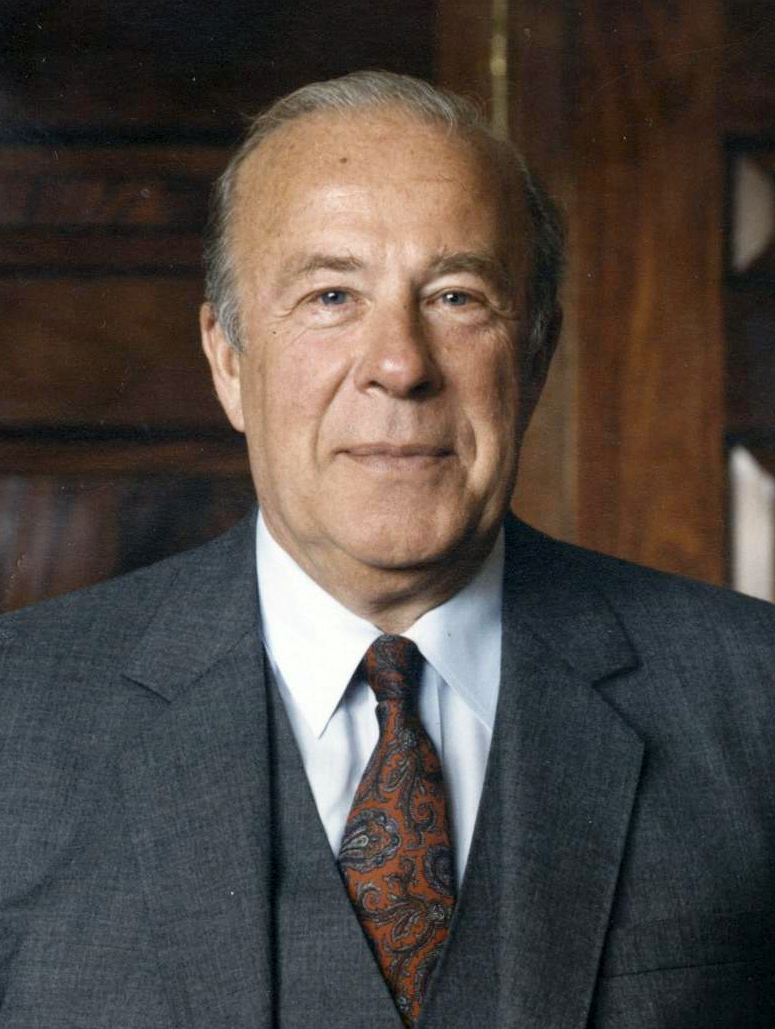
George Shultz
Former United States Secretary of State · U.S. Department of State · 1982–1989
George Shultz served as United States Secretary of State (1982–1989). The page below collects sourced biographical facts, the appointment record, and provenance for Shultz.
Key facts
- Full name
- George Shultz
- Department
- U.S. Department of State
- Office
- United States Secretary of State
- Status
- Former secretary
- Appointment
- Senate-confirmed
- Tenure
- 1982–1989
- Confirmed
- —
- Born
- 1920
- Died
- 2021
- First year in office
- 1982
- Dataset version
- 1.20260703
Appointment & service record
United States Secretary of State · 1982–1989
- Department
- U.S. Department of State
- Appointment
- Senate-confirmed
- Appointing president
- —
- Confirmed
- —
Department, appointment type (Senate-confirmed, acting, recess, or designated), appointing president, confirmation status, and service dates are drawn from Wikidata and the White House Cabinet roster.[1][2][3]
Sources
- [1]https://www.wikidata.org/wiki/Q313411Wikidata · retrieved 2026-07-03
- [2]https://www.whitehouse.gov/administration/cabinet/whitehouse.gov · retrieved 2026-07-03
- [3]https://www.wikidata.org/wiki/Q639738wikidata-cabinet · retrieved 2026-07-03
Biographical narrative
951 words · sourced from the Wikipedia REST extract
George Pratt Shultz was an American economist, businessman, diplomat, and statesman whose public service spanned several decades and multiple presidential administrations. He is best known for serving as the United States Secretary of State from 1982 to 1989, a period during which he helped shape the foreign policy direction of the Reagan administration and influenced subsequent conservative approaches to international affairs. Prior to that, Shultz held three other Cabinet-level positions—Secretary of Labor, Director of the Office of Management and Budget, and Secretary of the Treasury—making him one of only two individuals in U.S. history to occupy four distinct cabinet posts.
Early life and career
George Pratt Shultz was born on December 13, 1920, in New York City as the sole child of Margaret Lennox (née Pratt) and Birl Earl Shultz. He grew up in Englewood, New Jersey, where his family’s German immigrant roots were part of his early cultural background. After completing local public schooling, he attended the Englewood School for Boys—now known as Dwight‑Englewood School—through his second year of high school before graduating from Loomis Chaffee School in Windsor, Connecticut, in 1938.
Shultz entered Princeton University in 1939 and earned a cum laude bachelor’s degree in economics with a minor in public and international affairs in 1942. His senior thesis examined the agricultural impact of the Tennessee Valley Authority, reflecting an early interest in how federal programs could affect local economies. Following graduation, he served as an artillery officer in the United States Marine Corps from 1942 to 1945, attaining the rank of captain. During his military service he participated in operations with the 7th Defense Battalion at Nanumea and later with the U.S. Army’s 81st Infantry Division during the Battle of Angaur.
After World War II, Shultz pursued graduate studies at the Massachusetts Institute of Technology (MIT), where he earned a Ph.D. in industrial economics in 1949. He joined MIT’s Department of Economics and Sloan School of Management as a faculty member in 1948, teaching until 1957. In 1955 he took a leave of absence to serve on President Dwight D. Eisenhower’s Council of Economic Advisers as a senior staff economist. Returning to MIT, he continued his academic work before moving to the University of Chicago Graduate School of Business in 1957 as a professor of industrial relations. He later became dean of that graduate school from 1962 until 1968, during which time he was influenced by Nobel laureates Milton Friedman and George Stigler, reinforcing his commitment to free‑market principles.
Cabinet tenure
Shultz entered the federal executive branch in 1969 when President Richard Nixon appointed him Secretary of Labor. In that role he confronted labor disputes such as the Longshoremen’s Union strike, applying academic theories about negotiation and market dynamics to real‑world industrial relations. He also implemented the Philadelphia Plan, a policy requiring construction contractors who refused to hire black workers to accept racial quotas—a first use of federal racial quotas in U.S. history.
In 1970 Shultz became the inaugural director of the Office of Management and Budget (OMB), overseeing federal budgetary planning and fiscal policy during a period of economic uncertainty. Two years later, in 1972, he was appointed Secretary of the Treasury. As Treasury secretary, Shultz supported Nixon’s “shock” strategy aimed at reviving the economy, which included measures such as ending the gold standard and concluding the Bretton Woods system of international monetary relations.
Shultz left the Nixon administration in May 1974 to join Bechtel Corporation, an engineering and services company. He served as president and director there until 1982, during which time he applied his economic expertise to corporate strategy and operations.
In 1982 President Ronald Reagan appointed Shultz Secretary of State, a position he held through 1989. Confirmed by the Senate, he became the 60th individual to occupy that office. During his tenure he played a significant role in shaping U.S. foreign policy during the final years of the Cold War. He encouraged President Reagan to pursue diplomatic engagement with Soviet leader Mikhail Gorbachev, contributing to a thaw in relations between Washington and Moscow. Shultz also opposed the use of U.S. aid for Contra forces attempting to overthrow the Sandinista government—a program that was later revealed to have involved illicit arms sales to Iran, leading to the Iran–Contra affair.
Legacy
After stepping down from public office at the end of his term as Secretary of State in 1989, Shultz remained active in business and policy circles. He continued to serve on corporate boards, including those of Bechtel and the Charles Schwab Corporation, and participated in a variety of think‑tank and advisory organizations such as the Hoover Institution, the Institute for International Economics, and the Washington Institute for Near East Policy.
Shultz also offered informal counsel to subsequent presidents; he advised George W. Bush and helped shape the Bush Doctrine of preemptive war. In addition, he served on the Global Commission on Drug Policy, California Governor Arnold Schwarzenegger’s Economic Recovery Council, and other public service initiatives.
From 2013 onward, Shultz advocated for a revenue‑neutral carbon fee and dividend as an economically sound approach to addressing anthropogenic climate change. His later years were marked by continued engagement with policy debates and corporate governance until his death on February 6, 2021. He was survived by family members, including a grandson, Tyler Shultz, who had worked at Theranos before becoming a whistleblower about the company’s fraudulent practices.
Shultz’s career spanned academia, business, and four distinct cabinet positions, reflecting a broad influence on both domestic economic policy and international diplomacy. His work in labor relations, fiscal management, monetary policy, and foreign affairs left an enduring imprint on U.S. governance and contributed to shaping the trajectory of American public policy during the latter half of the twentieth century.
Sources & provenance
Every quantitative or attributable claim above carries a per-section [N] marker that resolves to the corresponding URL below. Each entry records the upstream provider, the canonical URL, and the timestamp at which the underlying source was retrieved.
Key facts
- https://www.wikidata.org/wiki/Q313411Wikidata · retrieved 2026-07-03
- https://www.whitehouse.gov/administration/cabinet/whitehouse.gov · retrieved 2026-07-03
- https://www.wikidata.org/wiki/Q639738wikidata-cabinet · retrieved 2026-07-03
Biographical narrative
- https://en.wikipedia.org/wiki/George_ShultzWikipedia · retrieved 2026-07-03
Explore the Cabinet
The Cabinet includes the Vice President and the heads of the 15 executive departments. Browse the full roster of current and former secretaries, or explore how the Cabinet fits into the federal government.