
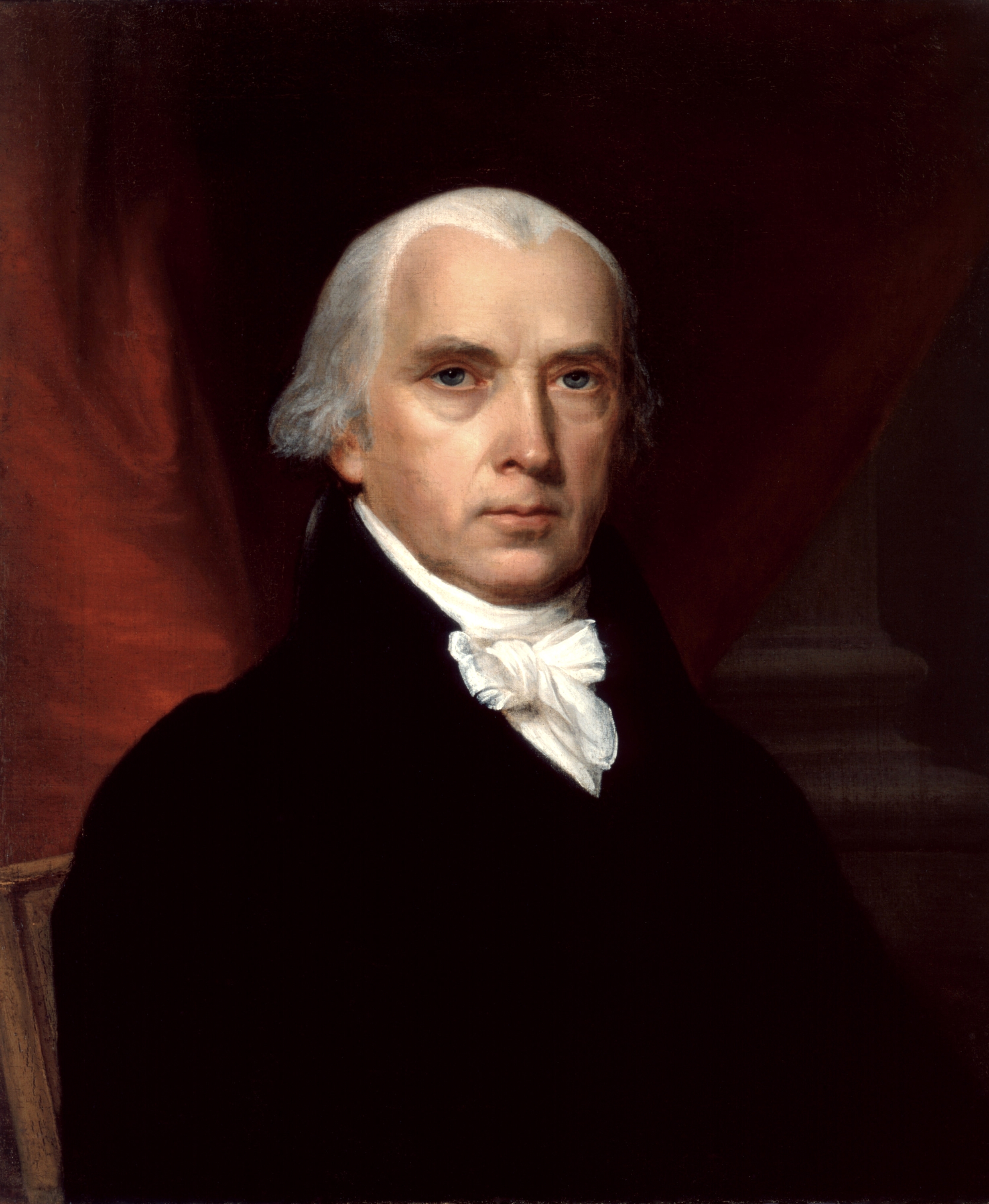
Historical · U.S. Department of State
James Madison
Former United States Secretary of State · U.S. Department of State · 1801–1809
James Madison served as United States Secretary of State (1801–1809). The page below collects sourced biographical facts, the appointment record, and provenance for Madison.
Key facts
- Full name
- James Madison
- Department
- U.S. Department of State
- Office
- United States Secretary of State
- Status
- Former secretary
- Appointment
- Senate-confirmed
- Tenure
- 1801–1809
- Confirmed
- —
- Born
- 1751
- Died
- 1836
- First year in office
- 1801
- Dataset version
- 1.20260703
Appointment & service record
United States Secretary of State · 1801–1809
- Department
- U.S. Department of State
- Appointment
- Senate-confirmed
- Appointing president
- —
- Confirmed
- —
Department, appointment type (Senate-confirmed, acting, recess, or designated), appointing president, confirmation status, and service dates are drawn from Wikidata and the White House Cabinet roster.[1][2][3]
Sources
- [1]https://www.wikidata.org/wiki/Q11813Wikidata · retrieved 2026-07-03
- [2]https://www.whitehouse.gov/administration/cabinet/whitehouse.gov · retrieved 2026-07-03
- [3]https://www.wikidata.org/wiki/Q639738wikidata-cabinet · retrieved 2026-07-03
Biographical narrative
877 words · sourced from the Wikipedia REST extract
James Madison (March 16, 1751 – June 28, 1836) was an American statesman who served as the fourth President of the United States from 1809 to 1817 and earlier held the office of Secretary of State under President Thomas Jefferson from 1801 to 1809. A key figure in the drafting of the Constitution and a prolific contributor to The Federalist Papers, Madison’s career spanned legislative, executive, and diplomatic roles. His tenure as secretary was marked by significant foreign policy decisions that shaped early American international relations, while his later presidency confronted war, territorial expansion, and domestic economic challenges.
Early life and career
Madison was born on March 16, 1751, at the Belle Grove plantation near Port Conway in colonial Virginia to James Madison Sr. and Eleanor Madison. The family had long roots in the region; his paternal great‑grandfather served in the House of Burgesses, and his father managed a large tobacco estate that included approximately 100 enslaved people and 5,000 acres. Growing up on Montpelier, Madison was the eldest of twelve children, though only six survived into adulthood.
From ages eleven to sixteen he studied under Donald Robertson, learning mathematics, geography, and classical languages—particularly Latin. After returning to Montpelier at sixteen, he continued his education with Reverend Thomas Martin in preparation for college. In 1769, Madison entered the College of New Jersey (later Princeton University), where he pursued a curriculum that emphasized rhetoric, philosophy, and the Enlightenment literature. He graduated in 1771 after completing his Bachelor of Arts degree in two years, having studied under President John Witherspoon and alongside classmates such as Aaron Burr.
Madison’s early political engagement began during the American Revolution. In 1774 he joined the Patriot cause in opposition to British taxation. He served in both the Virginia House of Delegates and the Continental Congress, contributing to debates on independence and governance. Dissatisfied with the weak national government under the Articles of Confederation, Madison helped organize the Constitutional Convention of 1787. His Virginia Plan provided the framework for the convention’s deliberations, leading to a new Constitution that strengthened federal authority while preserving republican principles.
As an advocate for ratification, Madison collaborated with Alexander Hamilton and John Jay on The Federalist Papers, a series of essays defending the proposed Constitution. His writings remain influential in American political thought. After the Constitution was adopted, Madison continued his legislative career, becoming a prominent member of the House of Representatives and serving as a close adviser to President George Washington.
In the early 1790s, Madison opposed the economic program championed by Treasury Secretary Alexander Hamilton, particularly its emphasis on centralization of power. Together with Thomas Jefferson, he organized opposition that eventually coalesced into the Democratic–Republican Party, though Madison himself was not formally identified as a party member in his later service.
Cabinet tenure
In 1801, President Thomas Jefferson appointed James Madison to serve as Secretary of State, a position he held until 1809. The Senate confirmed his appointment, and he served under Jefferson for eight years. During this period, Madison played a central role in shaping U.S. foreign policy. He persuaded Jefferson to submit the Louisiana Purchase Treaty to the Senate for approval, thereby facilitating one of the most significant territorial expansions in American history.
Madison’s diplomatic activities also involved managing relations with European powers and Native American tribes. His tenure was characterized by efforts to maintain neutrality amid growing tensions between Britain and France, while safeguarding American trade interests. He worked closely with other cabinet members to navigate complex international dynamics that would later influence the nation’s stance during the War of 1812.
After completing his service as Secretary of State, Madison transitioned to the presidency in 1809, succeeding Jefferson. His experience in foreign affairs informed his approach to national leadership, particularly as he faced challenges related to trade embargoes and British maritime practices that threatened American commerce.
Legacy
James Madison’s legacy is multifaceted. As a Founding Father, he is widely regarded as one of the most significant architects of the United States’ constitutional framework. His contributions to The Federalist Papers and his leadership during the Constitutional Convention underscore his influence on the nation’s foundational legal structure.
Madison’s presidency, which followed his cabinet service, was marked by both accomplishments and controversies. He led the country through the War of 1812, a conflict that ended inconclusively but is often viewed as a “second war of independence” that reinforced national identity. His administration also oversaw the creation of the Second Bank of the United States and enacted protective tariffs in 1816, reflecting his commitment to strengthening federal economic policy.
His personal life included ownership of enslaved people; he freed one slave in 1783 to prevent a rebellion at Montpelier but did not free any slaves in his will. Historians have noted both his pivotal role in nation‑building and the contradictions inherent in his support for slavery, which has led to critical assessments of his legacy.
Madison’s name endures across the United States through landmarks such as Madison Square Garden, James Madison University, the James Madison Memorial Building, the capital city of Wisconsin, and the USS James Madison. His influence on American political thought, constitutional design, and early diplomatic practice continues to be studied by scholars and remains integral to discussions of the nation’s formative years.
Sources & provenance
Every quantitative or attributable claim above carries a per-section [N] marker that resolves to the corresponding URL below. Each entry records the upstream provider, the canonical URL, and the timestamp at which the underlying source was retrieved.
Key facts
- https://www.wikidata.org/wiki/Q11813Wikidata · retrieved 2026-07-03
- https://www.whitehouse.gov/administration/cabinet/whitehouse.gov · retrieved 2026-07-03
- https://www.wikidata.org/wiki/Q639738wikidata-cabinet · retrieved 2026-07-03
Biographical narrative
- https://en.wikipedia.org/wiki/James_MadisonWikipedia · retrieved 2026-07-03
Explore the Cabinet
The Cabinet includes the Vice President and the heads of the 15 executive departments. Browse the full roster of current and former secretaries, or explore how the Cabinet fits into the federal government.