
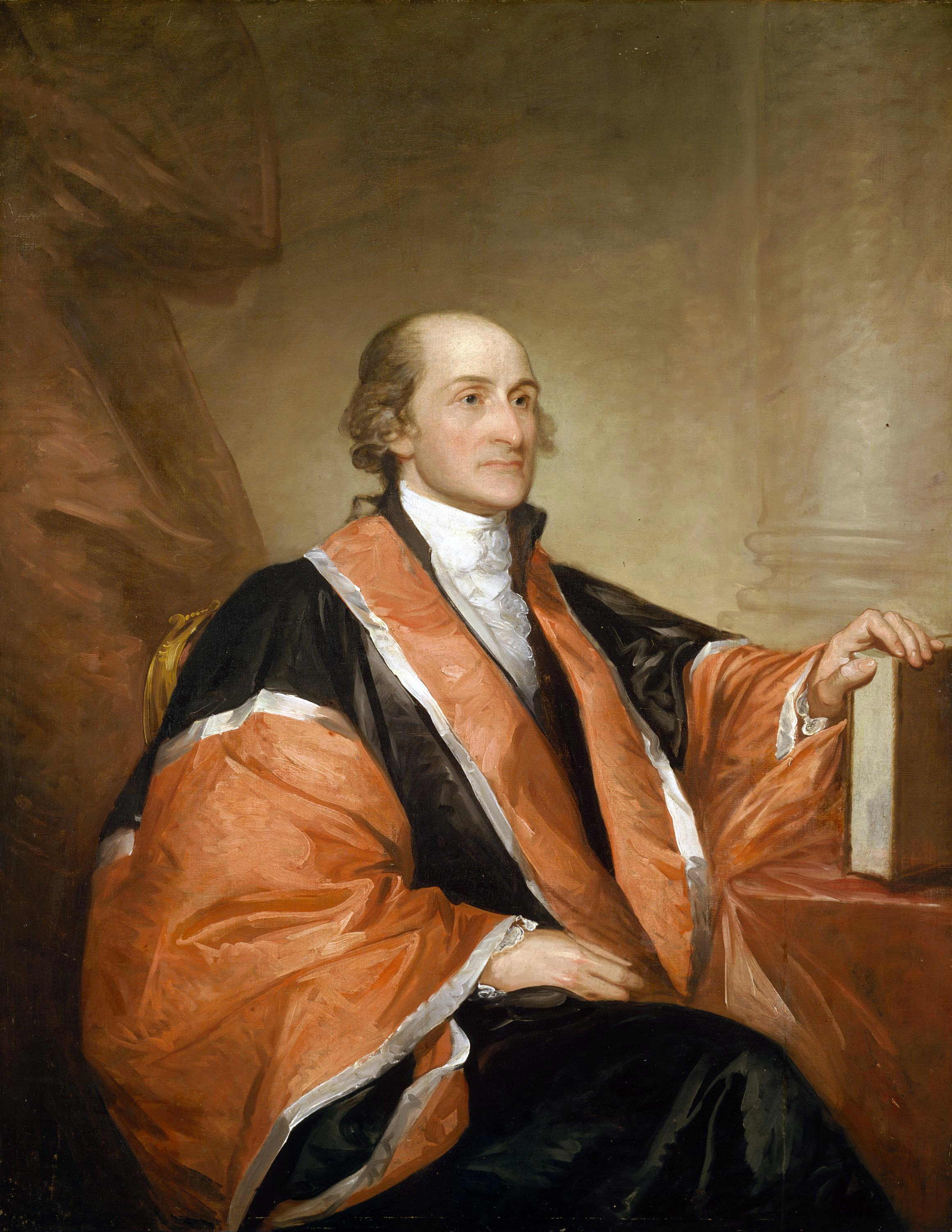
Historical · U.S. Department of State
John Jay
Former United States Secretary of State · U.S. Department of State · 1789–1790
John Jay served as United States Secretary of State (1789–1790). The page below collects sourced biographical facts, the appointment record, and provenance for Jay.
Key facts
- Full name
- John Jay
- Department
- U.S. Department of State
- Office
- United States Secretary of State
- Status
- Former secretary
- Appointment
- Senate-confirmed
- Tenure
- 1789–1790
- Confirmed
- —
- Born
- 1745
- Died
- 1829
- First year in office
- 1789
- Dataset version
- 1.20260703
Appointment & service record
United States Secretary of State · 1789–1790
- Department
- U.S. Department of State
- Appointment
- Senate-confirmed
- Appointing president
- —
- Confirmed
- —
Department, appointment type (Senate-confirmed, acting, recess, or designated), appointing president, confirmation status, and service dates are drawn from Wikidata and the White House Cabinet roster.[1][2][3]
Sources
- [1]https://www.wikidata.org/wiki/Q310847Wikidata · retrieved 2026-07-03
- [2]https://www.whitehouse.gov/administration/cabinet/whitehouse.gov · retrieved 2026-07-03
- [3]https://www.wikidata.org/wiki/Q639738wikidata-cabinet · retrieved 2026-07-03
Biographical narrative
995 words · sourced from the Wikipedia REST extract
John Jay (December 12, 1745 – May 17, 1829) was an American statesman who played a central role in the early development of the United States. He served as the first Secretary of State from 1789 to 1790 under President George Washington and held several other prominent positions, including chief justice of the Supreme Court, governor of New York, and negotiator of the Treaty of Paris that ended the Revolutionary War.
Early life and career
John Jay was born in New York City on December 12, 1745 (the date corresponding to December 23 in the Gregorian calendar). His family had long ties to commerce and public service; his father, Peter Jay, was a prosperous merchant who had retired after a smallpox epidemic that claimed two of their children. The Jays were descendants of French Huguenots who had fled persecution following the revocation of the Edict of Nantes in 1685. Their ancestor, Auguste Jay, had relocated from France to Charleston, South Carolina, and then to New York, where he established a successful trading enterprise. John’s mother, Mary Van Cortlandt, came from a prominent Dutch family whose patriarch, Jacobus Van Cortlandt, served twice as mayor of New York City.
Jay spent his early years in Rye, New York, where he received private instruction from his mother until the age of eight. He then studied under Anglican priest Pierre Stoupe in New Rochelle for three years before returning to homeschooling in Rye with tutors George Murray and others. In 1760, at fourteen, he entered King’s College (later Columbia University) in New York City. There he formed close friendships with fellow students such as Robert Livingston and pursued a liberal education that prepared him for a career in law.
After graduating in 1764, Jay studied under the prominent lawyer Benjamin Kissam, who also taught other notable figures of the era. By 1767 he had earned a Master of Arts degree, a customary step for young men entering professional life at the time. In 1768, after being admitted to the bar of New York, Jay opened his own legal practice and began working as a law clerk while also engaging in public affairs.
Jay’s early political activity was rooted in opposition to British policies that he viewed as infringements on colonial rights. He joined the New York Committee of Correspondence in 1774, serving as its secretary and becoming an active organizer of resistance against measures such as the Intolerable Acts. His involvement in the revolutionary cause deepened when he represented the “Radical Whig” faction that sought to protect property rights and uphold the rule of law while resisting what they considered unlawful British taxation.
In 1774, Jay was elected as a delegate to the First Continental Congress, where he signed the Continental Association, an agreement among the colonies to boycott British goods. He later served in the Second Continental Congress, eventually becoming its president during the war. His diplomatic skills were recognized when he was appointed ambassador to Spain from 1779 to 1782; there he persuaded Spanish officials to provide financial assistance to the fledgling United States. Jay also played a key role as a negotiator of the Treaty of Paris in 1783, which secured British recognition of American independence.
Following the war, Jay served as Secretary of Foreign Affairs under the Articles of Confederation government and acted as interim Secretary of State on several occasions. His experience in foreign affairs and his reputation for prudence made him a natural choice when the new federal government was formed.
Cabinet tenure
When George Washington became the first President of the United States, he appointed John Jay as the inaugural Secretary of State in 1789. The Senate confirmed Jay’s appointment, allowing him to assume the responsibilities of directing U.S. foreign policy during the formative years of the republic. As Secretary, Jay was tasked with establishing diplomatic protocols, managing relations with European powers, and laying the groundwork for a coherent national foreign policy.
Jay’s tenure coincided with significant challenges, including navigating the complex political landscape of Europe after the French Revolution and addressing lingering tensions with Britain. His experience as an ambassador to Spain and as a negotiator of the Treaty of Paris informed his approach to diplomacy during this period. Although his time in office was relatively brief—ending in 1790—the foundations he helped establish influenced subsequent administrations.
During his service, Jay also worked closely with other members of Washington’s cabinet, contributing to discussions on domestic policy while maintaining a focus on foreign affairs. His leadership style emphasized careful deliberation and respect for the authority of the executive branch, reflecting his broader commitment to strong, centralized governance.
Legacy
John Jay’s influence extended far beyond his brief period as Secretary of State. He was one of the principal authors of The Federalist Papers, collaborating with Alexander Hamilton and James Madison on five of the eighty‑five essays that argued in favor of ratifying the Constitution. His legal scholarship and constitutional interpretation helped shape early American jurisprudence.
After serving as Secretary of State, Jay became the first Chief Justice of the Supreme Court, a position he held from 1789 to 1795. The court’s workload during his tenure was modest; it decided only four cases over six years, allowing him to focus on establishing procedural norms and maintaining judicial independence.
Jay later served as governor of New York from 1795 to 1801, where he enacted gradual emancipation legislation while personally owning a small number of slaves. His governance reflected the complex social dynamics of the era and his commitment to public service at both state and national levels.
John Jay retired to his farm in Westchester County after declining a second term as chief justice during the final days of President John Adams’ administration. He lived there until his death on May 17, 1829. His legacy endures through his contributions to the founding documents of the United States, his role in establishing early federal institutions, and his lasting impact on American diplomacy and law.
Sources & provenance
Every quantitative or attributable claim above carries a per-section [N] marker that resolves to the corresponding URL below. Each entry records the upstream provider, the canonical URL, and the timestamp at which the underlying source was retrieved.
Key facts
- https://www.wikidata.org/wiki/Q310847Wikidata · retrieved 2026-07-03
- https://www.whitehouse.gov/administration/cabinet/whitehouse.gov · retrieved 2026-07-03
- https://www.wikidata.org/wiki/Q639738wikidata-cabinet · retrieved 2026-07-03
Biographical narrative
- https://en.wikipedia.org/wiki/John_JayWikipedia · retrieved 2026-07-03
Explore the Cabinet
The Cabinet includes the Vice President and the heads of the 15 executive departments. Browse the full roster of current and former secretaries, or explore how the Cabinet fits into the federal government.