
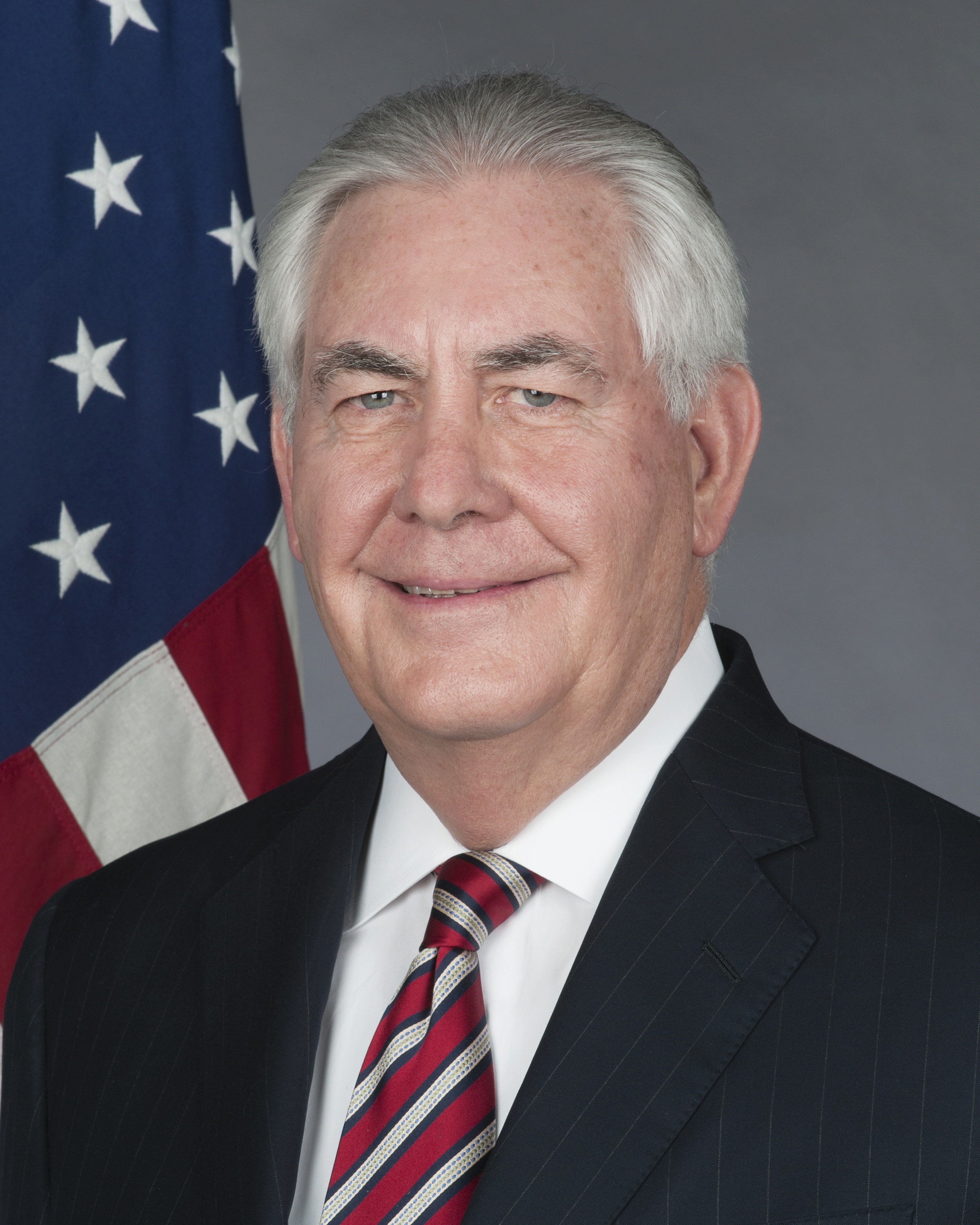
Historical · U.S. Department of State
Rex Tillerson
Former United States Secretary of State · U.S. Department of State · 2017–2018
Rex Tillerson served as United States Secretary of State (2017–2018). The page below collects sourced biographical facts, the appointment record, and provenance for Tillerson.
Key facts
- Full name
- Rex Tillerson
- Department
- U.S. Department of State
- Office
- United States Secretary of State
- Status
- Former secretary
- Appointment
- Senate-confirmed
- Tenure
- 2017–2018
- Confirmed
- —
- Born
- 1952
- Died
- —
- First year in office
- 2017
- Dataset version
- 1.20260703
Appointment & service record
United States Secretary of State · 2017–2018
- Department
- U.S. Department of State
- Appointment
- Senate-confirmed
- Appointing president
- —
- Confirmed
- —
Department, appointment type (Senate-confirmed, acting, recess, or designated), appointing president, confirmation status, and service dates are drawn from Wikidata and the White House Cabinet roster.[1][2][3]
Sources
- [1]https://www.wikidata.org/wiki/Q331401Wikidata · retrieved 2026-07-03
- [2]https://www.whitehouse.gov/administration/cabinet/whitehouse.gov · retrieved 2026-07-03
- [3]https://www.wikidata.org/wiki/Q639738wikidata-cabinet · retrieved 2026-07-03
Biographical narrative
1,067 words · sourced from the Wikipedia REST extract
Rex Wayne Tillerson, born March 23 1952, is an American businessman who served as the 69th United States Secretary of State from February 2017 until his dismissal in March 2018. Prior to entering public office, he spent three decades at ExxonMobil, ultimately becoming chairman and chief executive officer. His tenure in Washington was marked by a quiet diplomatic style that contrasted with the high‑profile nature of the position, and it coincided with significant changes within the State Department’s career ranks.
Early life and career
Tillerson grew up in several small towns across Texas and Oklahoma, including Vernon, Stillwater, and Huntsville. His parents were Patty Sue (née Patton) and Bobby Joe Tillerson; his father held an executive role with the Boy Scouts of America, a connection that would influence Rex’s lifelong involvement with the organization. He has two sisters: Rae Ann Hamilton, a physician based in Abilene, Texas, and Jo Lynn Peters, who works as a high‑school educator.
During his youth, Tillerson earned the rank of Eagle Scout, the highest achievement attainable within the Boy Scouts. His early work experience included roles such as busser at Oklahoma State University’s student union, cotton picking on weekends, and janitorial duties in an engineering building—positions that reflected the modest beginnings common to many in his generation.
He graduated from Huntsville High School in 1970, where he also served as a percussionist in the school band. A scholarship from the University of Texas Longhorn Band enabled him to attend the University of Texas at Austin. There he completed a bachelor of science degree in civil engineering in 1975 and participated in campus activities such as the Tejas Club and the marching band.
Immediately after graduation, Tillerson joined Exxon Company USA as a production engineer. Over the next twenty‑five years he advanced through a series of managerial positions: general manager of Exxon USA’s central production division (1989), president of Exxon Yemen Inc. and Esso Exploration and Production Khorat Inc. (1995), vice president of Exxon Ventures (CIS) and president of Exxon Neftegas Limited (1998). These roles placed him at the center of Exxon’s operations in Russia, the Caspian Sea, and other key energy markets.
In 1999, following the merger of Exxon and Mobil, Tillerson was named executive vice president of ExxonMobil Development Company. By 2004 he had become president and director of ExxonMobil, positioning him as the natural successor to CEO Lee Raymond. On January 1 2006, he was elected chairman and chief executive officer of ExxonMobil, a company that at the time employed approximately 80,000 people worldwide and generated nearly $400 billion in annual revenue.
During his leadership, ExxonMobil expanded its presence in the Middle East, engaging with Saudi Arabia, Qatar, and the United Arab Emirates. The company also maintained limited sales operations through its European subsidiary Infineum in countries such as Iran, Sudan, and Syria; these activities were described by corporate officials as compliant with legal frameworks and small relative to overall revenue. In 2009, ExxonMobil acquired XTO Energy for $31 billion in stock, a transaction that became a notable part of Tillerson’s business legacy.
Tillerson also navigated complex international agreements, including a multibillion‑dollar deal with the government of Iraqi Kurdistan—a partnership that faced criticism from U.S. officials concerned about regional stability. He was an advocate against certain regulatory provisions under the Dodd–Frank Act, notably Rule 1504, which would have required disclosure of payments to foreign governments; this rule was ultimately overturned by Congress shortly before his confirmation as Secretary of State.
He retired from ExxonMobil effective January 1 2017, after more than forty years with the company. In addition to his corporate career, Tillerson remained active in the Boy Scouts, serving as national president from 2010 to 2012—the organization’s highest volunteer position.
Cabinet tenure
President Donald Trump nominated Tillerson for Secretary of State on January 31 2017, and he was confirmed by the United States Senate on February 1 2017. His appointment made him the first former chief executive officer of a Fortune‑500 company to hold the office in modern U.S. history.
Tillerson’s approach to diplomacy differed from that of his predecessors. He maintained a low public profile, rarely appearing in televised briefings or engaging extensively with the press. This understated style was noted by observers as a departure from the traditionally high‑visibility role of the Secretary of State.
During his tenure, the Department of State experienced notable changes among its career ranks. Applications for entry into the Foreign Service fell by approximately fifty percent, and several senior career officials departed: four of six career ambassadors and fourteen of thirty‑three career ministers left the department during this period. These movements were attributed in part to evolving priorities within the administration.
Relations between Tillerson and President Trump deteriorated over time, culminating in the president’s decision to dismiss him in March 2018. The dismissal was announced publicly on March 15 2018, with Mike Pompeo—then director of the Central Intelligence Agency—named as his successor. Tillerson’s departure marked a brief tenure that spanned just over one year.
Legacy
Tillerson’s legacy is multifaceted, reflecting both his corporate background and his short period in public service. In the business arena, he is remembered for steering ExxonMobil through significant expansion into natural gas production and international markets, as well as for negotiating large-scale deals such as the acquisition of XTO Energy. His tenure also involved navigating regulatory challenges and maintaining relationships with key global partners.
In the diplomatic sphere, his time as Secretary of State was characterized by a low‑profile approach that contrasted sharply with the expectations traditionally associated with the position. The reduction in Foreign Service applications and the departure of several senior career officials during his term have been cited by analysts as indicators of broader shifts within the department’s culture and recruitment strategies.
While his service in Washington was brief, Tillerson’s appointment underscored a willingness by the Trump administration to bring private‑sector executives into high‑level government roles. His experience illustrates both the potential benefits and challenges of such cross‑sector appointments, particularly regarding adaptation to the distinct demands of public diplomacy and bureaucratic governance.
Overall, Rex Tillerson’s career trajectory—from civil engineer to corporate chief executive and finally to Secretary of State—provides a case study in the intersection of business leadership and foreign policy execution. His impact on both ExxonMobil’s global strategy and the U.S. Department of State’s internal dynamics continues to be examined by scholars of public administration, international relations, and corporate governance.
Sources & provenance
Every quantitative or attributable claim above carries a per-section [N] marker that resolves to the corresponding URL below. Each entry records the upstream provider, the canonical URL, and the timestamp at which the underlying source was retrieved.
Key facts
- https://www.wikidata.org/wiki/Q331401Wikidata · retrieved 2026-07-03
- https://www.whitehouse.gov/administration/cabinet/whitehouse.gov · retrieved 2026-07-03
- https://www.wikidata.org/wiki/Q639738wikidata-cabinet · retrieved 2026-07-03
Biographical narrative
- https://en.wikipedia.org/wiki/Rex_TillersonWikipedia · retrieved 2026-07-03
Explore the Cabinet
The Cabinet includes the Vice President and the heads of the 15 executive departments. Browse the full roster of current and former secretaries, or explore how the Cabinet fits into the federal government.