
Historical · U.S. Department of State
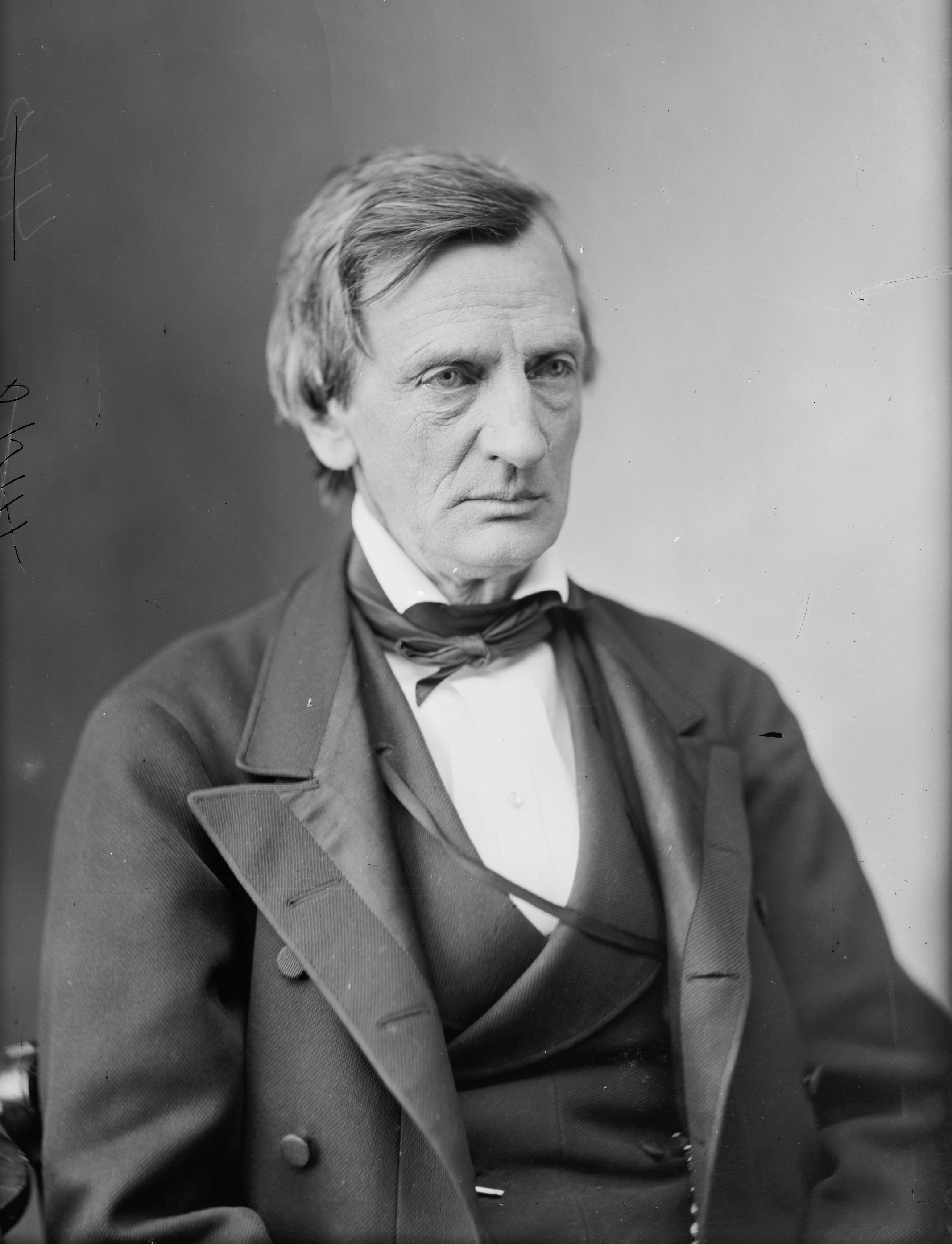
William M. Evarts
Former United States Secretary of State · U.S. Department of State · 1877–1881
William M. Evarts served as United States Secretary of State (1877–1881). The page below collects sourced biographical facts, the appointment record, and provenance for Evarts.
Key facts
- Full name
- William M. Evarts
- Department
- U.S. Department of State
- Office
- United States Secretary of State
- Status
- Former secretary
- Appointment
- Senate-confirmed
- Tenure
- 1877–1881
- Confirmed
- —
- Born
- 1818
- Died
- 1901
- First year in office
- 1877
- Dataset version
- 1.20260703
Appointment & service record
United States Secretary of State · 1877–1881
- Department
- U.S. Department of State
- Appointment
- Senate-confirmed
- Appointing president
- —
- Confirmed
- —
Department, appointment type (Senate-confirmed, acting, recess, or designated), appointing president, confirmation status, and service dates are drawn from Wikidata and the White House Cabinet roster.[1][2][3]
Sources
- [1]https://www.wikidata.org/wiki/Q709167Wikidata · retrieved 2026-07-03
- [2]https://www.whitehouse.gov/administration/cabinet/whitehouse.gov · retrieved 2026-07-03
- [3]https://www.wikidata.org/wiki/Q639738wikidata-cabinet · retrieved 2026-07-03
Biographical narrative
1,014 words · sourced from the Wikipedia REST extract
William Maxwell Evarts was an American lawyer and public servant whose career spanned the mid‑nineteenth to early twentieth centuries. Born in 1818, he rose from a modest legal practice in New York City to serve as United States Secretary of State under President Rutherford B. Hayes, while also holding positions as Attorney General and U.S. Senator for New York. His reputation as an incisive litigator and his participation in several landmark national controversies—such as the impeachment of a president, international arbitration at Geneva, and the resolution of the disputed 1876 presidential election—made him one of the most influential figures in American jurisprudence during his era.
Early life and career
William M. Evarts entered the world on February 6, 1818, in Charlestown, Massachusetts, to Jeremiah Evarts and Mehitabel Barnes Sherman. His father, a Vermont native, had been a respected lawyer and later an editor of *The Panoplist*, while his mother descended from Roger Sherman, a founding father who signed foundational American documents. After the death of his father when William was thirteen, he pursued education at Boston Latin School before enrolling at Yale College. While at Yale, Evarts distinguished himself academically—graduating third in his class in 1837—and became active in intellectual societies, including the Linonian Society and Skull and Bones. He also helped found *Yale Literary Magazine* in 1836.
Following graduation, Evarts moved to Windsor, Vermont, where he studied law under Horace Everett while teaching school to support himself. He spent a year at Harvard Law School, earning the respect of professors Joseph Story and Simon Greenleaf, before completing his legal education with Daniel Lord in New York City. Admitted to the bar in 1841, Evarts entered practice as a junior associate in Lord’s firm.
In 1843, he married Helen Minerva Bingham Wardner, daughter of Allen Wardner, a prominent Vermont businessman and banker who had served as state treasurer. The couple would have twelve children between 1845 and 1862, all born while the family resided in New York City.
Evarts’s early legal career was marked by high‑profile cases that showcased his courtroom skill. One of his first major assignments involved the defense of Monroe Edwards, a notorious forger; although Edwards was convicted, Evarts’s performance drew attention to his potential as a leading lawyer. In 1851 he formed a partnership with Charles F. Southmayd, creating the firm Butler, Evarts & Southmayd. The partnership endured in various configurations throughout his career, and in 1859 Joseph Hodges Choate joined, giving rise to Evarts, Southmayd & Choate. While Southmayd was credited with meticulous case preparation, it was Evarts who often delivered the persuasive arguments before juries.
Evarts’s reputation extended beyond private practice into public service. In 1855 he represented the State of Virginia in a contentious appeal concerning the release of eight black slaves in the Lemmon Slave Case; his arguments helped secure a ruling that upheld the decision, a case that attracted widespread attention across both Northern and Southern states. Two years later, he defended the widow of Henry Parish in a complex probate dispute involving wills and codicils worth over $1.5 million; after extensive testimony and appellate proceedings, the court ultimately affirmed his client’s position.
Cabinet tenure
Evarts entered national politics during the Reconstruction era, serving as United States Attorney General before being elected to the U.S. Senate representing New York. His tenure in these roles positioned him at the center of several pivotal national debates. He was actively involved in the impeachment proceedings against President Andrew Johnson—a case that tested the limits of congressional authority and executive power. Additionally, Evarts played a role in the Geneva arbitration, an international dispute resolution effort that reflected growing American engagement with global diplomacy.
In 1877, President Rutherford B. Hayes appointed Evarts as Secretary of State. Confirmed by the Senate, he served in this capacity until 1881. During his term, Evarts was known for his commitment to civil service reform and his opposition to the spoils system that had long characterized federal appointments. He aligned with the “Half‑Breed” faction within the Republican ranks—an informal group advocating for merit‑based hiring and broader governmental accountability. His tenure also coincided with the resolution of the contested 1876 presidential election, a crisis that required diplomatic negotiation and legal acumen to resolve disputes over electoral votes.
Evarts’s approach as Secretary of State emphasized careful analysis of international treaties and a preference for negotiated settlements over unilateral action. While specific policy initiatives are not detailed in available records, his background as a seasoned litigator informed his handling of diplomatic correspondence and treaty negotiations. He maintained the office’s traditional responsibilities—managing foreign affairs, representing U.S. interests abroad, and advising the president on matters of international law—while also navigating the domestic political pressures that accompanied Reconstruction and post‑Civil War governance.
Legacy
William M. Evarts’s legacy is multifaceted, reflecting his contributions to both American legal practice and public service. As a lawyer, he was celebrated for his courtroom presence and strategic thinking; his early cases established him as one of the most respected litigators in New York. The partnership with Charles F. Southmayd and later Joseph Hodges Choate produced a firm that became a notable institution in the American legal landscape.
In public office, Evarts’s participation in high‑stakes national controversies—such as presidential impeachment, international arbitration, and electoral dispute resolution—underscored his capacity to handle complex constitutional questions. His advocacy for civil service reform aligned with broader movements toward meritocracy within federal institutions, setting a precedent that would influence subsequent administrations.
Evarts’s personal life also reflected the era’s social norms; he married into a family of civic prominence and raised a large family in New York City. He remained active in legal circles until his death on February 28, 1901, leaving behind a body of work that continued to inform discussions on law, governance, and diplomatic practice well beyond his lifetime.
Overall, William M. Evarts exemplified the role of a lawyer‑turned‑statesman who leveraged legal expertise to shape national policy during a transformative period in American history. His career bridged private practice and public duty, illustrating how rigorous advocacy can translate into effective governance within the United States federal system.
Sources & provenance
Every quantitative or attributable claim above carries a per-section [N] marker that resolves to the corresponding URL below. Each entry records the upstream provider, the canonical URL, and the timestamp at which the underlying source was retrieved.
Key facts
- https://www.wikidata.org/wiki/Q709167Wikidata · retrieved 2026-07-03
- https://www.whitehouse.gov/administration/cabinet/whitehouse.gov · retrieved 2026-07-03
- https://www.wikidata.org/wiki/Q639738wikidata-cabinet · retrieved 2026-07-03
Biographical narrative
- https://en.wikipedia.org/wiki/William_M._EvartsWikipedia · retrieved 2026-07-03
Explore the Cabinet
The Cabinet includes the Vice President and the heads of the 15 executive departments. Browse the full roster of current and former secretaries, or explore how the Cabinet fits into the federal government.