
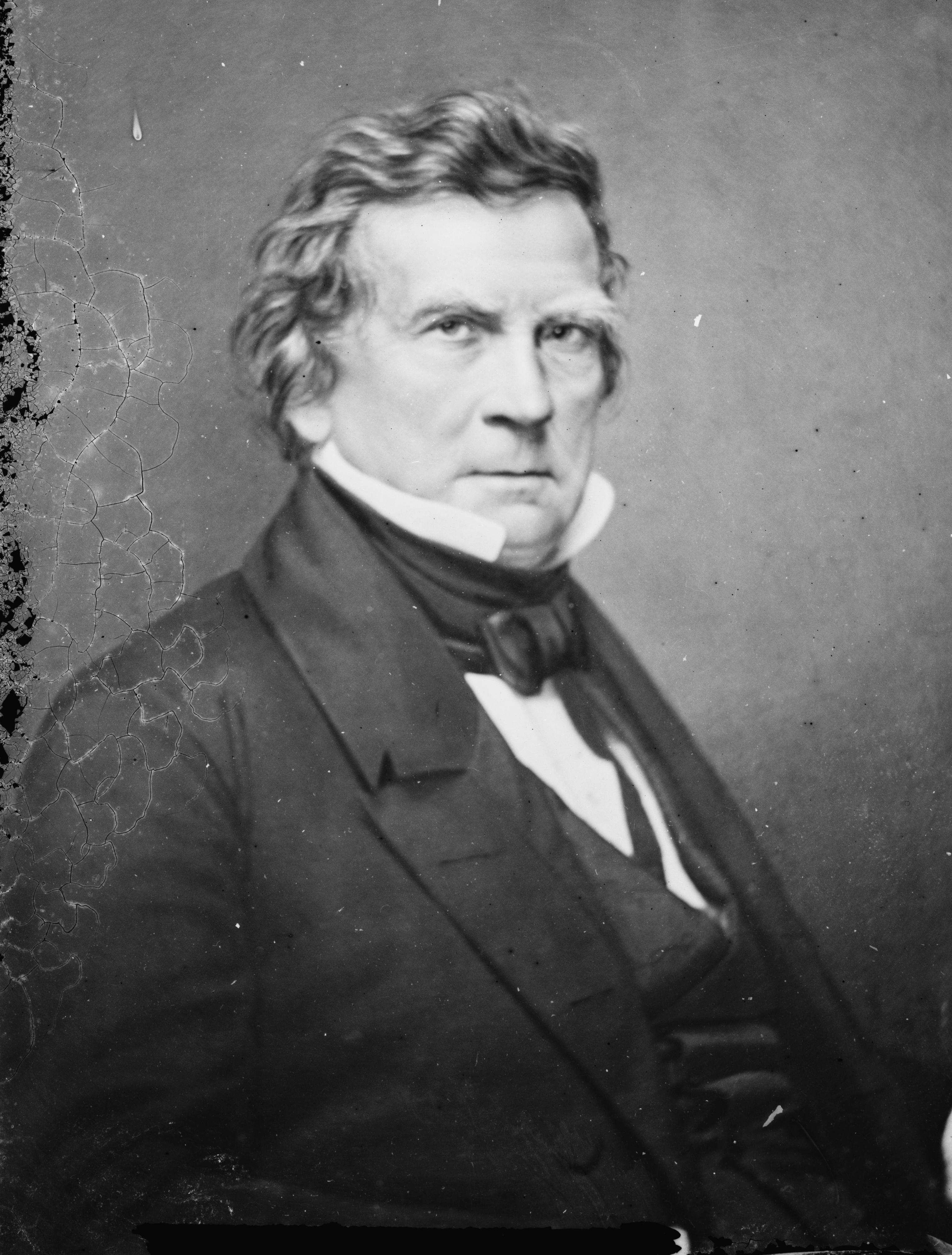
Historical · U.S. Department of State
William L. Marcy
Former United States Secretary of State · U.S. Department of State · 1853–1857
William L. Marcy served as United States Secretary of State (1853–1857). The page below collects sourced biographical facts, the appointment record, and provenance for Marcy.
Key facts
- Full name
- William L. Marcy
- Department
- U.S. Department of State
- Office
- United States Secretary of State
- Status
- Former secretary
- Appointment
- Senate-confirmed
- Tenure
- 1853–1857
- Confirmed
- —
- Born
- 1786
- Died
- 1857
- First year in office
- 1853
- Dataset version
- 1.20260703
Appointment & service record
United States Secretary of State · 1853–1857
- Department
- U.S. Department of State
- Appointment
- Senate-confirmed
- Appointing president
- —
- Confirmed
- —
Department, appointment type (Senate-confirmed, acting, recess, or designated), appointing president, confirmation status, and service dates are drawn from Wikidata and the White House Cabinet roster.[1][2][3]
Sources
- [1]https://www.wikidata.org/wiki/Q389258Wikidata · retrieved 2026-07-03
- [2]https://www.whitehouse.gov/administration/cabinet/whitehouse.gov · retrieved 2026-07-03
- [3]https://www.wikidata.org/wiki/Q639738wikidata-cabinet · retrieved 2026-07-03
Biographical narrative
902 words · sourced from the Wikipedia REST extract
William Learned Marcy (December 12, 1786 – July 4, 1857) was an American lawyer, judge, and statesman who served in several high‑level federal offices during the first half of the nineteenth century. His career spanned the early republic through the era of westward expansion, culminating in his appointment as United States Secretary of State under President Franklin Pierce. In that role he negotiated the Gadsden Purchase, the last major territorial acquisition within what would become the contiguous United States, and helped shape U.S. diplomatic practice at a time when the nation was solidifying its presence abroad.
Early life and career
Marcy was born in Southbridge, Massachusetts to farmer Jedediah Marcy and Ruth (Learned) Marcy. He received his early education in local schools before attending The Woodstock Academy in Connecticut. In 1808 he graduated from Brown University, after which he taught school in Dedham, Massachusetts and Newport, Rhode Island. He studied law under Troy attorney William L. Bliss and was admitted to the bar in 1811, establishing a practice in Troy, New York.
During the War of 1812 Marcy served in the state militia, beginning as an ensign in the 155th New York Infantry Regiment and advancing through the ranks to first lieutenant and captain. He participated in the storming of the British post at St. Regis, Canada on October 22, 1812, and remained with the regiment after hostilities ended, ultimately attaining the rank of lieutenant colonel as second in command.
Marcy’s early public service included two terms as Troy City Recorder (1816‑18 and 1821‑23) and a stint as editor of the local newspaper, the *Troy Budget*. His political alignment with the Anti‑Dewitt Clinton faction of the Democratic‑Republican Party—known as the Bucktails—placed him within the influential Albany Regency, a group that dominated New York politics in the 1820s and 1830s. In this capacity he held several state offices: Adjutant General of New York (1821‑23) with the rank of brigadier general; New York State Comptroller (1823‑29); and associate justice of the New York Supreme Court (1829‑31).
In 1831 Marcy was elected by the New York legislature to the United States Senate, serving from March 4, 1831 until January 1, 1833. He resigned upon his election as Governor of New York, a position he held for three consecutive terms from 1833 to 1838. As governor he oversaw reforms in banking regulation and played a role in shaping state policy during a period of significant economic change.
After leaving the governorship Marcy returned to private law practice and remained active within the Democratic Party’s conservative Hunker faction, which favored compromise on contentious issues such as slavery. He also served on the Mexican Claims Commission from 1839 to 1842, an early engagement with U.S.–Mexico relations that would later inform his diplomatic work.
Cabinet tenure
Marcy’s first federal cabinet appointment came in 1845 when President James K. Polk named him Secretary of War. In this role he oversaw the United States Army during the Mexican–American War (1846‑1848), a conflict that resulted in significant territorial gains for the nation. After completing his service under Polk, Marcy returned to private practice and continued to influence state politics as a leader of the Hunkers.
In 1853 President Franklin Pierce appointed Marcy Secretary of State. The Senate confirmed him, and he served in that office until July 1857. During his tenure he pursued several diplomatic initiatives aimed at clarifying U.S. positions abroad and simplifying foreign representation. He resolved disputes concerning the status of American immigrants overseas and directed U.S. diplomats to adopt a plain dress style rather than the elaborate court‑dress that had previously been common among American envoys.
Marcy negotiated a reciprocity treaty with British North America, fostering trade relations between the United States and its northern neighbor. His most enduring achievement was the negotiation of the Gadsden Purchase from Mexico, which added approximately 30,000 square miles (78,000 km²) to the United States. The acquisition encompassed land that would become parts of present‑day Arizona and New Mexico, thereby extending U.S. territory further into the southwestern region.
Throughout his cabinet service Marcy maintained a reputation for careful negotiation and adherence to established diplomatic protocols. His efforts contributed to a period of relative stability in U.S. foreign affairs as the nation continued to expand its borders and solidify its international standing.
Legacy
William Learned Marcy’s career reflects the trajectory of a public servant who moved from local legal practice to influential federal positions during a formative era for the United States. His leadership within the Albany Regency helped shape New York politics in the early nineteenth century, while his tenure as governor saw significant reforms in state banking and governance.
As Secretary of War, Marcy oversaw military operations that expanded U.S. territory through the Mexican–American War, setting a precedent for future westward expansion. His later role as Secretary of State was marked by diplomatic initiatives that clarified American positions abroad and streamlined diplomatic conduct. The Gadsden Purchase remains his most notable legacy; it was the final major land acquisition in the contiguous United States and played a key role in defining the nation's southwestern boundary.
Marcy’s death on July 4, 1857—shortly after leaving office—closed a career that spanned law, state governance, military oversight, and foreign diplomacy. His contributions to territorial expansion, diplomatic practice, and political organization left an imprint on both New York’s development and the broader trajectory of U.S. national policy during a period of rapid growth and change.
Sources & provenance
Every quantitative or attributable claim above carries a per-section [N] marker that resolves to the corresponding URL below. Each entry records the upstream provider, the canonical URL, and the timestamp at which the underlying source was retrieved.
Key facts
- https://www.wikidata.org/wiki/Q389258Wikidata · retrieved 2026-07-03
- https://www.whitehouse.gov/administration/cabinet/whitehouse.gov · retrieved 2026-07-03
- https://www.wikidata.org/wiki/Q639738wikidata-cabinet · retrieved 2026-07-03
Biographical narrative
- https://en.wikipedia.org/wiki/William_L._MarcyWikipedia · retrieved 2026-07-03
Explore the Cabinet
The Cabinet includes the Vice President and the heads of the 15 executive departments. Browse the full roster of current and former secretaries, or explore how the Cabinet fits into the federal government.