
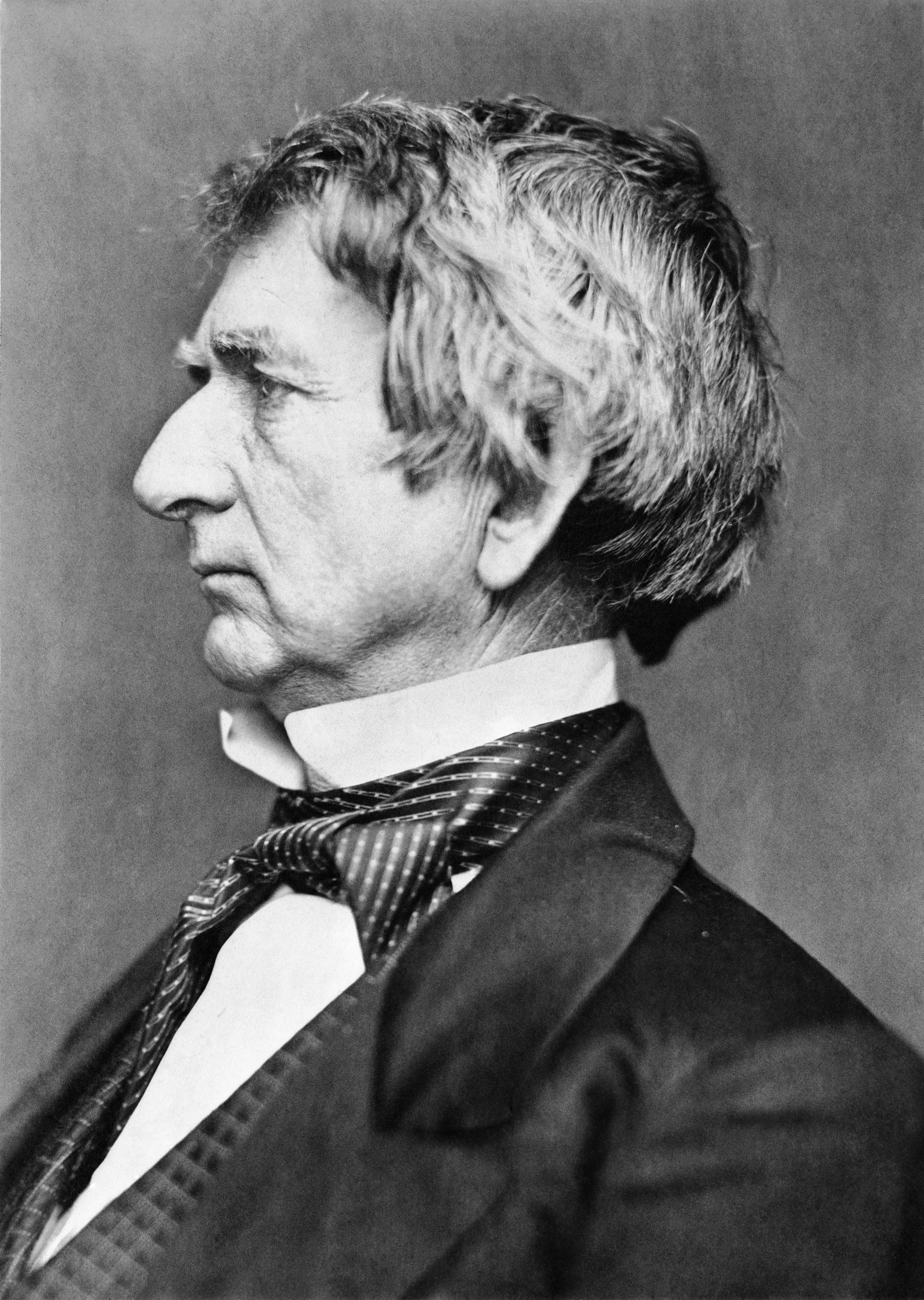
Historical · U.S. Department of State
William H. Seward
Former United States Secretary of State · U.S. Department of State · 1861–1869
William H. Seward served as United States Secretary of State (1861–1869). The page below collects sourced biographical facts, the appointment record, and provenance for Seward.
Key facts
- Full name
- William H. Seward
- Department
- U.S. Department of State
- Office
- United States Secretary of State
- Status
- Former secretary
- Appointment
- Senate-confirmed
- Tenure
- 1861–1869
- Confirmed
- —
- Born
- 1801
- Died
- 1872
- First year in office
- 1861
- Dataset version
- 1.20260703
Appointment & service record
United States Secretary of State · 1861–1869
- Department
- U.S. Department of State
- Appointment
- Senate-confirmed
- Appointing president
- —
- Confirmed
- —
Department, appointment type (Senate-confirmed, acting, recess, or designated), appointing president, confirmation status, and service dates are drawn from Wikidata and the White House Cabinet roster.[1][2][3]
Sources
- [1]https://www.wikidata.org/wiki/Q297308Wikidata · retrieved 2026-07-03
- [2]https://www.whitehouse.gov/administration/cabinet/whitehouse.gov · retrieved 2026-07-03
- [3]https://www.wikidata.org/wiki/Q639738wikidata-cabinet · retrieved 2026-07-03
Biographical narrative
806 words · sourced from the Wikipedia REST extract
William Henry Seward was a prominent American public servant whose career spanned the formative years of the United States Republican Party and the most turbulent decade of the nation’s history. He served as United States Secretary of State from 1861 to 1869, a period that encompassed the Civil War and the early Reconstruction era. Prior to his cabinet service, he was governor of New York, a long‑time U.S. senator, and an influential figure in the emerging Republican movement. Seward is best remembered for his diplomatic efforts to keep foreign powers from recognizing the Confederacy and for negotiating the purchase of Alaska from Russia.
Early life and career
William Henry Seward was born on May 16, 1801, in the village of Florida in Orange County, New York. His father, Samuel Sweezy Seward, was a landowner who also owned slaves; slavery remained legal in New York until 1827. Growing up in this rural community, Seward attended local schools and later studied at Union College in Schenectady, where he distinguished himself academically and became a member of Phi Beta Kappa.
After completing his education, Seward pursued the study of law under several attorneys in Goshen and New York City. He was admitted to the bar in 1822 and chose to establish his practice in Auburn, Cayuga County, rather than remain in his hometown. In Auburn he joined a legal partnership that would provide the foundation for his later political career.
Seward entered public office as a member of the New York State Senate in 1830, elected on an Anti‑Masonic platform. His early legislative work focused on issues related to state governance and social reform. In 1834 he became the Whig Party’s gubernatorial nominee; although he was not successful in that election, Seward ran again and won the governorship of New York in 1838. He served two consecutive terms, ending his tenure in 1840. During this period he enacted several laws aimed at expanding civil rights for black residents and ensuring fair legal processes for fugitive slaves. His administration also intervened on behalf of freed individuals who were illegally enslaved in the South.
After leaving state office, Seward returned to private law practice before being elected by the New York legislature to the United States Senate in 1849. He was re‑elected in 1855 and served until 1861. Throughout his senatorial career he became a vocal opponent of slavery’s expansion into new territories. His outspoken positions earned him both admiration among abolitionists and hostility from Southern politicians. In the years leading up to the Civil War, Seward joined the nascent Republican Party and emerged as one of its most prominent leaders.
Cabinet tenure
In 1860, after Abraham Lincoln secured the Republican presidential nomination, Seward campaigned on Lincoln’s behalf. Following Lincoln’s election victory, Seward was appointed United States Secretary of State in 1861. The Senate confirmed his appointment; no specific vote tally is recorded in the available sources.
As Secretary of State during the Civil War, Seward focused on preventing foreign intervention that might aid the Confederacy. His diplomatic efforts were largely successful in deterring both the United Kingdom and France from formally recognizing the Confederate States. In 1865, while serving as secretary, he was targeted by a plot to assassinate President Lincoln; Seward himself sustained serious injuries when conspirator Lewis Powell attacked him.
Seward remained in his cabinet position throughout President Andrew Johnson’s administration, which followed Lincoln’s assassination. During this time he negotiated the purchase of Alaska from Russia in 1867, a transaction that expanded United States territory significantly. He also supported Johnson during the president’s impeachment proceedings, providing diplomatic counsel and assistance as required by his office.
Seward’s tenure concluded in 1869, after which he retired from public life. His service spanned two presidencies and encompassed some of the most turbulent years in American history.
Legacy
William Henry Seward left a lasting imprint on United States diplomacy and domestic policy. His steadfast opposition to slavery contributed to the preservation of the Union during the Civil War. The diplomatic measures he implemented helped keep European powers from recognizing or supporting the Confederacy, thereby limiting external assistance that could have altered the war’s outcome.
The Alaska Purchase, negotiated under Seward’s stewardship, added a vast expanse of territory to the United States and has had enduring strategic and economic significance. Contemporary observers noted his willingness to act ahead of public opinion; one such remark described him as “one of those spirits who sometimes will go ahead of public opinion instead of tamely following its footprints.”
Seward died on October 10, 1872, leaving behind a legacy characterized by diplomatic skill, anti‑slavery advocacy, and a commitment to national unity. His career is frequently cited in discussions of Civil War diplomacy and territorial expansion, underscoring his role as a key figure in shaping the United States during a critical period of its development.
Sources & provenance
Every quantitative or attributable claim above carries a per-section [N] marker that resolves to the corresponding URL below. Each entry records the upstream provider, the canonical URL, and the timestamp at which the underlying source was retrieved.
Key facts
- https://www.wikidata.org/wiki/Q297308Wikidata · retrieved 2026-07-03
- https://www.whitehouse.gov/administration/cabinet/whitehouse.gov · retrieved 2026-07-03
- https://www.wikidata.org/wiki/Q639738wikidata-cabinet · retrieved 2026-07-03
Biographical narrative
- https://en.wikipedia.org/wiki/William_H._SewardWikipedia · retrieved 2026-07-03
Explore the Cabinet
The Cabinet includes the Vice President and the heads of the 15 executive departments. Browse the full roster of current and former secretaries, or explore how the Cabinet fits into the federal government.