
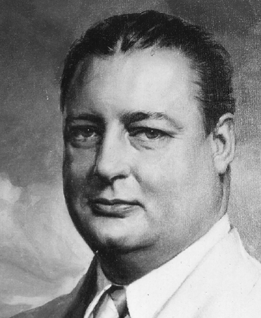
Historical · U.S. Department of the Interior
Julius Albert Krug
Former United States Secretary of the Interior · U.S. Department of the Interior · 1946–1949
Julius Albert Krug served as United States Secretary of the Interior (1946–1949). The page below collects sourced biographical facts, the appointment record, and provenance for Krug.
Key facts
- Full name
- Julius Albert Krug
- Department
- U.S. Department of the Interior
- Office
- United States Secretary of the Interior
- Status
- Former secretary
- Appointment
- Senate-confirmed
- Tenure
- 1946–1949
- Confirmed
- —
- Born
- 1907
- Died
- 1970
- First year in office
- 1946
- Dataset version
- 1.20260704
Appointment & service record
United States Secretary of the Interior · 1946–1949
- Department
- U.S. Department of the Interior
- Appointment
- Senate-confirmed
- Appointing president
- —
- Confirmed
- —
Department, appointment type (Senate-confirmed, acting, recess, or designated), appointing president, confirmation status, and service dates are drawn from Wikidata and the White House Cabinet roster.[1][2][3][4]
Sources
- [1]https://www.wikidata.org/wiki/Q464472Wikidata · retrieved 2026-07-04
- [2]https://www.whitehouse.gov/administration/cabinet/whitehouse.gov · retrieved 2026-07-04
- [3]https://www.wikidata.org/wiki/Q639738wikidata-cabinet · retrieved 2026-07-04
- [4]https://www.doi.gov/interiormuseum/past-secretariesdoi.gov past-secretaries roster · retrieved 2026-07-04
Biographical narrative
906 words · sourced from the Wikipedia REST extract
Julius Albert Krug (November 23, 1907 – March 26, 1970) was an American public servant who held several senior positions in federal agencies before being appointed United States Secretary of the Interior during President Harry S. Truman’s administration. His career spanned engineering, wartime production management, and resource stewardship, culminating in a cabinet role that placed him at the center of national debates over natural resource use and Native American land rights.
Early life and career
Krug was born on November 23, 1907, in Madison, Wisconsin, to Julius J. Krug (1877–1971) and Emma M. Korfmacher (1877–1949). He completed his undergraduate studies at the University of Wisconsin–Madison, graduating in 1929 with a degree that prepared him for work in engineering and public administration. Following graduation, he entered federal service, beginning a long association with agencies focused on power development.
In 1938, Krug joined the Tennessee Valley Authority (TVA), a New Deal agency tasked with regional economic development through hydroelectric power generation and flood control. He was appointed chief power engineer, a role that leveraged his technical background to oversee the design and operation of power facilities. Two years later, in 1940, he advanced to manager of power within the TVA, expanding his responsibilities to include broader operational oversight of the agency’s power production.
Krug’s expertise in power management led to a transfer to Washington, D.C., where he became chief of the power branch in the Office of Production Management in 1941. The office was charged with coordinating industrial output for national defense, and Krug’s role involved ensuring that power resources were allocated efficiently to support wartime production. After the United States entered World War II, the Office of Production Management evolved into the War Production Board; Krug continued his service as director of the Office of War Utilities in 1943, overseeing the distribution and management of utilities critical to war efforts.
In April 1944, Krug enlisted in the United States Navy. His wartime experience was further recognized when he was recalled in August of that year to serve as chairman of the War Production Board. He held this position until the board’s dissolution in November 1945, during which time it coordinated the allocation of industrial resources and managed production priorities for the war.
Cabinet tenure
President Truman nominated Krug to be Secretary of the Interior on February 26, 1946, and the Senate confirmed his appointment. He assumed office on March 18, 1946, serving until December 1, 1949. During this period, he oversaw a broad portfolio that included federal lands, natural resources, Native American affairs, and public utilities.
Krug’s tenure was marked by a cautious approach to resource development. He opposed proposals from lumber companies seeking logging rights in the extensive forests of Washington state, arguing for more stringent oversight of timber harvests. Similarly, he resisted plans to construct dams that he deemed unnecessary, reflecting a concern for balancing development with environmental considerations.
As administrator of coal mines nationwide, Krug attempted to mediate between labor and industry during a period of significant tension. He led negotiations involving John L. Lewis and mine owners in an effort to resolve a widespread strike by the United Mine Workers of America; however, these talks did not result in a settlement.
In 1948, Krug signed a contract that required the tribe residing at the Fort Berthold Indian Reservation in North Dakota to sell 155,000 acres of land for the construction of the Garrison Dam and its associated reservoir. The resulting water body flooded approximately one‑quarter of the reservation, destroying key community infrastructure and agricultural lands. Tribal leaders expressed deep concern about the loss of their homeland.
Beyond domestic policy, Krug also engaged in international environmental discussions. In August 1949, he chaired a 19‑member United States Citizens Committee that participated in the United Nations Scientific Conference on Conservation and Utilization of Resources held at Lake Success, New York. The committee included notable figures such as former President Herbert Hoover, Thomas Watson, Howard E. Babcock, and Randolph Greene Pack.
Krug resigned from his cabinet position effective December 1, 1949, concluding a nearly four‑year period in which he shaped federal approaches to natural resource management and Native American land issues.
Legacy
After leaving the Interior Department, Krug transitioned to private industry while maintaining involvement in public service. He worked as a utilities consultant based in Washington, D.C., applying his expertise in power distribution and resource planning to commercial projects. In addition, he served as chairman of the board for Brookside Mills, contributing to industrial operations outside the federal sphere. He also co‑founded the Volunteer Asphalt Company in Knoxville, Tennessee, where he helped develop regional infrastructure through asphalt production.
Krug’s personal life included marriage to Margaret Catherine Dean; together they had two children: a daughter, Marilyn Krug Grether, and a son, James Allen Krug. He passed away on March 26, 1970, at the age of 62 in Knoxville, Tennessee. His remains were interred at Arlington National Cemetery in Arlington, Virginia, an honor reflecting his service to the nation both in government and military capacities.
While his career was primarily defined by public service roles rather than elected office, Krug’s influence extended into areas that continue to shape discussions about resource use, environmental stewardship, and Native American land rights. His tenure as Secretary of the Interior is often cited as an example of a technocratic approach to federal management during the post‑war era, emphasizing engineering expertise and administrative oversight in the governance of natural resources.
Sources & provenance
Every quantitative or attributable claim above carries a per-section [N] marker that resolves to the corresponding URL below. Each entry records the upstream provider, the canonical URL, and the timestamp at which the underlying source was retrieved.
Key facts
- https://www.wikidata.org/wiki/Q464472Wikidata · retrieved 2026-07-04
- https://www.whitehouse.gov/administration/cabinet/whitehouse.gov · retrieved 2026-07-04
- https://www.wikidata.org/wiki/Q639738wikidata-cabinet · retrieved 2026-07-04
- https://www.doi.gov/interiormuseum/past-secretariesdoi.gov past-secretaries roster · retrieved 2026-07-04
Biographical narrative
- https://en.wikipedia.org/wiki/Julius_Albert_KrugWikipedia · retrieved 2026-07-04
Explore the Cabinet
The Cabinet includes the Vice President and the heads of the 15 executive departments. Browse the full roster of current and former secretaries, or explore how the Cabinet fits into the federal government.