
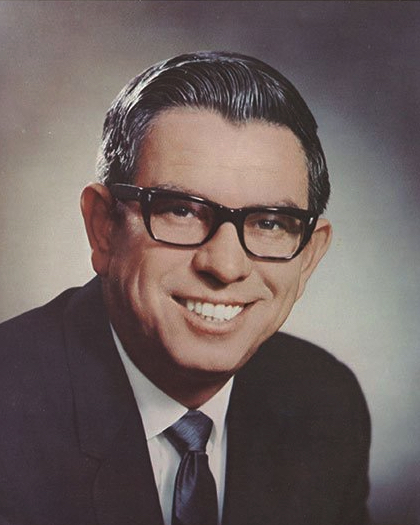
Historical · U.S. Department of the Interior
Manuel Lujan
Former United States Secretary of the Interior · U.S. Department of the Interior · 1989–1993
Manuel Lujan served as United States Secretary of the Interior (1989–1993). The page below collects sourced biographical facts, the appointment record, and provenance for Lujan.
Key facts
- Full name
- Manuel Lujan
- Department
- U.S. Department of the Interior
- Office
- United States Secretary of the Interior
- Status
- Former secretary
- Appointment
- Senate-confirmed
- Tenure
- 1989–1993
- Confirmed
- —
- Born
- 1928
- Died
- 2019
- First year in office
- 1989
- Dataset version
- 1.20260703
Appointment & service record
United States Secretary of the Interior · 1989–1993
- Department
- U.S. Department of the Interior
- Appointment
- Senate-confirmed
- Appointing president
- —
- Confirmed
- —
Department, appointment type (Senate-confirmed, acting, recess, or designated), appointing president, confirmation status, and service dates are drawn from Wikidata and the White House Cabinet roster.[1][2][3]
Sources
- [1]https://www.wikidata.org/wiki/Q445980Wikidata · retrieved 2026-07-03
- [2]https://www.whitehouse.gov/administration/cabinet/whitehouse.gov · retrieved 2026-07-03
- [3]https://www.wikidata.org/wiki/Q639738wikidata-cabinet · retrieved 2026-07-03
Biographical narrative
1,050 words · sourced from the Wikipedia REST extract
Manuel Archibald Lujan Jr., born on May 12, 1928 in San Ildefonso Pueblo, New Mexico, was a long‑serving public official who represented his state in the United States House of Representatives for twenty years before being appointed by President George H. W. Bush as Secretary of the Interior from 1989 to 1993. His career spanned local business, state politics, national legislation, and federal administration. Lujan passed away on April 25, 2019.
Early life and career
Lujan was raised in a family that combined civic engagement with entrepreneurship. His parents were Manuel A. Lujan Sr., who served as Mayor of Santa Fe and pursued several campaigns for state and federal office, and Lorenzita (née Romero) Lujan. He received his early education at Catholic schools in Santa Fe before attending Saint Mary’s College in California in 1946. After returning to New Mexico, he graduated from St. Michael’s College in Santa Fe in 1950.
Following graduation, Lujan joined the family insurance business that his father had founded in 1925. The company, known as the Manuel Lujan Agencies, grew into a prominent risk‑management and insurance firm headquartered in Albuquerque; by 2002 it was recognized as the most profitable Hispanic‑owned business in New Mexico.
His entry into politics began with an unsuccessful bid for the New Mexico State Senate in 1964. The defeat did not deter him; three years later he helped establish the Republican National Hispanic Assembly, a group that sought to increase Hispanic participation within the party. In 1968, Lujan challenged and defeated incumbent Representative Thomas G. Morris, securing his first term in Congress. He went on to win re‑elections throughout the 1970s and into the 1980s, establishing himself as a low‑key but effective backbencher.
During the 1970s Lujan’s legislative focus reflected the priorities of western states: he worked on issues related to Indian affairs, nuclear power expansion, and the opening of federal lands for commerce and recreation. In 1978 he became the first Hispanic Republican to join the newly formed Congressional Hispanic Caucus, marking a milestone in bipartisan representation.
The 1980 election presented a significant challenge when Democrat Bill Richardson mounted an unexpectedly strong campaign against him. The subsequent reapportionment that followed New Mexico’s gain of a third congressional district altered Lujan’s constituency; the old First District was largely rural and included much of Albuquerque, while the new First District became more compact and urban, encompassing three‑quarters of the city. In response to these demographic changes, Lujan stepped down as ranking Republican on the House Interior and Insular Affairs Committee and moved to serve as ranking Republican on the House Science, Space and Technology Committee.
Beyond his congressional duties, Lujan was a regular presence at national party events. He served as New Mexico’s delegate to every Republican National Convention from 1972 through 2004, and in 1980 he delivered a featured speech during the convention’s night session when delegates were nominating a vice‑presidential candidate.
Cabinet tenure
After President Ronald Reagan’s inauguration in 1981, Lujan was frequently mentioned as a potential nominee for Secretary of the Interior. He was considered alongside other prominent figures such as Dick Cheney to replace James G. Watt following Watt’s resignation; however, the position ultimately went to William Clark. When the Bush transition team approached Lujan in late 1988, he initially declined but later accepted after a personal appeal from the president‑elect.
Lujan was confirmed by the Senate and served as Secretary of the Interior from 1989 until 1993 under President George H. W. Bush. His tenure began with criticism from environmental groups and media outlets over what they described as a hands‑off approach to policy and several public speaking gaffes, including an instance in which he mistakenly claimed that the federal government received royalty payments for certain mineral rights.
A significant aspect of his administration involved offshore oil drilling. As chair of a White House task force studying the issue, Lujan publicly voiced strong support for drilling off the California coast during a speech to western governors. The effort drew opposition from 19 members of the California congressional delegation—all Democrats—as well as Republican Governor Pete Wilson, who called for his resignation from the study group; Lujan declined to step down. In the wake of the Exxon Valdez oil spill in April 1989, he opposed Democratic efforts to halt offshore drilling.
In 1990, Lujan expressed reservations about the Endangered Species Act, describing it as “too tough” and suggesting that not every subspecies needed protection. The Bush administration distanced itself from his remarks at a time when public scrutiny of the Interior Department was intensifying.
Other notable events during his term included debates over the spotted owl, discussions surrounding the construction of a National Football League stadium for the Washington Commanders on federal property in Washington, D.C., and increased regulation of Indian casinos. Lujan’s background in Indian affairs from his congressional years earned him recognition for his handling of those issues while serving as secretary.
After leaving the Interior Department at the conclusion of Bush’s second term, Lujan reflected on the nature of his role. He described it as one marked by constant tension: actions perceived as pro‑development drew criticism from environmental groups, whereas measures seen as pro‑environmental attracted opposition from industry stakeholders. His statement underscored the balancing act required in overseeing federal lands and resources.
Legacy
Manuel Lujan’s career left a multifaceted imprint on both state and national politics. As a representative of New Mexico for two decades, he championed issues pertinent to western states while also engaging with broader national concerns such as science, technology, and environmental policy. His participation in the founding of the Republican National Hispanic Assembly helped expand Hispanic representation within the party.
In his cabinet role, Lujan navigated complex debates over natural resource development, conservation, and indigenous affairs. While his positions on offshore drilling and the Endangered Species Act drew criticism from various advocacy groups, he also earned praise for his moderate stance and willingness to engage with multiple stakeholders. His tenure exemplified the challenges inherent in managing federal lands that serve both economic interests and environmental protections.
Following his public service, Lujan remained a respected figure within New Mexico’s political landscape until his death on April 25, 2019. His legacy is reflected in the continued dialogue over resource management, conservation policy, and the representation of Hispanic voices in American politics.
Sources & provenance
Every quantitative or attributable claim above carries a per-section [N] marker that resolves to the corresponding URL below. Each entry records the upstream provider, the canonical URL, and the timestamp at which the underlying source was retrieved.
Key facts
- https://www.wikidata.org/wiki/Q445980Wikidata · retrieved 2026-07-03
- https://www.whitehouse.gov/administration/cabinet/whitehouse.gov · retrieved 2026-07-03
- https://www.wikidata.org/wiki/Q639738wikidata-cabinet · retrieved 2026-07-03
Biographical narrative
- https://en.wikipedia.org/wiki/Manuel_Lujan_Jr.Wikipedia · retrieved 2026-07-03
Explore the Cabinet
The Cabinet includes the Vice President and the heads of the 15 executive departments. Browse the full roster of current and former secretaries, or explore how the Cabinet fits into the federal government.