
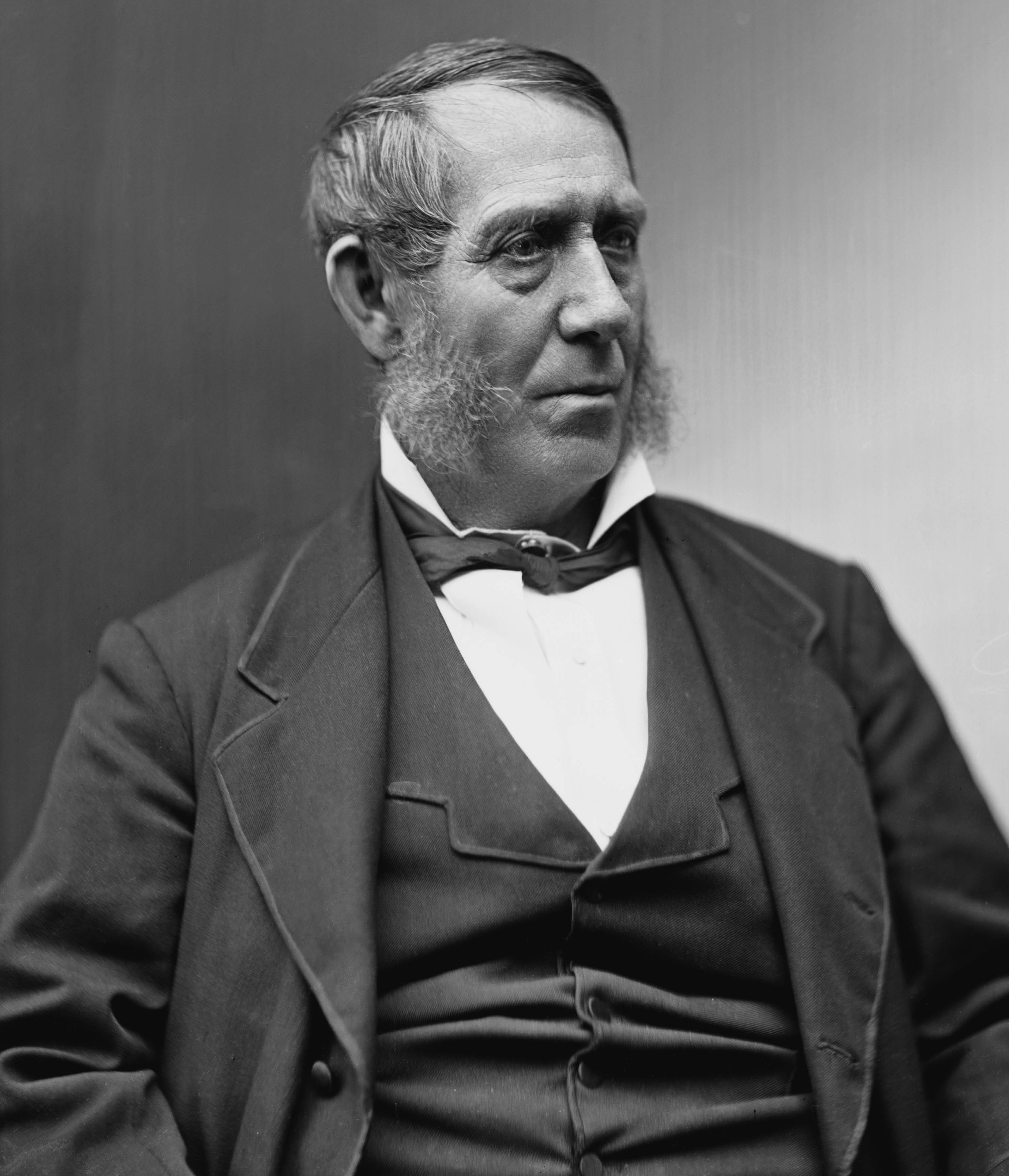
Historical · U.S. Department of the Interior
Samuel J. Kirkwood
Former United States Secretary of the Interior · U.S. Department of the Interior · 1881–1882
Samuel J. Kirkwood served as United States Secretary of the Interior (1881–1882). The page below collects sourced biographical facts, the appointment record, and provenance for Kirkwood.
Key facts
- Full name
- Samuel J. Kirkwood
- Department
- U.S. Department of the Interior
- Office
- United States Secretary of the Interior
- Status
- Former secretary
- Appointment
- Senate-confirmed
- Tenure
- 1881–1882
- Confirmed
- —
- Born
- 1813
- Died
- 1894
- First year in office
- 1881
- Dataset version
- 1.20260703
Appointment & service record
United States Secretary of the Interior · 1881–1882
- Department
- U.S. Department of the Interior
- Appointment
- Senate-confirmed
- Appointing president
- —
- Confirmed
- —
Department, appointment type (Senate-confirmed, acting, recess, or designated), appointing president, confirmation status, and service dates are drawn from Wikidata and the White House Cabinet roster.[1][2][3]
Sources
- [1]https://www.wikidata.org/wiki/Q708401Wikidata · retrieved 2026-07-03
- [2]https://www.whitehouse.gov/administration/cabinet/whitehouse.gov · retrieved 2026-07-03
- [3]https://www.wikidata.org/wiki/Q639738wikidata-cabinet · retrieved 2026-07-03
Biographical narrative
842 words · sourced from the Wikipedia REST extract
Samuel Jordan Kirkwood (December 20 1813 – September 1 1894) was an American public servant who held a variety of elected and appointed positions throughout the mid‑nineteenth century. He served twice as governor of Iowa, represented the state in the United States Senate on two separate occasions, and was appointed by President James A. Garfield to serve as Secretary of the Interior from 1881 until 1882. His career spanned local business ventures, state politics, national legislative work, and a brief federal cabinet tenure during a period of rapid expansion and change for the United States.
Early life and career
Samuel Jordan Kirkwood was born in Harford County, Maryland, on December 20 1813. At seventeen he began teaching school, an occupation that would introduce him to future luminaries such as his cousin Daniel Kirkwood, who later became a noted mathematician and astronomer. After spending part of his youth in Washington, D.C., Kirkwood joined his father’s family when they relocated to Ohio in 1835. In the new state he emerged as an active participant in anti‑slavery circles and was elected to several local offices, working closely with Thomas Bartley—who would later become governor of Ohio—in the 1840s.
In 1855 Kirkwood moved westward to Iowa, settling northwest of Iowa City. There he entered the milling business alongside members of the Clark family, a venture that led him into land speculation with the Clarks and Lucas families. His marriage to Jane Clark, sister of Phoebe Ann Clark, linked him by kinship to Edward Lucas, son of Robert Lucas, Iowa’s first territorial governor. Although Kirkwood had intended to retire from politics after establishing his business interests, he became involved in the nascent Republican Party. A flour‑dust‑streaked speech delivered at the party’s founding meeting in February 1856 helped secure its early success in the state, and that same year he was elected to the Iowa Senate, serving until 1859.
Kirkwood’s political ascent continued when he won the gubernatorial election of 1859, defeating Augustus C. Dodge amid a campaign dominated by slavery issues. His first term as governor coincided with heightened national tensions; in 1860 he opposed the extradition of Barclay Coppock—a former participant in John Brown’s raid—allowing the young man to remain in Iowa. During the Civil War, Kirkwood became known for his vigorous efforts to recruit soldiers and supply the Union Army from Iowa, aligning closely with President Abraham Lincoln’s wartime policies. He attended the Loyal War Governors’ Conference in Altoona, Pennsylvania, in 1862, a gathering that bolstered Lincoln’s support for the Emancipation Proclamation.
After concluding his first gubernatorial term in 1864, Kirkwood returned to private life in Iowa City, practicing law and divesting portions of his milling enterprise. He filled the remainder of James Harlan’s Senate seat from 1865 to 1867 and was elected again to the U.S. Senate for a full term beginning in 1877. Between these senatorial terms he served a second stint as governor from 1876 to 1877, resigning that office upon his return to the Senate.
Cabinet tenure
In 1881 Kirkwood resigned his Senate seat to accept an appointment as Secretary of the Interior under President James A. Garfield. The Senate confirmed him for the position; he continued in the role after Garfield’s assassination when Chester A. Arthur assumed the presidency. His service lasted until 1882, during which time he oversaw the department responsible for federal lands and natural resources. No specific policy initiatives or legislative achievements are recorded in the available sources for this period of his tenure.
Legacy
Samuel J. Kirkwood died on September 1 1894 in Iowa City and was interred at Oakland Cemetery. His legacy is commemorated through a number of memorials and place names across the United States. A sculpted likeness by Vinnie Ream stands among the two statues representing each state in the National Statuary Hall Collection within the U.S. Capitol. A bust of Kirkwood resides in the Vicksburg National Military Park, and a plaque honoring him is located at the front of Iowa City High School.
Educational institutions bearing his name include Kirkwood Community College, which operates several campuses throughout eastern Iowa, and Kirkwood Elementary School in Coralville, the town where he once ran a mill. Geographic features named after him comprise the town of Kirkwood, Illinois; multiple streets—Kirkwood Avenue in both Iowa City and Des Moines, as well as Kirkwood Boulevard in Davenport—and the historic Kirkwood House in Iowa City, listed on the National Register of Historic Places. The Hotel Kirkwood in Des Moines also carries his name and is likewise recognized by the National Register.
Through his roles at state, federal legislative, and cabinet levels, Samuel J. Kirkwood contributed to the political and civic development of Iowa and the broader United States during a formative era. His service as Secretary of the Interior, though brief, placed him among the senior officials responsible for managing the nation’s public lands and natural resources in the post‑Civil War period. The enduring presence of his name in public monuments, institutions, and place names reflects the lasting impact of his career on American public life.
Sources & provenance
Every quantitative or attributable claim above carries a per-section [N] marker that resolves to the corresponding URL below. Each entry records the upstream provider, the canonical URL, and the timestamp at which the underlying source was retrieved.
Key facts
- https://www.wikidata.org/wiki/Q708401Wikidata · retrieved 2026-07-03
- https://www.whitehouse.gov/administration/cabinet/whitehouse.gov · retrieved 2026-07-03
- https://www.wikidata.org/wiki/Q639738wikidata-cabinet · retrieved 2026-07-03
Biographical narrative
- https://en.wikipedia.org/wiki/Samuel_J._KirkwoodWikipedia · retrieved 2026-07-03
Explore the Cabinet
The Cabinet includes the Vice President and the heads of the 15 executive departments. Browse the full roster of current and former secretaries, or explore how the Cabinet fits into the federal government.