
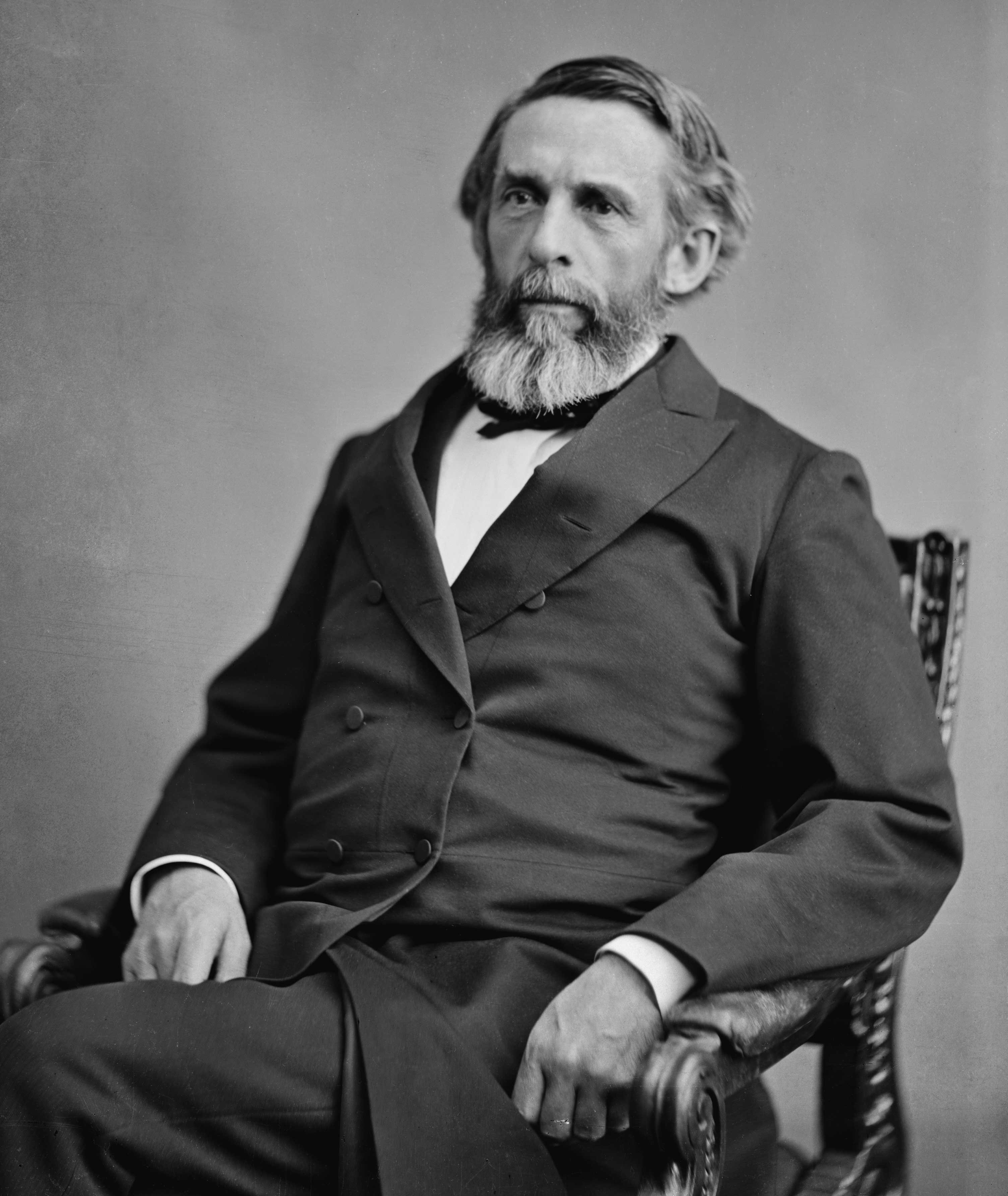
Historical · U.S. Department of the Treasury
George S. Boutwell
Former United States Secretary of the Treasury · U.S. Department of the Treasury · 1869–1873
George S. Boutwell served as United States Secretary of the Treasury (1869–1873). The page below collects sourced biographical facts, the appointment record, and provenance for Boutwell.
Key facts
- Full name
- George S. Boutwell
- Department
- U.S. Department of the Treasury
- Office
- United States Secretary of the Treasury
- Status
- Former secretary
- Appointment
- Senate-confirmed
- Tenure
- 1869–1873
- Confirmed
- —
- Born
- 1818
- Died
- 1905
- First year in office
- 1869
- Dataset version
- 1.20260703
Appointment & service record
United States Secretary of the Treasury · 1869–1873
- Department
- U.S. Department of the Treasury
- Appointment
- Senate-confirmed
- Appointing president
- —
- Confirmed
- —
Department, appointment type (Senate-confirmed, acting, recess, or designated), appointing president, confirmation status, and service dates are drawn from Wikidata and the White House Cabinet roster.[1][2][3]
Sources
- [1]https://www.wikidata.org/wiki/Q544561Wikidata · retrieved 2026-07-03
- [2]https://www.whitehouse.gov/administration/cabinet/whitehouse.gov · retrieved 2026-07-03
- [3]https://www.wikidata.org/wiki/Q639738wikidata-cabinet · retrieved 2026-07-03
Biographical narrative
1,139 words · sourced from the Wikipedia REST extract
George Sewall Boutwell was a prominent American public servant whose career spanned the mid‑nineteenth and early twentieth centuries. Born in 1818, he served as a lawyer, legislator, governor of Massachusetts, U.S. senator, and United States Secretary of the Treasury under President Ulysses S. Grant. His work during Reconstruction helped shape federal policy on civil rights, while his tenure at the Treasury Department introduced reforms that stabilized the nation’s finances after the Civil War. Boutwell remained active in public affairs until his death in 1905, leaving a legacy that continued to be examined well into the twentieth century.
Early life and career
Boutwell entered the world on January 28, 1818, in Brookline, Massachusetts. He was raised on his family’s farm in Lunenburg, where he attended public schools until the age of seventeen. During the summer months he worked barefooted tending oxen and picking chestnuts while studying arithmetic, algebra, geometry, and Latin grammar. From 1830 to 1835 he served as an apprentice and clerk for Simeon Heywood, who owned a palm‑leaf hat store; this period also included brief teaching work at Pound Hill in Shirley, Massachusetts, before completing his primary schooling in February 1835.
Between 1835 and 1838 Boutwell worked as a clerk and shopkeeper in Groton. In 1836 he began studying law under attorney Bradford Russell, whose office was located above the store where Boutwell clerked. Although he did not take the bar exam or practice law until many years later, he continued to read and write extensively while managing the shop, which his owner offered him a partnership in 1838.
Boutwell’s public career began in 1839 when he served as a pension agent for widows of veterans from the American Revolutionary War. The trip to Washington, D.C., exposed him to the political environment of the capital and left a lasting impression on him; he was particularly struck by the speeches of Daniel Webster. A conversation with an enslaved Black woman whose youngest child had been sold to Louisiana further solidified his commitment to abolition.
In 1841 Boutwell married Sarah Adelia Thayer, daughter of Nathan Thayer of Hollis, New Hampshire. The couple had two children: Georgianna, born May 18, 1843, and Francis, born February 26, 1847.
Boutwell’s early political involvement began as a Democrat and supporter of Martin Van Buren. He was appointed head of the Groton post office by his business partner, who served as postmaster. His first elective position came when he ran for the Groton School Committee as a Temperance Party candidate; after serving there for several years, he sought election to the Massachusetts state legislature on the same party’s ticket but lost. In 1840 he secured the Democratic nomination and won a seat in the state House of Representatives, defeating incumbent John Boynton in 1841. He served two additional annual terms before losing elections in 1844 and 1845. Returning to the legislature in 1846, Boutwell served from 1847 to 1850 on judiciary and finance committees, where he built a reputation for meticulous research and advocacy of free trade, restraint of the money supply, and increased taxation for educational reforms. He supported the Mexican–American War but did not believe it was driven by expansionist slavery motives.
During this period Boutwell also ran three times for a seat in the United States House of Representatives, losing each time by significant margins to Whig opponents. In 1848 he was considered for the Democratic nomination for governor, placing third at the convention. The following year he was appointed state banking commissioner by Whig Governor George N. Briggs; in that role he inspected bank charters subject to renewal, gaining valuable experience in banking and finance.
Cabinet tenure
Boutwell’s national prominence grew during the Civil War era. He served as the first Commissioner of Internal Revenue under President Abraham Lincoln, a position that placed him at the center of federal tax policy during wartime. His legal background and financial expertise led to his appointment as United States Secretary of the Treasury in 1869, serving until 1873 under President Ulysses S. Grant. The Senate confirmed his nomination.
As Treasury Secretary, Boutwell confronted a chaotic post‑war economy and the aftermath of President Andrew Johnson’s impeachment trial. He introduced reforms aimed at restoring order to the Treasury Department and stabilizing national finances. One notable policy involved reducing the national debt by selling Treasury gold and using greenbacks—paper currency issued during the war—to purchase Treasury bonds. This strategy, while effective in lowering debt levels, also created a temporary cash shortage.
In September 1869 Boutwell worked with President Grant to counter an attempt by private actors to corner the gold market. By releasing $4 million of gold into circulation, they prevented a speculative collapse that could have destabilized the economy. Boutwell’s actions during this episode underscored his commitment to maintaining monetary stability.
Boutwell also played a significant role in the Reconstruction era beyond fiscal matters. As a member of Congress—first as a representative and later as a senator from Massachusetts—he was instrumental in drafting and supporting the Fourteenth and Fifteenth Amendments, which extended citizenship rights and voting eligibility to African Americans. In 1875 he sponsored the Civil Rights Act, further advancing federal civil‑rights protections. He chaired a Senate select committee that investigated white supremacist violence against Black citizens and Republican supporters during the Mississippi state election of that year, reflecting his continued engagement with issues of racial justice.
After leaving the Treasury Department in 1873, Boutwell remained active in public service. In 1877 President Rutherford B. Hayes appointed him commissioner to codify the Revised Statutes of the United States, a task that required comprehensive legal scholarship. Three years later he served as United States counsel before the French and American Claims Commission, representing U.S. interests in international arbitration. He also practiced international law in other diplomatic forums.
Legacy
Boutwell’s career reflects a broad engagement with the major political and social challenges of his time. His early abolitionist convictions informed his legislative work on civil rights during Reconstruction, while his financial expertise guided significant reforms within the Treasury Department that helped stabilize the post‑war economy. As Secretary of the Treasury he demonstrated a willingness to employ unconventional measures—such as using greenbacks to buy bonds—to achieve fiscal objectives, and he acted decisively to prevent market manipulation.
Beyond his cabinet service, Boutwell’s contributions to legal scholarship were notable. His role in codifying federal statutes and representing the United States before international claims commissions helped shape the legal framework of the late nineteenth century. In the final decades of his life he shifted away from the Republican Party, opposing the acquisition of the Philippines and supporting Democrat William Jennings Bryan in the 1900 presidential election, indicating a willingness to reassess political affiliations in light of evolving national priorities.
Boutwell died on February 27, 1905, leaving behind a legacy that continued to be studied by scholars. In 2025 a
Sources & provenance
Every quantitative or attributable claim above carries a per-section [N] marker that resolves to the corresponding URL below. Each entry records the upstream provider, the canonical URL, and the timestamp at which the underlying source was retrieved.
Key facts
- https://www.wikidata.org/wiki/Q544561Wikidata · retrieved 2026-07-03
- https://www.whitehouse.gov/administration/cabinet/whitehouse.gov · retrieved 2026-07-03
- https://www.wikidata.org/wiki/Q639738wikidata-cabinet · retrieved 2026-07-03
Biographical narrative
- https://en.wikipedia.org/wiki/George_S._BoutwellWikipedia · retrieved 2026-07-03
Explore the Cabinet
The Cabinet includes the Vice President and the heads of the 15 executive departments. Browse the full roster of current and former secretaries, or explore how the Cabinet fits into the federal government.