
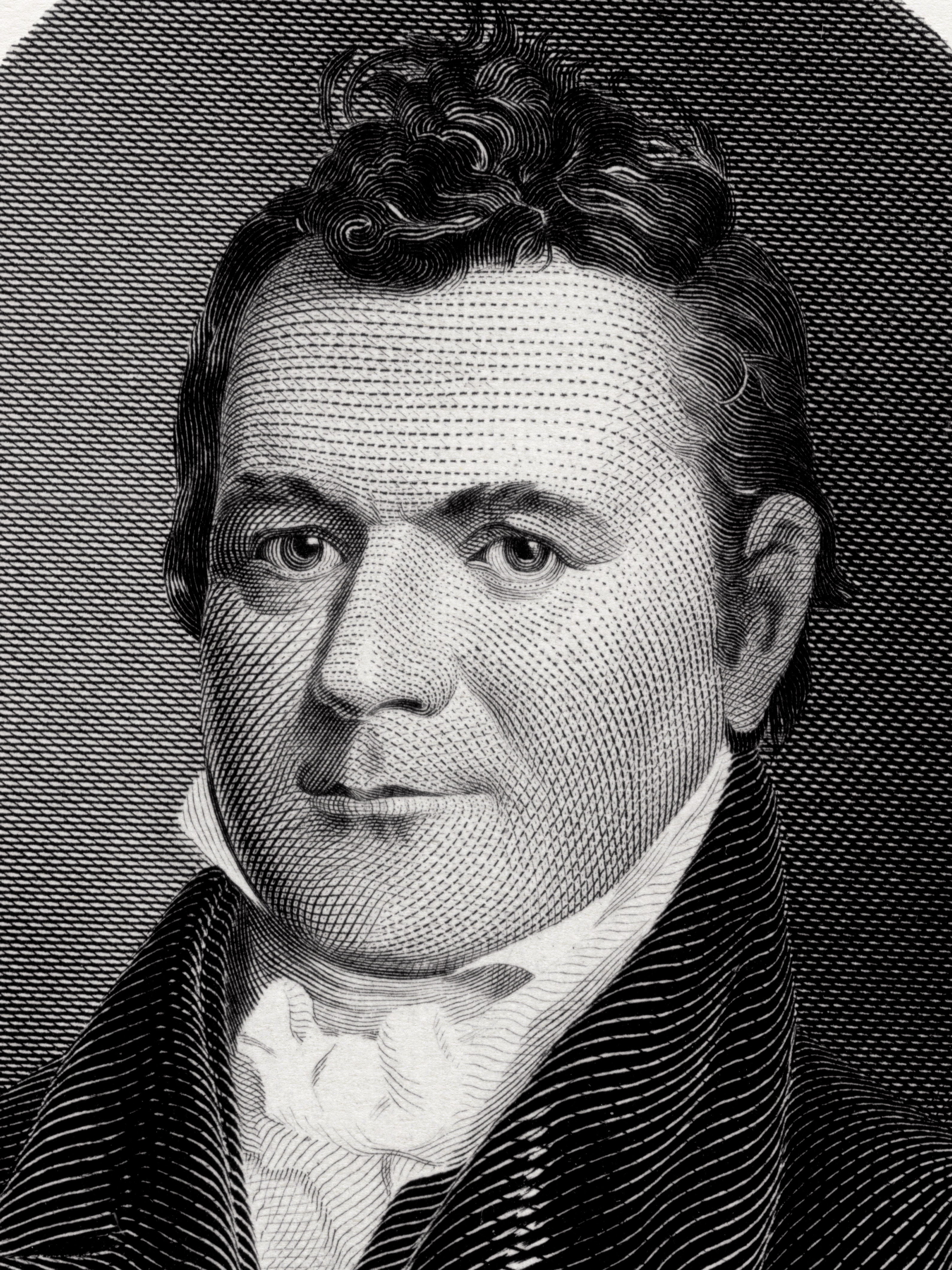
Historical · U.S. Department of the Treasury
George W. Campbell
Former United States Secretary of the Treasury · U.S. Department of the Treasury · 1814–1814
George W. Campbell served as United States Secretary of the Treasury (1814–1814). The page below collects sourced biographical facts, the appointment record, and provenance for Campbell.
Key facts
- Full name
- George W. Campbell
- Department
- U.S. Department of the Treasury
- Office
- United States Secretary of the Treasury
- Status
- Former secretary
- Appointment
- Senate-confirmed
- Tenure
- 1814–1814
- Confirmed
- —
- Born
- 1769
- Died
- 1848
- First year in office
- 1814
- Dataset version
- 1.20260703
Appointment & service record
United States Secretary of the Treasury · 1814–1814
- Department
- U.S. Department of the Treasury
- Appointment
- Senate-confirmed
- Appointing president
- —
- Confirmed
- —
Department, appointment type (Senate-confirmed, acting, recess, or designated), appointing president, confirmation status, and service dates are drawn from Wikidata and the White House Cabinet roster.[1][2][3]
Sources
- [1]https://www.wikidata.org/wiki/Q769752Wikidata · retrieved 2026-07-03
- [2]https://www.whitehouse.gov/administration/cabinet/whitehouse.gov · retrieved 2026-07-03
- [3]https://www.wikidata.org/wiki/Q639738wikidata-cabinet · retrieved 2026-07-03
Biographical narrative
997 words · sourced from the Wikipedia REST extract
George W. Campbell (February 9 1769 – February 17 1848) was a prominent American public servant who held several key positions in the early republic. Born in Scotland and raised in North Carolina, he pursued a career in law before entering politics. He served as a member of both houses of Congress, as a Tennessee Supreme Court justice, as the United States Secretary of the Treasury for part of 1814, and later as the U.S. ambassador to Russia. His public life spanned the formative years of the United States, intersecting with major events such as the War of 1812 and the early development of federal financial policy.
Early life and career
George Washington Campbell entered the world on February 9 1769 in the village of Tongue, Sutherland, located along the north coast of Scotland. In 1772 he immigrated with his parents—Dr. Archibald Campbell and Elizabeth Mackay Matheson Campbell—to North Carolina, settling near Crooked Creek in Mecklenburg County. The family’s relocation to the American colonies placed young George within a rapidly expanding frontier society.
During his early twenties, Campbell worked as an educator, teaching school before deciding to pursue higher education. In 1792 he entered the junior class at the College of New Jersey, which would later become Princeton University. He completed his studies in 1794 and then turned to legal training. After being admitted to the North Carolina bar, he established a law practice in Knoxville, Tennessee, beginning in 1798. His professional life was marked by the ownership of enslaved people, a fact that reflects the broader social and economic context of the region at the time.
Campbell’s entry into public office began with his election as a United States Representative from Tennessee’s at‑large congressional district. He served three consecutive terms in the House from 1805 to 1809, covering the eighth, ninth, and tenth Congresses. During his final term he chaired the Ways and Means Committee, overseeing matters related to taxation and revenue. In 1804, while still a member of the House, he was appointed as one of the managers tasked with prosecuting the impeachment trials of Judge John Pickering of New Hampshire and Associate Justice Samuel Chase of the Supreme Court. These responsibilities placed him at the center of early federal judicial accountability.
After leaving Congress in 1809, Campbell transitioned to the judiciary, serving as a justice on the Tennessee Supreme Court until 1811. His move from Knoxville to Nashville during this period marked a shift toward the political heart of the state. In July 1812 he married Harriet Stoddert, daughter of Benjamin Stoddert, who had served as the first Secretary of the Navy. The marriage connected Campbell with one of Maryland’s prominent families and linked him to influential national figures.
Cabinet tenure
Campbell’s most nationally visible role came when President James Madison appointed him United States Secretary of the Treasury on his forty‑fifth birthday in February 1814. His confirmation by the Senate followed shortly thereafter, placing him at the helm of federal finances during a turbulent period. The War of 1812 had strained the nation’s resources; Congress had not rechartered the First Bank of the United States after its charter expired in 1811, and war appropriations were limited. In this environment Campbell faced the daunting task of stabilizing government credit.
He attempted to raise funds by encouraging citizens to purchase government bonds, but the lack of a central banking institution forced him to accept lenders’ terms, resulting in bond sales at high interest rates. The situation deteriorated further when British forces occupied Washington, D.C., in September 1814, which lowered public confidence in the federal treasury’s solvency. Campbell’s efforts to secure additional revenue through bond sales proved unsuccessful, and after only eight months in office he resigned in October 1814. His brief tenure reflected the fiscal challenges confronting the young republic during wartime.
Following his resignation as Treasury Secretary, Campbell returned to the United States Senate, where he served from 1815 until 1818. He became the first chairman of the Senate Finance Committee and its predecessor, a position he held from December 4, 1815, until his resignation on April 20, 1818. His departure was prompted by an appointment as United States Ambassador to Russia, a diplomatic post he occupied from 1818 to 1821. While in Russia, Campbell’s tenure was interrupted by personal tragedy: three of his four young children died in April 1819. He requested recall from the position through correspondence with Secretary of State John Quincy Adams; although not immediately recalled, he eventually returned home in 1820.
In 1831, Campbell served as a member of the French Spoliation Claims Commission, which addressed claims related to property seized during conflicts involving France and the United States. This role underscored his continued involvement in matters of national importance well after his active political career had concluded.
Legacy
George W. Campbell’s public service spanned multiple branches of government—legislative, judicial, executive, and diplomatic—and intersected with critical episodes in early American history. His work as a legislator included leadership on the Ways and Means Committee during the War of 1812 era and chairmanship of the Senate Finance Committee, positions that placed him at the center of fiscal policy debates. As Secretary of the Treasury, he confronted unprecedented financial instability; although his tenure was brief, it highlighted the challenges of managing national debt without a central banking institution.
Campbell’s diplomatic service in Russia added an international dimension to his career, reflecting the United States’ expanding engagement with European powers during the early nineteenth century. His participation on the French Spoliation Claims Commission further demonstrated his ongoing commitment to resolving complex financial disputes involving foreign entities.
Beyond his governmental roles, Campbell’s life illustrates broader themes of the era: migration from Europe to America, the entrenchment of slavery in southern states, and the evolution of federal institutions during a period of war and nation‑building. He died on February 17 1848 and was interred at Nashville City Cemetery in Nashville, Tennessee, where his legacy remains part of the city’s historical record.
Sources & provenance
Every quantitative or attributable claim above carries a per-section [N] marker that resolves to the corresponding URL below. Each entry records the upstream provider, the canonical URL, and the timestamp at which the underlying source was retrieved.
Key facts
- https://www.wikidata.org/wiki/Q769752Wikidata · retrieved 2026-07-03
- https://www.whitehouse.gov/administration/cabinet/whitehouse.gov · retrieved 2026-07-03
- https://www.wikidata.org/wiki/Q639738wikidata-cabinet · retrieved 2026-07-03
Biographical narrative
- https://en.wikipedia.org/wiki/George_W._CampbellWikipedia · retrieved 2026-07-03
Explore the Cabinet
The Cabinet includes the Vice President and the heads of the 15 executive departments. Browse the full roster of current and former secretaries, or explore how the Cabinet fits into the federal government.