
Historical · U.S. Department of the Treasury
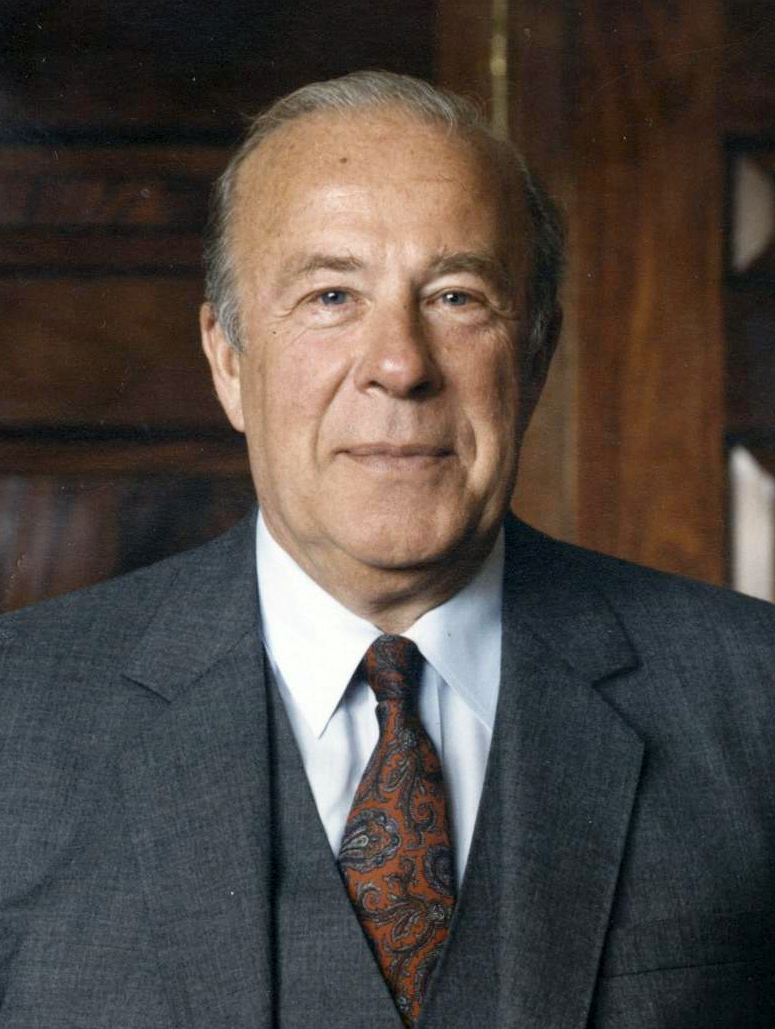
George Shultz
Former United States Secretary of the Treasury · U.S. Department of the Treasury · 1972–1974
George Shultz served as United States Secretary of the Treasury (1972–1974). The page below collects sourced biographical facts, the appointment record, and provenance for Shultz.
Key facts
- Full name
- George Shultz
- Department
- U.S. Department of the Treasury
- Office
- United States Secretary of the Treasury
- Status
- Former secretary
- Appointment
- Senate-confirmed
- Tenure
- 1972–1974
- Confirmed
- —
- Born
- 1920
- Died
- 2021
- First year in office
- 1972
- Dataset version
- 1.20260703
Appointment & service record
United States Secretary of the Treasury · 1972–1974
- Department
- U.S. Department of the Treasury
- Appointment
- Senate-confirmed
- Appointing president
- —
- Confirmed
- —
Department, appointment type (Senate-confirmed, acting, recess, or designated), appointing president, confirmation status, and service dates are drawn from Wikidata and the White House Cabinet roster.[1][2][3]
Sources
- [1]https://www.wikidata.org/wiki/Q313411Wikidata · retrieved 2026-07-03
- [2]https://www.whitehouse.gov/administration/cabinet/whitehouse.gov · retrieved 2026-07-03
- [3]https://www.wikidata.org/wiki/Q639738wikidata-cabinet · retrieved 2026-07-03
Biographical narrative
1,015 words · sourced from the Wikipedia REST extract
George Pratt Shultz was an influential American economist and public servant whose career spanned academia, business, and several high‑level government positions. Born in 1920, he served under Presidents Richard Nixon and Ronald Reagan, holding cabinet posts that included Secretary of Labor, Director of the Office of Management and Budget, Secretary of the Treasury, and later Secretary of State. After leaving public office, Shultz remained active as a business executive, advisor to subsequent administrations, and advocate for economic and environmental policy reforms until his death in 2021.
Early life and career
George Pratt Shultz entered the world on December 13, 1920, in New York City. He was raised in Englewood, New Jersey, where he attended local public schools before moving to the private preparatory boarding school Loomis Chaffee in Connecticut, from which he graduated in 1938. His academic pursuits led him to Princeton University, where he earned a cum laude bachelor's degree in economics with a minor in public and international affairs in 1942.
During World War II, Shultz served as an artillery officer in the United States Marine Corps, attaining the rank of captain. After the war, he pursued graduate studies at the Massachusetts Institute of Technology (MIT), completing a Ph.D. in industrial economics in 1949. He joined MIT’s Department of Economics and Sloan School of Management faculty in 1948, teaching until 1957. In 1955, he took a leave of absence to serve as a senior staff economist on President Dwight D. Eisenhower’s Council of Economic Advisers.
In 1957, Shultz transitioned to the University of Chicago Graduate School of Business as a professor of industrial relations. He became dean of that graduate school in 1962 and served until 1968. During his tenure at Chicago, he was influenced by economists Milton Friedman and George Stigler, whose ideas reinforced his belief in free‑market principles.
Shultz’s academic career was marked by a blend of teaching, research, and policy analysis. He published on industrial economics and labor relations, drawing upon his experience in both academia and government advisory roles. His reputation as an economist and educator positioned him for entry into national public service when President Richard Nixon appointed him to the cabinet.
Cabinet tenure
Shultz’s first cabinet appointment came in 1969 when he was named Secretary of Labor under President Nixon. In that role, he confronted a major labor dispute involving longshoremen; his approach emphasized allowing parties to negotiate directly rather than imposing federal intervention. He also implemented the Philadelphia Plan, which required construction contractors who refused to hire black workers to adopt affirmative action measures—a pioneering use of racial quotas by the federal government.
In 1970, Shultz became the inaugural Director of the Office of Management and Budget (OMB). Over the next two years he oversaw budgetary policy during a period of economic uncertainty. His tenure at OMB set the stage for his subsequent appointment as Secretary of the Treasury in 1972, a position confirmed by the Senate.
As Treasury Secretary from 1972 to 1974, Shultz supported President Nixon’s “shock” strategy aimed at reviving the economy. This included measures that ultimately led to the abandonment of the gold standard and the conclusion of the Bretton Woods system of international monetary relations. His leadership during this transitional period was instrumental in reshaping U.S. fiscal policy.
Shultz departed the Treasury in May 1974, moving into the private sector as an executive at Bechtel, a major engineering and services company. He served there until 1982, when President Ronald Reagan appointed him Secretary of State. During his tenure from 1982 to 1989, Shultz played a key role in fostering diplomatic relations with Soviet leader Mikhail Gorbachev, contributing to a thaw between the United States and the Soviet Union. He also opposed U.S. aid to Contra rebels that had been financed through illicit arms sales to Iran—a controversy that later became known as the Iran–Contra affair.
After concluding his service as Secretary of State in 1989, Shultz retired from public office but continued to influence policy through advisory roles and board memberships. He served informally on President George W. Bush’s staff, helping shape the administration’s preemptive war doctrine. His expertise was also sought by the Global Commission on Drug Policy, California Governor Arnold Schwarzenegger’s Economic Recovery Council, and corporate boards including Bechtel and the Charles Schwab Corporation.
In the 2010s, Shultz turned his attention to environmental economics, advocating for a revenue‑neutral carbon fee and dividend system as an economically sound method of addressing climate change. He remained active in think tanks such as the Hoover Institution, the Institute for International Economics, and the Washington Institute for Near East Policy. In addition, he served on the board of Theranos, a company that later faced allegations of fraud; his grandson Tyler Shultz worked at the firm before becoming a whistleblower.
Legacy
George Shultz’s career reflects a broad engagement with economic theory, public policy, and international relations. His academic work in industrial economics laid a foundation for evidence‑based decision making in government. As Secretary of Labor, he introduced early federal affirmative action measures that influenced subsequent civil rights policies. In the Treasury, his support for ending the gold standard helped transition the global monetary system toward floating exchange rates.
His tenure as Secretary of State is often highlighted for its role in easing tensions with the Soviet Union during a pivotal era of the Cold War. By encouraging dialogue with Mikhail Gorbachev, Shultz contributed to diplomatic efforts that ultimately led to significant arms reduction agreements and a more cooperative international climate.
Beyond his cabinet service, Shultz’s post‑government work bridged academia, business, and policy advocacy. His involvement in corporate boards and think tanks allowed him to shape discussions on fiscal responsibility, trade, and environmental regulation well into the 21st century. His later focus on carbon pricing reflects a continued commitment to applying economic principles to contemporary global challenges.
Shultz’s death on February 6, 2021 marked the end of a life characterized by public service across multiple administrations and sectors. His legacy persists through the policies he helped craft, the institutions he guided, and the ongoing debates in which his ideas continue to resonate.
Sources & provenance
Every quantitative or attributable claim above carries a per-section [N] marker that resolves to the corresponding URL below. Each entry records the upstream provider, the canonical URL, and the timestamp at which the underlying source was retrieved.
Key facts
- https://www.wikidata.org/wiki/Q313411Wikidata · retrieved 2026-07-03
- https://www.whitehouse.gov/administration/cabinet/whitehouse.gov · retrieved 2026-07-03
- https://www.wikidata.org/wiki/Q639738wikidata-cabinet · retrieved 2026-07-03
Biographical narrative
- https://en.wikipedia.org/wiki/George_ShultzWikipedia · retrieved 2026-07-03
Explore the Cabinet
The Cabinet includes the Vice President and the heads of the 15 executive departments. Browse the full roster of current and former secretaries, or explore how the Cabinet fits into the federal government.